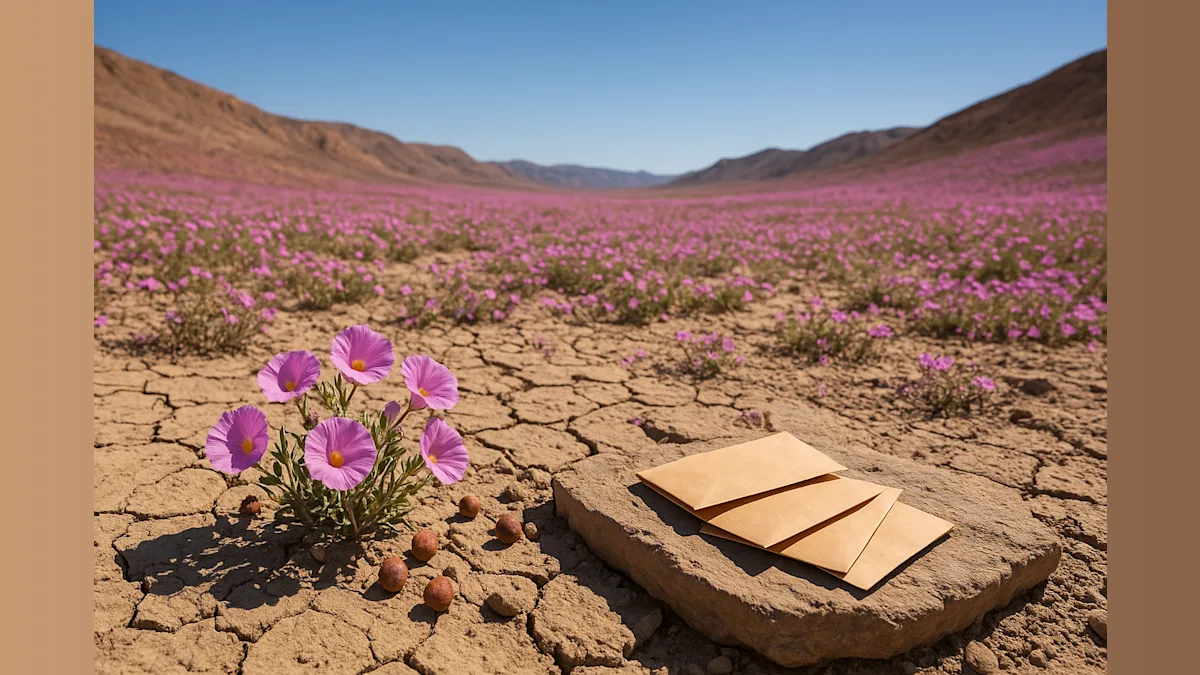
One of the planet's most barren landscapes has transformed into a carpet of color. Chile's Atacama Desert, widely regarded as the driest non-polar place on Earth, is experiencing what may be the most extensive floral display ever recorded there, with approximately 200 species now in bloom. Some of these plants have emerged in areas where flowers have not been observed since before the year 2000.
The event, commonly referred to as the "flowering desert," takes place only in certain years when rainfall and temperature patterns align to awaken seeds that have remained dormant beneath the sand. These seeds and tubers can survive for decades, waiting for the precise combination of moisture and warmth that triggers germination. This year's Super El Niño weather event delivered record precipitation to the region. During July and August, flooding allowed water to penetrate deep into the soil, reaching seeds that typically remain untouched by seasonal rains.
The resulting superbloom is considered the widest-reaching and most vivid in three decades, according to observations reported by NPR. Moisés Grimberg, who serves as administrator of Llanos de Challe National Park in the Atacama, described the ecological significance of the event in comments to NPR.
"This is a natural seed bank, a dormant archive that becomes a living one with the rains," Grimberg told NPR. He also emphasized the fleeting nature of the phenomenon, noting, "But it's a race against time — this brief biological window allows these species to complete their life cycle, which lasts roughly two to three months," in remarks to NPR.
The increased frequency of seasonal rains in the Atacama is producing conditions that support a wider variety of animal life, albeit temporarily. Reptiles, insects, bats, and other pollinators have been observed, along with larger animals such as the guanaco, a relative of the llama. These transient populations underscore the desert's capacity to respond rapidly when water becomes available.
The Atacama is also home to the Initihuasi Seed Bank, one of South America's largest botanical repositories. This facility functions as a central hub within a nationwide network of institutions dedicated to preserving Chile's plant diversity. Rather than simply documenting the bloom through photographs, scientists at the seed bank are actively collecting seeds produced by the recently pollinated flowers for future research.
Ana Sandoval, a researcher working with the seed bank, described the event's significance in an interview with NPR. "It's as if the desert is awakening," Sandoval told NPR. "Sometimes people think it's an empty, arid place, devoid of life, but actually our desert is just waiting for the right conditions, and any precipitation, to awaken it."
The current bloom follows a pattern of increasingly frequent rainfall events in the region, a trend that may lead to more regular displays of this kind. For now, the desert's dormant seed bank has become a living archive, offering scientists a rare opportunity to study and preserve the genetic material of species that may remain hidden for years at a time.