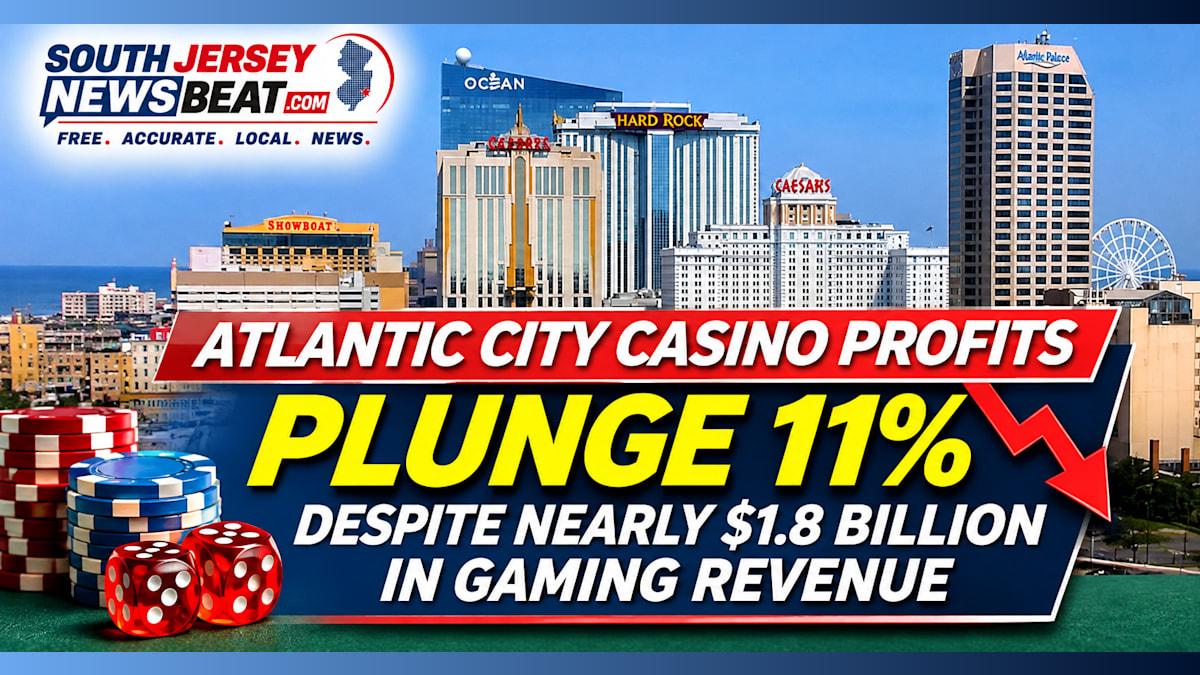
Stockton University gaming expert warns that rising operating costs and growing competition are squeezing casino profits, with the industry's third-quarter earnings falling to their lowest level in a decade.
ATLANTIC CITY — Atlantic City's casino industry is facing growing financial pressure despite generating nearly $1.8 billion in gross gaming revenue during the third quarter of 2026, according to new figures released Monday by the New Jersey Division of Gaming Enforcement.
The city's nine casino operators reported an 11% decline in gross operating profit during July, August and September compared with the same period last year, even as net revenue increased slightly.
The results underscore a growing challenge for Atlantic City's casino industry: record gaming revenues are not necessarily translating into stronger financial performance for the city's brick-and-mortar properties.
Brian Tyrrell, faculty director of the Lloyd D. Levenson Institute of Gaming, Hospitality and Tourism at Stockton University, said the latest numbers demonstrate how rising expenses and competition are eroding casino profitability.

"In the current inflationary environment, flat revenues put pressure on profit margins already narrowed by a competitive marketplace," Tyrrell said.
According to Tyrrell, the industry's net revenue increased just 0.3% during the third quarter compared with the same period in 2025.
That modest growth was not enough to offset higher operating expenses.
Casino Profits Falling for Second Consecutive Year
The third-quarter decline follows another disappointing performance in 2025, when gross operating profit fell nearly 3% compared with the same quarter in 2024.
The latest results put Atlantic City's casino operators on pace for a 13.6% decline in gross operating profit through the first nine months of 2026 compared with the same period last year.
The financial pressure is not being experienced equally across the industry.
According to Tyrrell's analysis, six of Atlantic City's nine casino operators recorded declines in gross operating profit greater than the industry average during the first nine months of the year.
Three operators experienced particularly steep declines, ranging from 22% to 82%.
Those figures suggest that some properties are facing significantly greater financial challenges than others.
Gross operating profit is an important measure of casino financial performance because it reflects earnings from operations before certain expenses, including interest, taxes and depreciation.
Unlike gross gaming revenue, which measures the amount casinos win from gambling activities, gross operating profit provides a clearer picture of how much money properties generate after paying their operating expenses.
Lowest Third-Quarter Operating Profit in a Decade
Despite the industry's nearly $1.8 billion in gross gaming revenue during the third quarter, Atlantic City's casino operators generated less than $210 million in combined gross operating profit.
Tyrrell said that represents the lowest third-quarter gross operating profit total in the past decade.
The figures illustrate the widening gap between the amount of money generated through gaming and the profits ultimately realized by casino operators.
While online gambling and other gaming products have helped push New Jersey's overall gaming revenue to record levels, those results do not necessarily reflect the financial condition of Atlantic City's physical casino properties.
The city's casino hotels face substantial expenses associated with staffing, maintaining large buildings, providing entertainment and operating restaurants, hotel rooms and other amenities.
Inflation Only Part of the Problem
Tyrrell said inflation is contributing to the industry's financial difficulties, but he believes it does not fully explain the magnitude of the profit declines.
He pointed to recent figures from the U.S. Bureau of Economic Analysis showing that core personal consumption expenditures inflation reached 3.1% during the 12 months ending in September.
That remains well above the Federal Reserve's 2% inflation target.
However, Tyrrell suggested the sharp declines in casino profitability indicate that other factors are also affecting operators.
"The most likely explanation is that casino properties are needing to spend more to retain market share in an increasingly competitive environment," Tyrrell said.
That competition includes other casino destinations, internet gambling and emerging gaming-related products.
Casinos may face pressure to spend more on promotions, amenities and customer incentives to maintain their existing customer bases.
Those expenditures can reduce profit margins even when overall gaming revenues remain strong.
New York Casino Competition Could Add Pressure
The industry's financial challenges come as Atlantic City prepares for additional competition from casino developments in downstate New York.
New casino properties closer to the New York metropolitan area's large population could eventually compete with Atlantic City for visitors and gaming spending.
Tyrrell also identified internet gaming and prediction markets as competitive pressures that could influence the industry's future.
"It is difficult to predict how the future will play out," Tyrrell said, particularly as operators confront additional competition and changing consumer preferences.
The potential impact of new casinos in New York has been a longstanding concern for Atlantic City's gaming industry.
Atlantic City already competes with casinos in Pennsylvania and other neighboring states, making customer retention an increasingly important part of casino operations.
What the Numbers Mean for Atlantic City
The financial performance of the city's casinos has implications extending beyond the gaming industry.
Atlantic City's nine casino properties are major employers and support a wide range of local businesses, including restaurants, suppliers, contractors and service providers.
Their financial health also affects investment decisions involving hotel renovations, entertainment offerings and other improvements intended to attract visitors.
While the latest results do not establish that layoffs or reductions in investment are imminent, sustained declines in operating profits could make future spending decisions more difficult for casino operators.
The latest figures also reinforce the importance of distinguishing between record gaming revenue and actual casino profitability.
For Atlantic City, the industry's ability to generate nearly $1.8 billion in quarterly gaming revenue is significant.
But the fact that less than $210 million translated into gross operating profit demonstrates the financial pressures facing the resort's casino operators.
With operating profits down 11% during the third quarter and 13.6% through the first nine months of the year, the industry enters the final months of 2026 confronting a difficult combination of rising costs, intense competition and uncertain future market conditions.

About the Author
Peter Killeen
A 25-year radio news veteran, Peter covers South Jersey for NewsTalk 1400 & 92.3 WOND radio. Known for his concise and impactful delivery, he ensures listeners and readers stay informed without unnecessary filler.