ATLANTIC CITY — When Ralph Hunter first came to Atlantic City on a bus trip in the early 1950s, he encountered something he had never seen before.
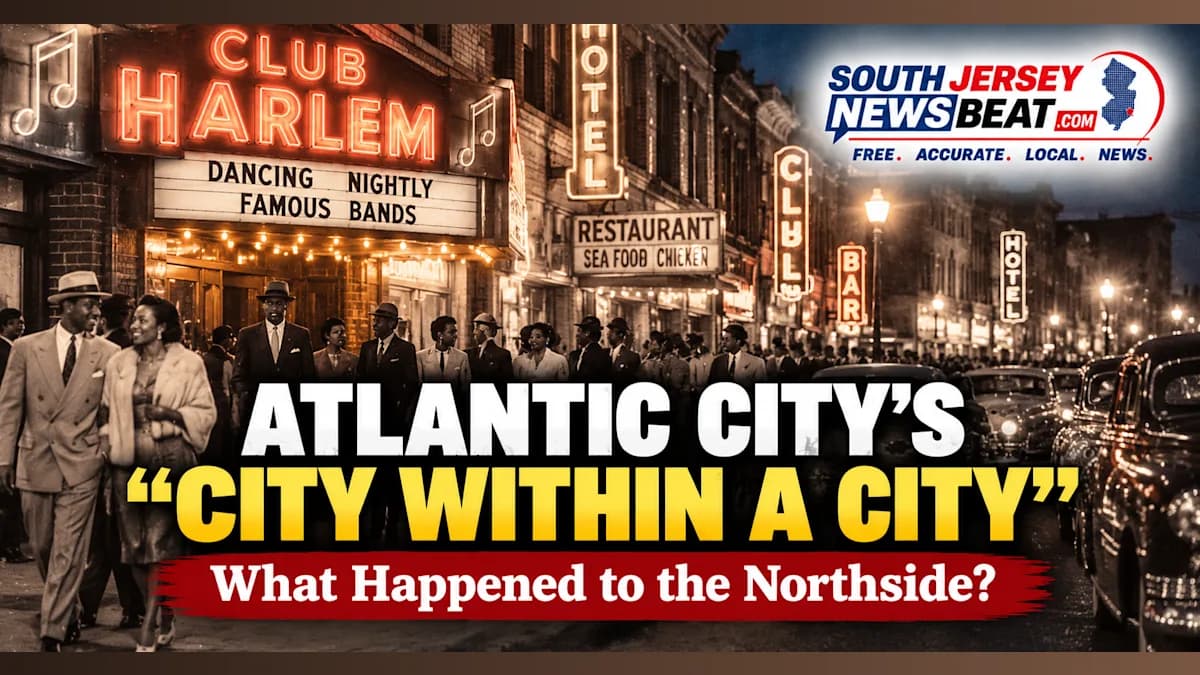
Black-owned hotels. Restaurants. Boarding houses. Nightclubs. Professionals and entrepreneurs. Music spilling into the streets from Club Harlem.
For Hunter, who had come from Philadelphia, it was unforgettable.
“I saw all of these people owning and operating their own businesses, walking down the street listening to music coming out of the nightclubs at the Club Harlem, going around the corner seeing the great restaurants and the boarding houses and the hotels, owned and operated by people who look like me,” Hunter recalled.
“I just couldn't believe I was in a world such as Atlantic City.”
More than seven decades later, much of that world is gone.
Hunter, founder and president of the African American Heritage Museum of Southern New Jersey, and retired Superior Court Judge Nelson Johnson, author of Boardwalk Empire and The Northside: African Americans and the Creation of Atlantic City, recently joined The AC Mike Lopez Show to discuss the rise, decline and legacy of Atlantic City's historic Northside.
Their conversation told the story of a community created partly out of discrimination but which grew into an extraordinary center of Black business, culture and professional life — and then changed dramatically as segregation ended, residents gained opportunities to live elsewhere and Atlantic City's economy was transformed.
Johnson described the old Northside succinctly:
It was “sort of a city within a city.”
A Community Built Under Segregation
African Americans were largely confined by discriminatory practices to Atlantic City's Northside, where they responded by developing their own businesses and institutions.
“Because of segregation, blacks were pushed to the North Side of Atlantic City, but they responded to the challenge by creating their own city within a city,” Johnson said.
“There were hotels, there were restaurants, there were nightclubs.”
Historical preservation research supports that description.
The National Trust for Historic Preservation describes the Northside as an approximately 80-square-block neighborhood that once contained businesses, entrepreneurs and professionals including doctors, lawyers, dentists and funeral directors. Black-owned hotels provided accommodations to travelers who were excluded elsewhere, while restaurants, clubs, cab companies and other businesses created an economic ecosystem within the neighborhood.
Kentucky Avenue became its entertainment center.
Club Harlem, founded in 1935, became one of the Northside's most famous institutions, attracting performers including Ella Fitzgerald, Billie Holiday, Sammy Davis Jr. and Aretha Franklin.
Hunter remembers the experience firsthand.
“I'd come out of Philadelphia out of the church, and so I had never seen this nightlife of Atlantic City,” he said. “I was really, really excited to have the opportunity to do that.”
“So it's been in my blood. I love it. It's part of my DNA.”
Doctors, Businesses and a Different Atlantic City
Johnson pointed to one statistic as evidence of just how substantial the community once was.
“Atlantic City's North Side was able to sustain 11 full-time physicians,” Johnson said. “Today, there isn't one.”
“It shows you how things have changed, and not for the better over the years,” he said. “But in its prime, Atlantic City's North Side was really sort of a mecca for entertainment and was a mecca for African-American people looking for a place to go when they got to the resort.”
Later in the interview, Hunter recalled the number as 13 Black doctors and said the neighborhood once had about 34 liquor licenses owned and operated by African Americans. He said none of those Northside liquor licenses remains today.
Historical accounts vary somewhat on the precise numbers. In an earlier interview with the National Trust for Historic Preservation, Hunter said the Northside once had 37 Black-owned-and-operated bars. But the broader picture is consistent: the neighborhood once supported a far larger concentration of Black-owned businesses and professional services than it does today.
Hunter has a name for what happened.
“It's the vanishing North Side as we knew it back in the '20s, '30s, '40s and '50s,” he said.
The Extraordinary Story of Sara Spencer Washington
Few people better illustrate the economic power that once existed within Atlantic City's Black community than Sara Spencer Washington.
Known as “Madame Washington,” she built the Apex beauty empire in Atlantic City.
The Atlantic City Free Public Library says Washington began a hairdressing business in the city in 1913 and later founded the Apex News & Hair Company. Apex eventually operated beauty colleges in 12 states and had about 35,000 agents worldwide. Washington was recognized at the 1939 New York World's Fair as one of its “Most Distinguished Businesswomen.”
Hunter told Lopez that Washington provided Black women with opportunities to become entrepreneurs.
“She was a lady who gave African-American women an opportunity to become entrepreneurs,” Hunter said.
Johnson described Washington as a mogul who helped graduates of her schools establish their own businesses, including by lending them money interest-free while requiring them to purchase Apex products.
“She understood that if you give out a little bit, you get back a lot,” Johnson said. “And she had quite a dynasty.”
Her holdings went beyond cosmetics.
Washington established the Apex Country Club and Golf Course after experiencing discrimination at another golf course. Academic research describes the Apex facility as including a nine-hole course, swimming pool, restaurant and bar, picnic grounds and hiking trails.
Her business operation also reached far beyond Atlantic City.
“She was an international corporation,” Hunter said, citing operations as far away as Johannesburg and Havana.
“She was a mogul,” Johnson added.
What Happened to the Northside?
That's where Hunter and Johnson's discussion becomes more complicated.
The institutions of the Northside had developed partly because segregation restricted where Black residents could live, conduct business and seek entertainment.
When those restrictions began falling, African Americans gained opportunities that previous generations had been denied — including the ability to live and conduct business outside historically segregated neighborhoods.
Johnson recalled something Hunter told an audience approximately 30 years ago.
“One of the first things that he said that I recall is, quote, ‘One of the worst things that happened to Atlantic City was the American Civil Rights Movement,’” Johnson said.
Johnson said the statement initially shocked him.
But he emphasized that Hunter's point was not opposition to civil rights. It was an observation about an unintended economic consequence of integration for neighborhoods that segregation had previously forced into self-sufficiency.
“People had the freedom to move, and some of them did move,” Johnson said. “And most of the people that moved were important role models for the community.”
Johnson said similar changes occurred in historically Black neighborhoods in Baltimore, Pittsburgh, Chicago, Kansas City and elsewhere.
He described it as “the law of unintended consequences.”
“You can set out to do something good. You can succeed in doing the good thing,” Johnson said. “And then an unforeseen consequence that's negative pops up and like, ‘Oh man, how'd that happen? We never saw that coming.’”
Historical preservation accounts similarly point to desegregation as one factor in the decline of the Northside's once-captive commercial economy. Casino development during the 1970s and 1980s subsequently demolished or substantially altered additional historic properties.
Then Came Casinos
New Jersey voters approved casino gambling in Atlantic City in 1976, and Resorts International opened the city's first legal casino in May 1978.
Hunter said the arrival of casinos further altered the city's traditional business structure.
Many people who once lived where they worked also moved into surrounding communities.
“More people live in a bedroom community than live at the actual resort,” Hunter said. “There are people who live in Margate, Ventnor, Longport, who live now out in the county.”
“They live in Galloway Township, Egg Harbor Township,” he continued. “So a lot of the people who lived in the city, who worked in the city, when it was the old Atlantic City, no longer live downtown Atlantic City. They live in a suburban area.”
Hunter also offered his own view of a decision he believes cost Atlantic City substantial revenue.
“The big mistake I think that they made here in Atlantic City is that when they started the casino industry, they didn't put a wage tax on the people who came here to work in the city,” Hunter said.
He argued that with tens of thousands of casino employees working in Atlantic City at the industry's peak, such a tax could have generated money for streets and other infrastructure.
That was Hunter's assessment; the interview did not provide an independent fiscal analysis of what such a tax would have generated or how it would have affected employment and the casino industry.
Johnson, meanwhile, cautioned against simply blaming casinos for Atlantic City's problems.
“You cannot blame casinos for any failings of Atlantic City to be more than it is because government tells them what they can and can't do,” Johnson said.
Casinos' primary obligation, he said, is serving their customers and generating repeat business.
“State government, I really think, dropped the ball in a lot of ways,” Johnson said. “City government did. County government did.”
Remembering What Was There
Johnson told Lopez that of his two books dealing extensively with Atlantic City, he considers The Northside more important than Boardwalk Empire, the book that inspired the HBO television series.
His reason goes to the heart of the story Hunter and Johnson are trying to preserve.
“If you remove the African American experience from Atlantic City's history, the town never comes to be,” Johnson said.
Today, organizations including Hunter's African American Heritage Museum of Southern New Jersey continue working to preserve that history. The Atlantic City Free Public Library also maintains extensive Northside oral histories and archival collections documenting Black businesses, entertainment, segregation and everyday life in the neighborhood.
For Hunter, though, this isn't simply archival history.
He remembers seeing the Northside alive.
He remembers its businesses.
He remembers its music.
And more than 70 years after that first bus trip from Philadelphia, he remembers what it felt like to encounter an Atlantic City unlike anything he had experienced before.
“It's been in my blood,” Hunter said.
“I love it.”
Ralph Hunter and retired Superior Court Judge Nelson Johnson spoke with Mike Lopez on The AC Mike Lopez Show on News Talk 1400 and 92.3 WOND. The AC Mike Lopez Show airs Monday through Friday from noon to 1 p.m.
About the Author
Karen Johnson
With over 30 years of news experience in major markets like Los Angeles, Denver, and Columbus, Karen now covers our area for South Jersey NewsBeat. She also brings her articulate and conversational news delivery to WOND radio listeners every weekday. Her background includes work with the NBC Radio Network, and she thrives in fast-paced news environments.