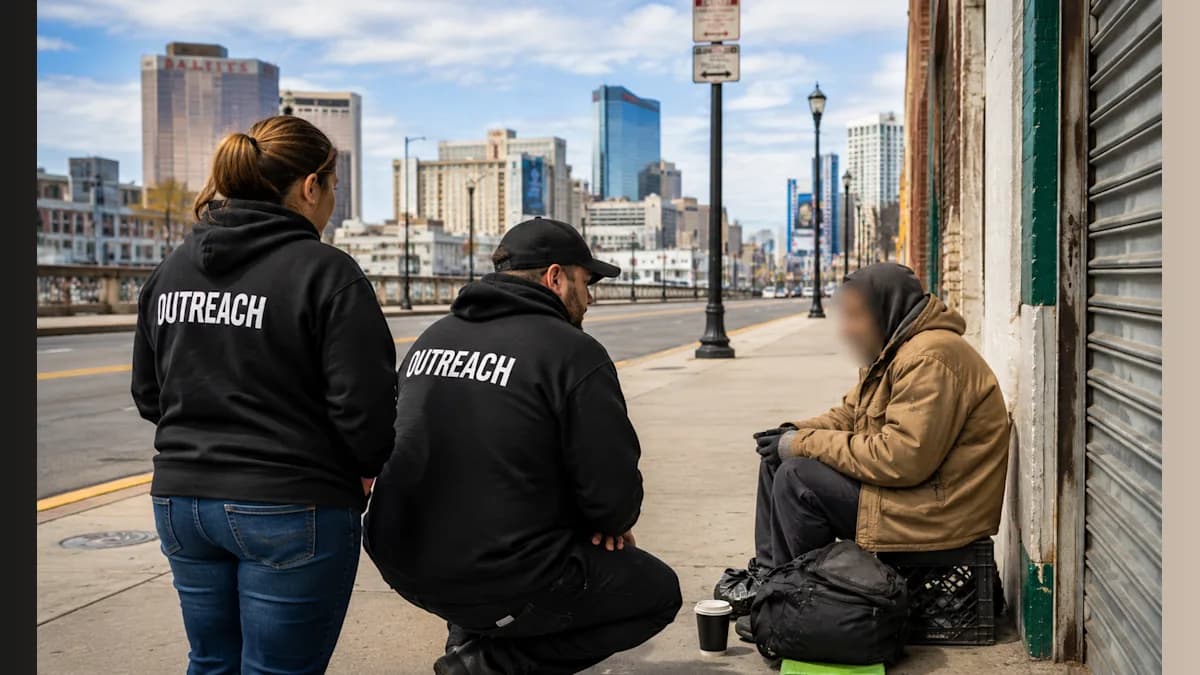
ATLANTIC CITY — An Atlantic City street outreach program says roughly one-third of the homeless people it encounters in the Chelsea neighborhood are being connected with some form of help, from addiction treatment to housing assistance to reunification with their families.
Lou Gasparini of Rising Tides Outreach and Alice Woods, president of the Chelsea Economic Development Corporation, discussed the city's continuing homelessness and addiction problems Wednesday on Klein Time with Dan Klein on WOND.

For Gasparini, the work is deeply personal.
“I do it because I was homeless,” Gasparini said. “I do it because it's something that I really enjoy doing, and I think — not to be a horn tooter — but I think I'm pretty good at it.”
Gasparini said Rising Tides uses peers who go directly onto Atlantic City's streets to work with homeless people and those struggling with addiction.
“I think we're making a big difference in the Chelsea section, actually the whole city,” he said.
Six Out of 10 Initially Say No
Convincing someone to accept help can be difficult.
Asked how many out of every 10 homeless people approached by his organization initially reject assistance, Gasparini estimated six.
“Six out of 10,” Gasparini said.
Woods agreed.
Some simply tell the outreach workers, “I'm not ready yet,” Gasparini said. Others tell them to leave them alone.
But Gasparini said his team continues going back.
“We just persist and persist until we either get help for somebody,” he said.
Gasparini said Rising Tides is seeing what he described as a 32% to 40% monthly success rate in Chelsea.
That doesn't necessarily mean someone has permanently overcome homelessness or addiction. Gasparini defines it as getting someone off the street and connected with meaningful assistance.
“We get one person out of three off the street for that month,” Gasparini said. “They are off the street to go to a rehab. We get a lot of people home. We call families. We call wives.”
He cautioned later in the interview that the statistic shouldn't be interpreted as a permanent success rate.
“When I say I have a one-in-three success, that means that one person in three for that month that I report back to Chelsea EDC has gotten some kind of help — going home, going to a rehab, a detox or whatever,” Gasparini said.
“That doesn't mean that they're not going to come back in six months.”
But Gasparini said that possibility doesn't diminish the importance of continuing to try.
“We can just keep helping and helping and hope that something clicks in somebody's head like it did for me.”
‘You're Going to Die’
Gasparini knows firsthand how many attempts it can take before someone struggling with addiction is willing to accept help.
He described spending years homeless and reaching a point where he had burned bridges with his family.
Eventually, he said, something changed.
Gasparini recalled being on the street when he felt worse than he ever had before.
“I 911ed myself, and I woke up in the emergency room like I had a hundred times or whatever,” Gasparini said.
This time, a doctor delivered a warning that registered differently.
“A doctor was staring over me and said, ‘Lou’ — she knew my name — ‘I'll get you through tonight, but you're going to die.’”
Gasparini had heard warnings before.
But this one stuck.
“For some reason ... it just clicked in then,” he said.
“The only way I can describe it then, the way programs describe it, is that you have a spiritual awakening. So there is like a light goes on.”
Gasparini returned to a counselor who recognized that he was finally ready for help.
“He saw that I was in surrender and called my family and made me go home,” Gasparini said.
Earlier in the interview, Gasparini explained why reconnecting homeless people with their families can be such an important part of outreach.
“Sometimes you need an intermediary,” he said.
Gasparini said Rising Tides won't make that call unless its workers believe the person is actually ready.
“We're never going to put somebody that's going to add more grief to a family or to a household,” he said. “And after years, you can tell.”
Businesses, Courts and Outreach Working Together
Gasparini also described a relatively new approach involving Atlantic City businesses, outreach workers, the municipal court and social-service providers.
Rising Tides operates what Gasparini called a Business Outreach Program, through which participating businesses give the organization permission to address homeless people on their properties.
Gasparini described it as an “accountability program.”
If someone is cited, Gasparini said, the goal is ultimately to connect that person with services rather than simply punish them.
On Atlantic City's homeless court day, Gasparini said he works with the prosecutor and turns participants over to Jewish Family Service, which can assign a caseworker and work toward housing.
The judge can then give the person time to continue participating in services.
“If you do these programs, you'll dismiss the fines,” Gasparini said.
He offered the example of someone who has spent months in a program and is close to moving into permanent housing.
“If you're right there at the edge of housing after six months, and you're ready to move in in two weeks, your landlord's getting your place ready, all your fines are dropped,” Gasparini said.
“This is a brand new program,” he added. “It's been very successful.”
Gasparini said cooperation between outreach workers and government has increased.
“I work with two wonderful — and I mean wonderful — police officers who are outreach officers on the Boardwalk,” he said. “They're not out there to ticket. They're out there to provide services.”
“We are more than ever collaborating,” Gasparini said.
Woods: Homelessness Must Be Treated as a Housing Issue
Woods said street outreach is an important part of Chelsea EDC's broader effort to improve the neighborhood.

“One of the key pieces that we know is helping the unhoused get connected to services,” Woods said. “That keeps our streets clean and safe. It helps people connect to housing, which is a big priority for us.”
She said Chelsea EDC's partnership with Rising Tides has become “a big part of our work.”
It's also important, Woods said, that Atlantic City not view homelessness exclusively as a law-enforcement problem.
“We also need to treat homelessness as a housing issue, not just some kind of enforcement issue,” Woods said.
“We need to help people get connected to permanent” housing, she said, adding that there remains a shortage of places for people to go.
Woods also spoke from personal experience with recovery.
“I'm a recovering person, too — 30 years — and I'm glad that no one gave up on me,” she said.
The goal, Woods said, shouldn't be measured against the unrealistic expectation that homelessness or addiction will completely disappear.
“To the extent we can continue and raise bottoms and just meet people where they're at and treat them with respect and dignity and try to look at this as a systemic problem versus an individual problem, I think we're going to be better off.”
Gasparini expressed a similar view.
“This is never going to get solved,” he said.
But that, he said, isn't a reason to stop trying.
“We can just keep helping and helping.”

About the Author
Karen Johnson
With over 30 years of news experience in major markets like Los Angeles, Denver, and Columbus, Karen now covers our area for South Jersey NewsBeat. She also brings her articulate and conversational news delivery to WOND radio listeners every weekday. Her background includes work with the NBC Radio Network, and she thrives in fast-paced news environments.