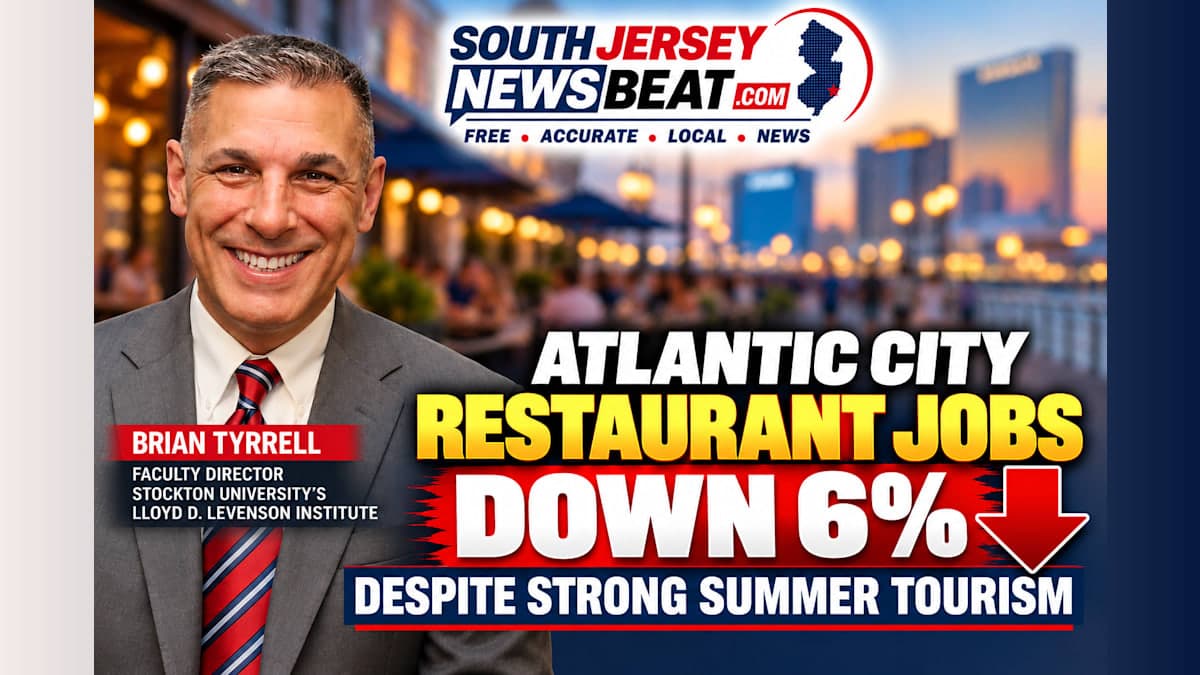
Stockton University tourism expert Brian Tyrrell says inflation, changing consumer spending and rising operating costs are creating challenges for Atlantic City's hospitality industry.
ATLANTIC CITY, N.J. — Atlantic City attracted millions of visitors during the summer of 2026, with major concerts, sporting events and casino entertainment helping draw crowds to the resort. But beneath the busy Boardwalk and packed entertainment venues, troubling economic numbers suggest that not everyone is benefiting equally from the tourism activity.
Employment at Atlantic City restaurants and bars declined approximately 6% compared with the previous summer, while direct casino employment fell 1.1%, according to findings presented at Stockton University's annual Jersey Shoreview Fall Tourism and Business Panel.
Broader summer employment was approximately 3% below the previous year's level, representing roughly 5,500 fewer jobs in the employment data examined by Stockton economist Oliver Cooke.
The findings illustrate an increasingly complicated picture for Atlantic City's economy: Visitors are still coming, but inflation, higher business expenses and changing spending habits are creating pressure on employers and workers.
Brian Tyrrell, faculty director of Stockton University's Lloyd D. Levenson Institute of Gaming, Hospitality and Tourism (LIGHT), discussed the findings during an October 21 appearance on Off The Press with Scott Cronick on News Talk 1400 & 92.3 WOND.
Tyrrell said the employment figures reveal a tourism economy in which businesses are becoming more cautious about hiring, even as visitation remains relatively healthy.
"We saw casino employment, direct casino employment down over the summer month compared to last year," Tyrrell said. "It was down about 1.1%."
But the decline in restaurant and bar employment was substantially larger.
"Being down 6% in the restaurant industry in town here is certainly not as good as only down 1%," Tyrrell said.
Visitors Are Coming, But Businesses Are Hiring Less
The employment declines are particularly striking because Atlantic City continued to attract significant visitor traffic throughout the summer.
Tyrrell cited approximately 2.5 million westbound vehicle movements through the Pleasantville toll area of the Atlantic City Expressway during the summer.
He described the traffic as an encouraging indication that people were still traveling to the resort.
"Two and a half million westbound travelers through the toll zone at Pleasantville on the Atlantic City Expressway was very impressive numbers," Tyrrell said.
The traffic figure is a measure of vehicle movements, not a count of unique visitors. It does, however, provide another indication of substantial travel activity during the tourism season.
The contrast between visitation and employment raises an important question: Why are hospitality jobs declining when Atlantic City continues to draw crowds?
Tyrrell said uncertainty about consumer spending is influencing business decisions.
"A lot of the metrics in the economy right now would suggest an employer should be cautious, cautious when you're hiring, but also cautious, you know, to retain some of the employees that you have," he said.
Employers are confronting higher expenses while trying to determine whether customers will continue spending at the same levels.
"The caution on the part of the employer is they don't really know, you know, are consumers going to react negatively to the inflationary pressures? Will we see less visitation?" Tyrrell said.
The result is a tourism industry that can appear busy while still experiencing financial strain.
A Mixed Summer for Atlantic City's Economy
The seventh annual Jersey Shoreview panel was held October 8 at Stockton University's Atlantic City campus.
The event, presented in partnership with Visit Atlantic City, brought together economists and representatives of the resort's entertainment, convention and tourism industries.
Cooke, an associate professor of economics at Stockton, characterized the summer as a cautious one.
His analysis showed that July was relatively strong, while June was softer and August disappointed compared with the previous year.
Tyrrell expanded on that assessment during his WOND interview.
"The summer was a little mixed though," he said.
He noted that differences in the calendar can influence year-over-year comparisons, particularly in a destination where weekends account for a significant portion of tourism activity.
"Oliver Cooke described June, I believe, as, you know, not as robust, a good July, but a weaker August compared to the prior year," Tyrrell said.
He also pointed to the financial challenges facing employers who must attract customers while protecting profit margins.
"They need to be worried about profit margins, and that's something we've seen under a lot of pressure in the city," Tyrrell said.
Casinos Spending More to Attract Customers
Tyrrell said another factor complicating Atlantic City's economic picture is the increasing cost of attracting visitors.
Casinos often use complimentary hotel rooms, meals, entertainment and promotional offers to encourage customers to visit their properties.
Those incentives can help maintain traffic and gaming activity, but they also create expenses that reduce profitability.
"Even when visitation's up, you know, they're having to spend more to bring the consumer into Atlantic City," Tyrrell said.
He explained that the cost of attracting casino customers can place additional pressure on operating margins.
"That's going to hurt their margins," he said.
"There's going to be extra expenses associated with giving away a room or giving away a meal or entertainment in order to get that casino customer down here."
The distinction between revenue and profit is important in Atlantic City, where reported gaming revenue includes activity that does not necessarily translate into equivalent earnings for casino operators.
Stockton's LIGHT Institute has repeatedly emphasized that gross gaming revenue is an imperfect measure of casino profitability because operators have different expenses, promotional strategies and revenue-sharing arrangements.
The institute's August 2026 analysis noted that complimentary services and promotional gaming credits can stimulate customer activity without necessarily producing comparable improvements in profits.
For Atlantic City's broader economy, the issue extends beyond casinos.
Restaurants, bars, retailers and other tourism-dependent businesses must also manage labor costs, food prices, utilities and other operating expenses while competing for customers' limited discretionary spending.
A Growing Divide Between Higher-Income and Budget-Conscious Visitors
Another important finding discussed at Jersey Shoreview involved what economists call a K-shaped economy.
The term describes an economic environment in which higher-income consumers continue to prosper and spend, while lower-income households experience greater financial pressure.
Tyrrell said that divide is increasingly relevant to Atlantic City's casino and hospitality industry.
"You hear a lot of discussion about the K-shaped economy, regardless of what industry or area of the country they were talking about here," Tyrrell said.
He explained that consumers with greater financial resources are generally better positioned to continue spending on vacations, entertainment and other discretionary purchases.
"It's referring to those consumers with higher income doing rather well and continuing to have aggressive spend, right, healthy spend," Tyrrell said.
"But everybody else, you know, it's a bit of a struggle right now."
He said inflation has affected lower-income consumers disproportionately.
"The impact that inflationary pressures have on the lower part of that K, if you will, are outsized compared to others," Tyrrell said.
As a result, hospitality properties catering to more affluent visitors may have an advantage over businesses that depend more heavily on price-sensitive customers.
"Properties that are going after those consumers that are, you know, a little bit more wealthy right now are finding an easier time of doing that," he said.
The trend may help explain why some Atlantic City casinos are performing more strongly than others, although individual property results also depend on management, investment, amenities and operating costs.
During the interview, Cronick pointed to Borgata, Ocean Casino Resort and Hard Rock as examples of properties performing relatively well compared with some competitors.
The discussion suggested that Atlantic City's casino market is becoming increasingly divided, with customer spending power playing an important role.
Gas Prices and Inflation Affect Tourism Spending
Tyrrell also discussed how higher transportation costs can influence tourism decisions.
When consumers spend more on gasoline or other travel expenses, they may have less money available for restaurants, entertainment, shopping and accommodations.
"Gas prices are certainly negative in that regard," Tyrrell said.
"They hurt our disposable income."
He explained that even travelers who decide to take a vacation may reduce their spending once they reach their destination.
"That's less money we might be able to spend, even if we do take a trip," Tyrrell said.
He said the effects can extend across several parts of the tourism economy.
"The entertainment or the shopping or the lodging, you know, could easily be taken, you know, reduced because of the necessary increase in the transportation part of a consumer's budget."
However, higher travel costs can also create an opportunity for destinations such as Atlantic City.
Visitors who might otherwise take longer vacations may instead choose destinations within driving distance.
Tyrrell said that could work in Atlantic City's favor because much of the resort's visitor market is located within a few hours.
"It's behavior like that, that tends to favor destinations that are closer to an individual's home," he said.
"Certainly the majority of our visitors are from within a few hours drive of Atlantic City."
Entertainment Remains a Bright Spot
Despite the employment declines and economic concerns, Stockton's Jersey Shoreview panel identified several encouraging developments.
Atlantic City hosted major concerts and events during the summer, including performances by Shakira, Phish and RÜFÜS DU SOL, along with WWE events and the Atlantic City Airshow.
Jim McDonald, general manager of Jim Whelan Boardwalk Hall, said major entertainment events continue attracting visitors from outside the immediate region.
According to figures presented at the panel, approximately 95% of Boardwalk Hall attendees travel more than 60 miles to attend events.
For the recent three-day Phish concert series, approximately 65% of attendees traveled more than 150 miles.
Those visitors can generate additional spending at hotels, restaurants and other businesses throughout Atlantic City.
However, the employment figures suggest that successful events alone do not guarantee stronger hiring across every segment of the local tourism economy.
Why Convention Business Matters
Tyrrell also emphasized the importance of Atlantic City's convention industry, particularly during the fall and spring when leisure tourism typically slows.
He said convention business helps sustain hotel occupancy and employment outside the peak summer season.
"I think that there is a need for significant reinvestment," Tyrrell said while discussing the Atlantic City Convention Center and the city's convention business.
He said conventions provide important support during periods when tourism activity would otherwise decline.
"It does a great job of bringing in business into the town and really helps us get through those otherwise lean fall and spring, you know, off seasons, if you will," Tyrrell said.
He also called attention to the need for public investment alongside the money casino operators are spending to upgrade their properties.
"You see significant reinvestment on the private industry's part in the properties in town here, really putting a good face on the properties and spending significant sums of money," Tyrrell said.
He argued that the Convention Center needs similar attention.
"I think it's probably necessary at the convention center as well, but that falls on the government, right, to step to the plate there and figure out what we need to do," he said.
The issue has become increasingly urgent as Atlantic City faces uncertainty surrounding the Sheraton Atlantic City Convention Center Hotel and potential competition from new casinos in the New York metropolitan area.
What Comes Next for Atlantic City's Workers?
The summer employment figures highlight a challenge that extends beyond the casino floors.
Restaurants, bars, hotels and other hospitality businesses provide jobs for thousands of Atlantic County residents.
When employers reduce staffing or become reluctant to hire, the effects can extend to household income and spending throughout the region.
The roughly 6% decline in restaurant and bar employment is especially concerning because those businesses serve both visitors and local residents.
However, the available figures do not establish how much of the decline resulted from layoffs, unfilled positions, seasonal staffing decisions or other factors.
Additional employment and business data will be needed to determine whether the summer decline represents a temporary adjustment or a longer-term trend.
Tyrrell said the outlook ultimately depends on both employers and consumers.
Businesses must decide how aggressively to hire and invest, while households must determine how much they can afford to spend on travel and entertainment.
"We've talked about the caution on the part of the employer, but there's caution on the part of the consumer as well," Tyrrell said.
"And the part of the visitor, right? Can they afford to take that vacation?"
For Atlantic City, that may be the central economic question heading into the remainder of 2026.
The resort continues to demonstrate that it can attract visitors through major entertainment, casino gaming and conventions.
The challenge is translating that activity into stronger employment, sustainable business profits and broader economic benefits for the people who live and work in South Jersey.
Brian Tyrrell, faculty director of Stockton University's Lloyd D. Levenson Institute of Gaming, Hospitality and Tourism, discussed the findings on the October 21 edition of Off The Press with Scott Cronick, airing weekdays from 4 to 6 p.m. on News Talk 1400 & 92.3 WOND.

About the Author
Peter Killeen
A 25-year radio news veteran, Peter covers South Jersey for NewsTalk 1400 & 92.3 WOND radio. Known for his concise and impactful delivery, he ensures listeners and readers stay informed without unnecessary filler.