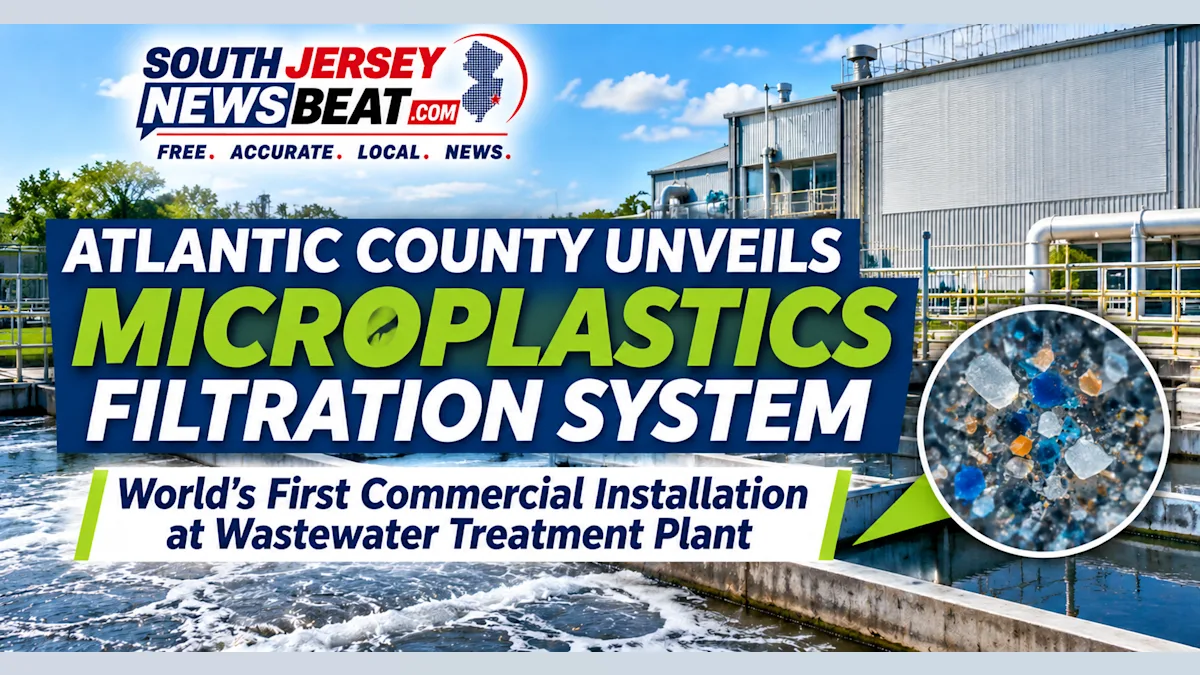
New technology at Atlantic City's wastewater treatment plant aims to prevent hundreds of millions of tiny plastic particles from reaching the Atlantic Ocean
ATLANTIC CITY, N.J. — A groundbreaking environmental project in Atlantic City is putting Atlantic County at the forefront of efforts to remove microscopic plastic pollution from wastewater before it reaches the ocean.
The Atlantic County Utilities Authority has partnered with PolyGone Systems to install what the organizations describe as the world's first permanent commercial-scale municipal wastewater treatment system specifically designed to capture microplastics.

The technology officially entered its permanent commercial phase October 20, following a pilot program that demonstrated the potential to remove hundreds of millions of tiny plastic particles annually.
The installation represents a significant development for South Jersey's coastal environment, where clean water, healthy marine ecosystems, fishing and tourism are central to the regional economy.
More Than 580 Million Plastic Particles Captured Annually
According to the Atlantic County Utilities Authority, its pilot program captured an estimated 580 million microplastic particles per year.
The results helped convince officials to move forward with a permanent installation at the authority's Atlantic City wastewater treatment facility.
The plant processes approximately 40 million gallons of wastewater daily from 14 Atlantic County municipalities.
After undergoing conventional wastewater treatment, the water is eventually discharged into the Atlantic Ocean.
Although wastewater treatment facilities remove many contaminants, extremely small plastic particles can remain in treated water.
Those particles, known as microplastics, originate from the breakdown of larger plastic materials, synthetic clothing fibers, packaging and numerous other sources.
Because they are so small, microplastics can pass through some conventional treatment processes and enter waterways.
The new system is designed to capture additional particles before the treated water is discharged.
The 580 million figure is based on project-reported pilot results and should not be interpreted as an independently verified annual removal rate for the new permanent installation.
How the Technology Works
The system, developed by PolyGone Systems, uses specialized filtration technology inspired by naturally occurring plants.
The company's PolyPod system contains silicone-based filters designed to attract and capture tiny plastic particles as water passes through.
Unlike conventional systems that rely primarily on screening particles by size, the technology takes advantage of the tendency of certain plastic particles to adhere to specialized surfaces.
The equipment is positioned along the wastewater treatment plant's existing water flow, allowing it to operate without major reconstruction of the facility.
An automated mechanism periodically raises the filters for cleaning.
High-pressure water removes the collected particles, which are then concentrated for further handling and disposal.
The filters are subsequently returned to service.
PolyGone says its technology can remove more than 98 percent of microplastics under certain controlled testing conditions. However, that figure should not be confused with a verified removal rate for all water passing through the Atlantic City facility.
The company and ACUA are continuing to evaluate the system's performance under actual operating conditions.
From Princeton University to Atlantic City
PolyGone Systems was founded by Princeton University graduates Yidian Liu and Nathaniel Banks, who developed an approach to addressing plastic pollution through specialized materials and filtration design.
The company began working with ACUA in 2022 to evaluate microplastic contamination and possible removal methods.
A pilot filtration system was installed in September 2024.
Following approximately two years of testing and development, the partners moved forward with the permanent commercial installation.
The project received approximately $2 million in financing through the New Jersey Infrastructure Bank, with principal forgiveness helping support the investment.
The New Jersey Department of Environmental Protection has also supported the initiative.
Why Microplastics Matter
Microplastics are generally defined as plastic particles smaller than five millimeters.
They have been detected in oceans, rivers, lakes, soil, drinking water and living organisms.
Researchers are increasingly studying how the particles move through ecosystems and whether long-term exposure poses risks to human health.
Scientists have detected microplastics in human tissues, but the full health consequences of exposure remain under investigation.
For coastal communities such as Atlantic City, Brigantine, Ventnor, Margate, Longport and Ocean City, preventing additional plastic pollution from reaching the ocean is an important environmental objective.
The Atlantic County project is particularly notable because wastewater treatment facilities are not generally required under existing federal regulations to install dedicated microplastic-removal systems.
ACUA's decision to pursue the technology therefore represents a voluntary effort to address an emerging environmental concern.
Could Other Communities Follow Atlantic County's Lead?
The Atlantic City installation could provide a model for other wastewater treatment authorities seeking to reduce microplastic discharges.
Environmental advocates have expressed interest in whether similar technology could be deployed at treatment facilities elsewhere in New Jersey and throughout the country.
The project's long-term success will depend on several factors, including its actual particle-removal performance, operating costs, maintenance requirements and ability to function reliably over time.
Researchers will also need to determine how effectively the technology captures different types and sizes of microplastics.
For now, Atlantic County is serving as an early testing ground for a technology that could eventually become part of wastewater treatment operations elsewhere.
Project Highlighted During WOND Broadcast
The environmental initiative also received attention during the Saturday, November 7, edition of Nancy Adler Nutrition Live! on News Talk 1400 & 92.3 WOND.
During the broadcast, Adler highlighted ACUA's partnership with PolyGone Systems and its potential environmental benefits.
"That is incredible," Adler said while discussing the filtration technology.
She also told listeners that ACUA President Matthew DeNafo is expected to appear on her program later this month to discuss the project.
That interview could provide additional insight into the system's operation, its costs and what the technology could mean for Atlantic County residents.
For a region whose economy and identity are closely connected to the Atlantic Ocean, the new installation represents a potentially important step toward reducing an increasingly widespread form of pollution.
Nancy Adler Nutrition Live! airs on News Talk 1400 & 92.3 WOND. The November 7 broadcast originated from Essential Elements Vitamin and Nutrition Center in Northfield.

About the Author
Karen Johnson
With over 30 years of news experience in major markets like Los Angeles, Denver, and Columbus, Karen now covers our area for South Jersey NewsBeat. She also brings her articulate and conversational news delivery to WOND radio listeners every weekday. Her background includes work with the NBC Radio Network, and she thrives in fast-paced news environments.