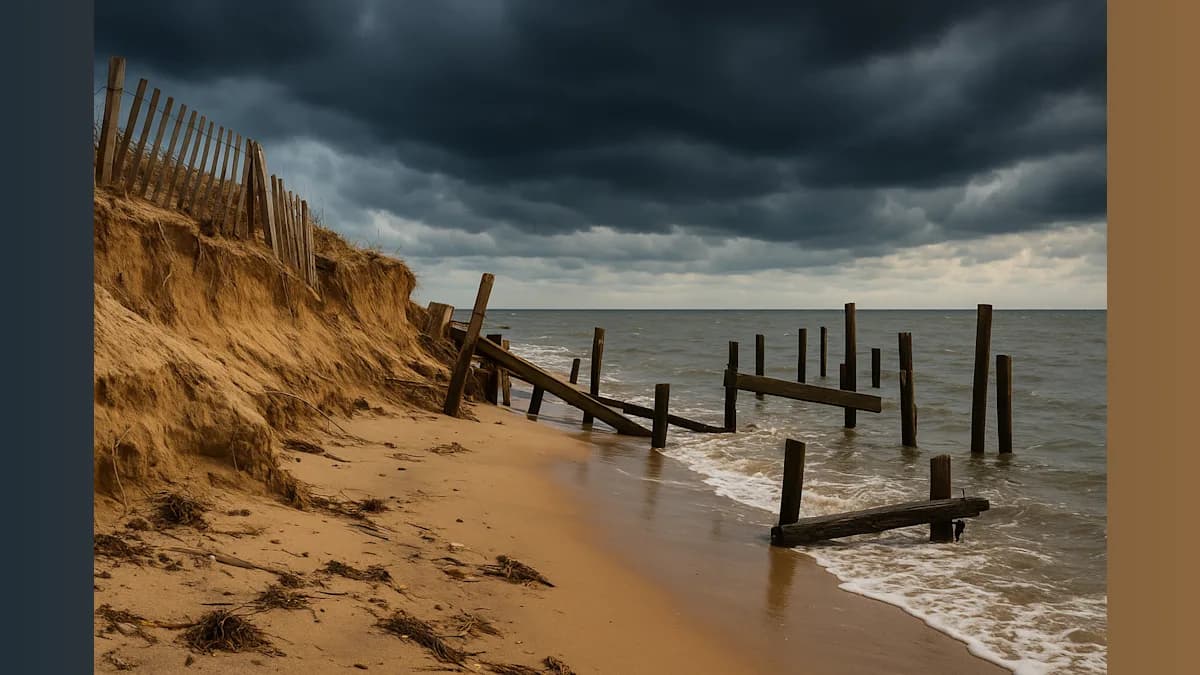
Our community's greatest asset in the face of growing casino competition may be slipping away — literally. The beaches along Atlantic City's northern Boardwalk are experiencing severe erosion that's shrinking the shoreline and threatening the resort's long-term appeal, just as three major New York City casinos prepare to open their doors.
The timing couldn't be worse. This summer was supposed to mark Atlantic City's strongest season since the COVID-19 pandemic, with millions invested in casino upgrades and a nearly $40 million sand restoration project completed just last year. That project moved 1.2 million cubic yards of sand to rebuild beaches in front of Resorts, Hard Rock, and Ocean casinos — but much of that transplanted sand has already washed back into the Atlantic Ocean.
"Beach erosion has hit the northern inlet end of Absecon Island harder than the wider beaches to the south. Because the beach is part of these businesses' product, a washed-out shoreline undercuts their seaside appeal and limits the attractions," George Goldhoff, president of Hard Rock Atlantic City and of the Casino Association of New Jersey, told The Press of Atlantic City.
The erosion problem extends beyond aesthetics — it's a concrete business threat. Leadership from Resorts, Ocean, and Hard Rock have escalated their concerns directly to federal, state, county, and local officials, documenting how the diminished beach is actively hurting their operations.
"Leadership executives at Resorts, Ocean, and Hard Rock have taken the case directly to federal, state, county, and local officials, laying out the economics and documenting how the lack of beach is hurting operations — a sign that this is a concrete business threat, not an abstract environmental worry," Goldhoff explained to The Press of Atlantic City.
The stakes are particularly high as our region braces for intensified competition. In the coming years, New York City will welcome three full-scale casinos — Resorts World, Metropolitan Park, and Bally's Bronx — all featuring slot machines and live dealer table games. For decades, Atlantic City has drawn heavily from New York customer traffic, and analysts believe our oceanfront setting represents our strongest competitive advantage. Queens and the Bronx simply can't offer families a beach vacation experience.
The erosion affecting our northern beaches stems from multiple factors: rising sea levels, increasingly frequent coastal storms, and the natural vulnerability of Atlantic City's geographic position. The northern end of Absecon Island functions as a natural bottleneck where ocean currents strip away sand far more aggressively than they do along beaches farther south.
Not all our casino operators are facing the same challenges. Caesars, located farther south on the Boardwalk, is betting big on beach season — the resort opened its first-ever beach club earlier this month, a milestone in the property's nearly 50-year history.
As our community looks ahead, the message from casino leadership is clear: protecting and restoring our beaches isn't just an environmental priority — it's an economic imperative that will help determine whether Atlantic City can maintain its position as a premier destination in an increasingly competitive regional gaming market.

About the Author
Karen Johnson
With over 30 years of news experience in major markets like Los Angeles, Denver, and Columbus, Karen now covers our area for South Jersey NewsBeat. She also brings her articulate and conversational news delivery to WOND radio listeners every weekday. Her background includes work with the NBC Radio Network, and she thrives in fast-paced news environments.