ATLANTIC CITY — For years, Atlantic City officials and developers have talked about creating something the resort has struggled to maintain outside its casino district: thriving residential neighborhoods filled with year-round residents and the stores, restaurants and everyday businesses that follow them.
Showboat owner and developer Bart Blatstein believes that transformation has finally begun.

“It’s really, really happening,” Blatstein said Thursday during an appearance on Off The Press with Scott Cronick on WOND. “It’s no longer speculation. It’s here and now.”
And Blatstein predicts the current wave of housing construction will eventually deliver something Atlantic City residents have long sought: a full-sized supermarket.
“People bring people,” Blatstein said. “Development brings more people. Then the retail will follow.”
“Of course, we all want a full-sized supermarket,” he added. “That’ll come. That’s a matter of time now.”
Blatstein's prediction remains just that — a prediction. No new full-sized supermarket project was announced during the interview.
But his broader contention that residential construction is accelerating in Atlantic City has plenty of evidence behind it.
National builder breaks ground in the Inlet
One of the clearest signs came just this month.
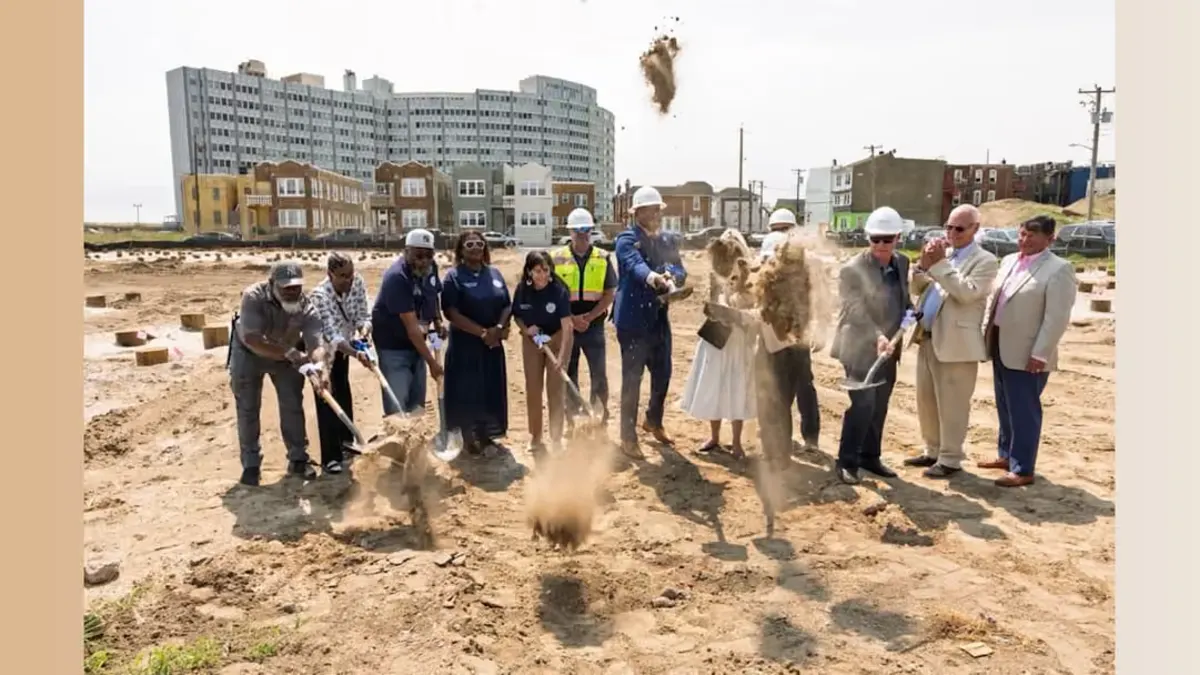
K. Hovnanian Homes broke ground Aug. 12 on Terraces at Absecon Inlet, a 38-home waterfront development at Pacific and New Hampshire avenues.
The four-story townhomes are expected to have about 1,848 square feet, three bedrooms, 3½ bathrooms, two-car tandem garages and upper-level balconies. The first homes could be delivered as early as summer 2027.
The project is significant beyond its 38 units: It marks the return of a major national homebuilder to the Atlantic City market.
Blatstein specifically pointed to K. Hovnanian during his interview.
“K. Hov has broken ground,” Blatstein said while listing projects around the Inlet. “It’s really, really happening.”
K. Hovnanian has said Atlantic City's potential and future helped drive its decision to invest in the city.
Lighthouse Row keeps growing
Just blocks away, another residential project is expanding.
Developer Keith Groff's Lighthouse Row completed its first phase in November 2024 with eight luxury homes near the Absecon Lighthouse.
Seven additional homes are being added in Phase II, which city officials said last month was expected to be completed around the beginning of fall. Those houses are expected to sell for approximately $850,000 to $1.5 million. All but one of the homes in the first phase sold, with the developer retaining the remaining property.
Blatstein pointed to that construction as another sign of momentum.
“There’s plenty of room,” he said. “It’s just going to continue on and on.”
The Inlet development is particularly notable because Atlantic City has spent decades struggling with vacant land and underdeveloped parcels despite being one of New Jersey's best-known destinations.
Luxury housing emerging elsewhere
The residential push isn't confined to the Inlet.
The Residences at Orange Loop, a group of 10 luxury townhouses on the Kentucky Avenue beach block, celebrated its opening in May.
One of those properties was already under contract for $850,000 at the time, according to The Philadelphia Inquirer.
Other larger residential proposals are also part of the city's development pipeline.
Blatstein said some of the developers now looking at Atlantic City are people he knows from the Philadelphia development community.
“A lot of the developers that have come down are friends of mine from Philadelphia that I encourage to come down,” he said.
“That’s what we want,” Blatstein added. “We want investment to continue. The rising tide floats all boats.”
Blatstein says more than housing will follow
For Blatstein, however, constructing homes isn't the ultimate objective.
The larger question is whether enough new residents can create functioning neighborhoods around them.
Cronick asked whether Atlantic City could eventually develop neighborhood retail similar to areas of Philadelphia where residential investment was followed by restaurants, shops and other businesses.
Blatstein, who developed Philadelphia's Northern Liberties neighborhood, said he has seen that progression before.
“100%. I’ve done this in the past,” Blatstein said. “I did an area called Northern Liberties.”
“100% this is happening,” he continued. “Yes, people bring people. Development brings more people. Then the retail will follow.”
His argument is essentially one of population density.
Build enough homes, attract enough residents and eventually businesses have enough potential customers to justify opening.
“As the area becomes denser and denser with development, the need will be there for a supermarket and for other uses,” Blatstein said. “Absolutely. You’re going to see a lot of things pop up now.”
An old housing stock
Blatstein also pointed to the age of Atlantic City's existing housing.
“Everybody knows that Atlantic City desperately needs new housing,” he said.
He estimated that more than 80% of the city's housing stock was built before 1979.
Historical planning data supports his larger point that Atlantic City's housing stock is unusually old. The city's master plan found the median year of construction for owner-occupied housing was 1952, compared with 1972 for Atlantic County.
That makes the current wave of newly constructed homes particularly significant.
For decades, much of the new residential construction in the region occurred in Atlantic City's suburbs rather than inside the resort itself.
Now developers are testing whether buyers will pay shore-town prices for newly built homes within Atlantic City.
Early results at projects such as Lighthouse Row suggest there is at least some demand.
What about Atlantic City's struggling commercial corridors?
Blatstein also offered a distinctly developer-driven solution for another longstanding Atlantic City problem: vacant and deteriorating commercial properties.
Cronick asked whether the city or Casino Reinvestment Development Authority should use eminent domain powers to acquire blighted properties, particularly along Pacific Avenue.
Blatstein rejected the idea.
“The answer is flat out absolutely not,” he said.
Instead, he believes residential development itself will eventually increase the value and desirability of nearby commercial property.
“All that needs to occur is for more residential development to create more demand for the commercial properties,” Blatstein said.
Then, he said, “you’ll see the coffee shops open up.”
“You’ll see the different uses start to pop into the shops,” Blatstein said.
He compared the potential progression to Philadelphia's Fishtown, where existing commercial buildings became increasingly valuable as surrounding neighborhoods attracted more residents and investment.
Blatstein said eminent domain should generally be reserved for situations in which parcels need to be assembled for a major project.
Blatstein: Plenty of room remains
Atlantic City's housing experiment is still relatively young.
Dozens of new homes are under construction, and considerably larger projects have been proposed, but whether the current activity ultimately produces the population growth and neighborhood retail Blatstein envisions will take years to determine.
Blatstein nevertheless sees Atlantic City's vacant land as an opportunity rather than an obstacle.
He said approximately 20% of the city remains undeveloped vacant land and claimed more than 1,000 building lots are currently “in play.”
South Jersey NewsBeat was able to independently confirm multiple active residential projects and dozens of homes currently planned or under construction, but did not find a public source independently establishing Blatstein's figure of more than 1,000 active building lots.
What can be documented is a collection of projects that would have been difficult to imagine in Atlantic City not long ago: luxury houses selling for more than $1 million, a major national homebuilder returning to the city and vacant parcels becoming residential neighborhoods.
For Blatstein, those developments are the beginning rather than the end.
“People bring people,” he said.
And if he's right, the next wave won't just be houses.
It will be the supermarkets, coffee shops, restaurants and neighborhood businesses needed to serve the people who live in them.

About the Author
Peter Killeen
A 25-year radio news veteran, Peter covers South Jersey for NewsTalk 1400 & 92.3 WOND radio. Known for his concise and impactful delivery, he ensures listeners and readers stay informed without unnecessary filler.