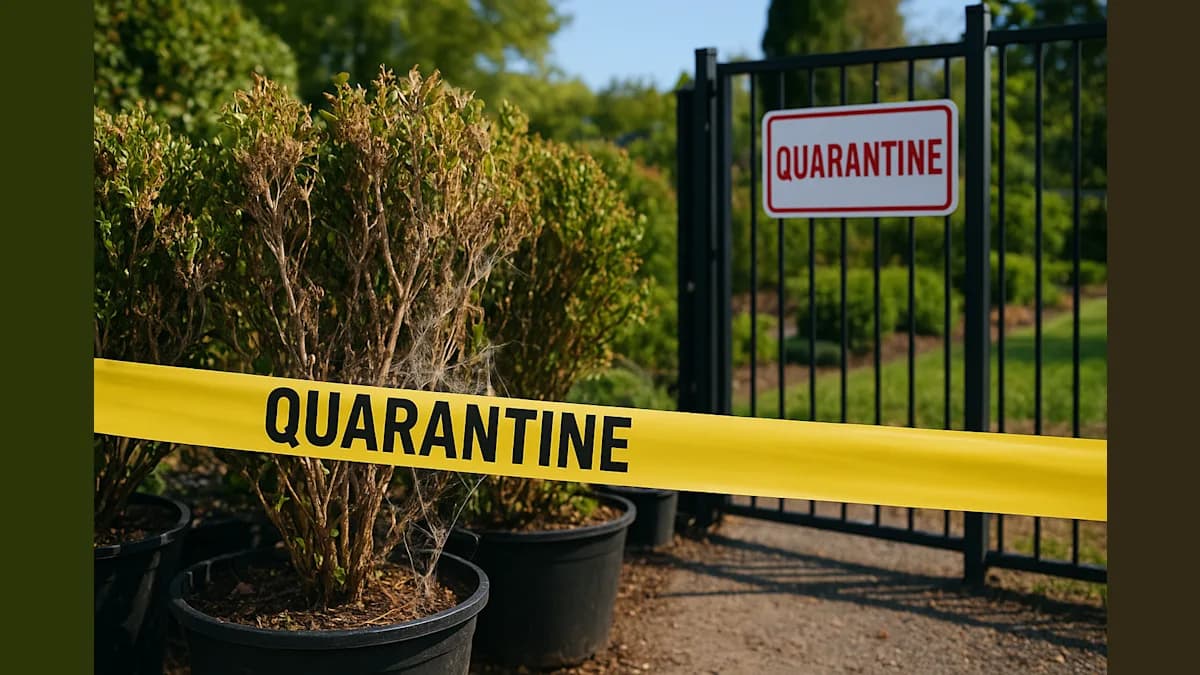
Our community is now under quarantine after federal officials confirmed the presence of an invasive pest that poses a serious threat to one of our region's most beloved landscaping plants.
The U.S. Department of Agriculture's Animal and Plant Health Inspection Service has detected the box tree moth at private residences in Cape May County, prompting immediate restrictions on the movement of boxwood plants and related materials. The New Jersey Department of Agriculture announced that the quarantine prohibits anyone from moving live boxwood plants, debris, or dead boxwood material outside Cape May County without a fully executed compliance agreement authorized by the department.
The box tree moth is a federally regulated invasive pest that feeds primarily on boxwood plants, those popular evergreen shrubs that grace countless gardens and commercial landscapes throughout our area. If left untreated, the insect can severely damage or kill these ornamental plants.
Economic Impact on Our Region
The stakes are significant for our local economy. According to the USDA National Agricultural Statistics Service, New Jersey's nursery and landscape industries that rely on boxwood plants generate more than $9.8 million in annual economic activity. Nationally, the boxwood industry is valued at an estimated $140 million.
State officials said the discovery was not unexpected, as infestations have already been confirmed in neighboring Delaware, Pennsylvania, Maryland, and New York, as well as in Michigan, Ohio, and Massachusetts. The pest has been steadily advancing through the region, making its arrival in Cape May County a matter of when, not if.
Current Situation and Response
Only a handful of properties in Cape May County have confirmed infestations so far, and control measures have already been implemented. The New Jersey Department of Agriculture is working with USDA officials and Rutgers Agricultural Experiment Station Cooperative Extension to map the extent of the infestation and contain its spread.
The invasive moth is capable of spreading naturally between three and six miles per year, though experts believe it may travel as far as 20 miles. What makes this pest particularly alarming is its destructive efficiency—the caterpillar stage can completely defoliate a boxwood plant in as little as 10 days.
What to Look For
Homeowners with boxwood shrubs should know what they're up against. The caterpillars are lime green with black stripes, white spots, hair, and shiny black heads. After consuming leaves, they feed on the bark, which can kill the plant. Heavy infestations also produce extensive webbing that's hard to miss.
Adult box tree moths typically have white wings with thick brown borders and are most active at night, making them less visible to casual observers during the day.
The New Jersey Department of Agriculture is urging homeowners with boxwood shrubs to inspect their plants for brown or skeletonized leaves, defoliation, webbing, and caterpillars. Early detection is crucial to preventing widespread damage.
How Residents Can Help
If you suspect an infestation, contact the New Jersey Department of Agriculture or the Rutgers Cooperative Extension office in Cape May County to report the pest and learn about treatment options. State and federal agricultural officials may also inspect plants and place detection traps on your property.
Officials recommend removing infested branches, or cutting heavily infested plants to the base to encourage regrowth. All boxwood debris should be double-bagged and disposed of in the trash—never composted or left in yard waste, as this could spread the pest.
Nursery owners, landscapers, and plant dealers are also encouraged to monitor boxwood inventory, implement safeguards to reduce the risk of spread, and report any detections to the New Jersey Department of Agriculture.
Additional information and management recommendations are available at https://www.nj.gov/agriculture/divisions/pi/prog/BoxtreeMoth.shtml.

About the Author
Peter Killeen
A 25-year radio news veteran, Peter covers South Jersey for NewsTalk 1400 & 92.3 WOND radio. Known for his concise and impactful delivery, he ensures listeners and readers stay informed without unnecessary filler.