
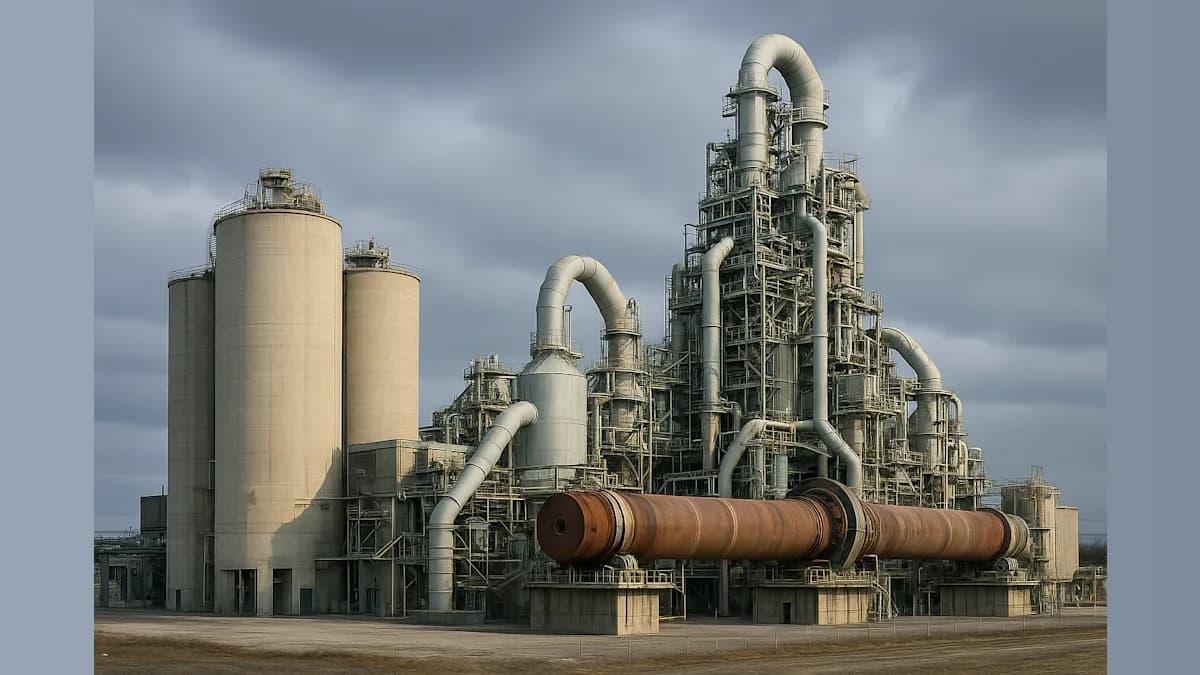
Cement manufacturing, responsible for approximately 4 billion metric tons of carbon dioxide emissions annually, could transition from a major climate problem to part of the solution, according to groundbreaking research from ETH Zurich.
The study reveals how integrating Direct Air Capture technology with cement production could enable the industry to remove more greenhouse gases from the atmosphere than it generates. The research, led by PhD student Vittoria Bolognaro at one of the world's premier engineering institutions, demonstrates that cement kilns could achieve a net-negative carbon footprint under specific operational conditions.
The breakthrough centers on a method called calcium looping, which shares fundamental chemical processes with traditional cement manufacturing. Both operations involve heating limestone to separate carbon dioxide and quicklime through calcination. The ETH Zurich team determined that switching from fossil fuel combustion to electric power could eliminate 78 percent of a cement kiln's carbon emissions.
Researchers partnered with Heirloom Carbon Technologies, a United States company operating commercial-scale calcium looping systems. The collaboration enabled the first prospective life-cycle analysis of this technology at industrial scale. Heirloom has operated a facility in California since 2023 with an annual nominal capacity of 1,000 tons of carbon dioxide removal.
The process exploits limestone's natural carbon absorption properties. After quicklime receives water treatment to become slaked lime, the material draws additional carbon dioxide from the atmosphere and reconverts to limestone. This regenerated limestone then serves as raw material for cement production, creating a continuous cycle. Each repetition of this cycle before final cement processing removes more atmospheric carbon dioxide.
Traditional cement kilns burning oil, coal, or gas introduce heavier elements into emissions that prevent limestone from reabsorbing the carbon dioxide. Electric operation eliminates this contamination problem. The captured atmospheric carbon dioxide does not remain in the finished cement product but instead undergoes compression and transport to underground storage facilities.
The research team examined whether industrial-scale plants could achieve net carbon removal across their entire operational lifecycle while assessing potential environmental tradeoffs in water consumption and land use. Their analysis revealed that energy requirements constitute the largest environmental impact, as extracting carbon dioxide from ambient air demands substantial power input.
To address this challenge, researchers evaluated multiple electricity supply scenarios: the current United States grid mix, a heavily decarbonized system utilizing wind and solar energy, and a fully autonomous configuration with photovoltaics and battery storage. The projections indicate that by 2050, carbon dioxide removal efficiency could range between 85 and 96 percent depending on the energy source employed.
Several uncertainties remain before widespread implementation becomes feasible. The study's core calculations rely on scenarios extending to 2050 that assume substantial electricity grid decarbonization, which may not materialize for various reasons. Additionally, critical components such as electric calcining kilns have not yet entered large-scale industrial deployment.
Economic viability remains an open question, as detailed cost analysis fell outside the current study's scope. Nevertheless, Bolognaro characterized the findings as an important foundation that demonstrates the climate potential of combining these technologies.
The cement industry represents one of the most challenging sectors for decarbonization due to emissions inherent in the chemical transformation of limestone. This research offers a pathway not merely to reduce those emissions but to reverse them entirely, potentially transforming cement plants into carbon removal facilities while maintaining production of a material essential to modern construction and infrastructure.