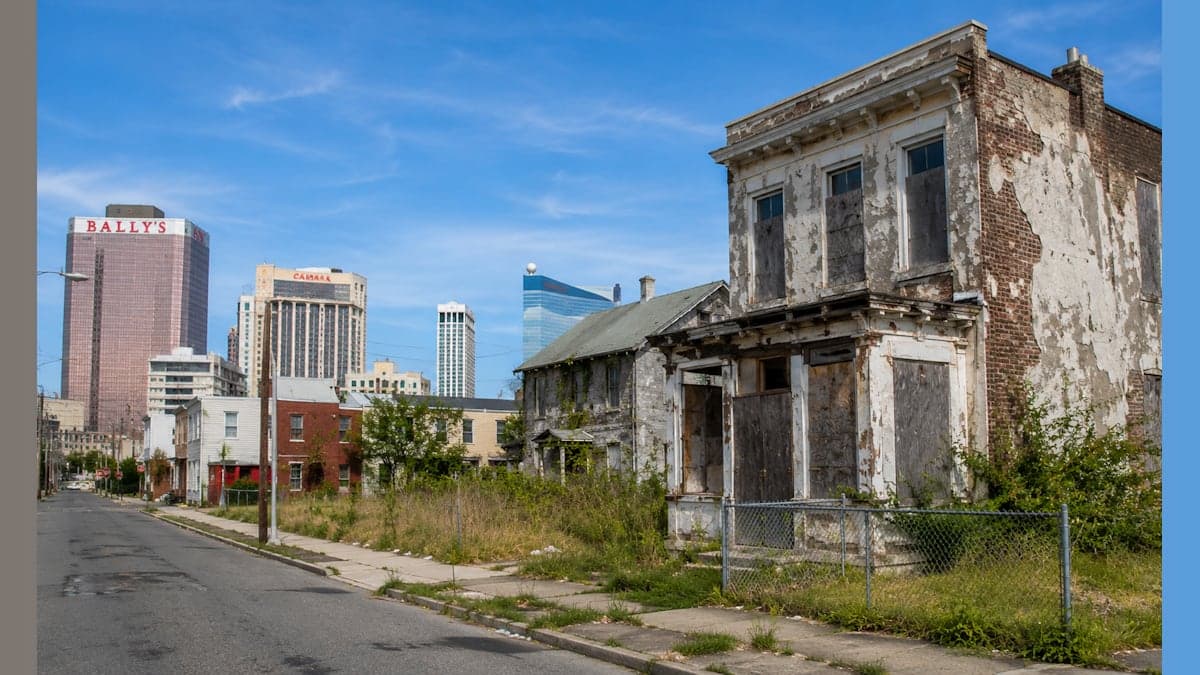
ATLANTIC CITY — Hundreds of abandoned properties remain scattered across Atlantic City, and the head of the Chelsea Economic Development Corporation says getting those buildings back into productive use should be one of the city's highest redevelopment priorities.
Chelsea EDC President Alice Woods discussed the scope of the problem Wednesday during an appearance on Klein Time with Dan Klein on WOND, saying her organization has been working with Atlantic City officials on ways to address vacant and deteriorating properties.

“We've been working with the city of Atlantic City to really address the abandoned properties,” Woods said.
“There are hundreds of abandoned properties in Atlantic City that we need to move. We need to get them activated.”
Chelsea EDC was founded in 2020 as Atlantic City's first community development corporation, according to Woods.
Its territory stretches from Texas Avenue to Annapolis Avenue and from the beach to the bay.
“We do revitalization, housing initiatives, beautification initiatives, events, all kinds of different things, facade things, improvements,” Woods said.
Three additional community development corporations have since been established in Atlantic City, and Woods said the four organizations meet monthly and collaborate on projects.
“We do some events together,” Woods said. “We're trying to do some housing initiatives together. We've been thinking about writing grants together.”
The goal, she said, is “leveraging what each other are doing.”
Four Pacific Avenue Buildings Getting Facade Improvements
One of Chelsea EDC's current projects targets a section of Pacific Avenue.
“We're doing four buildings on Pacific Avenue between Texas and California, redoing the facades there,” Woods said.
“That whole neighborhood is really improving.”
The work includes brick and stone improvements designed to make the buildings more attractive and help activate the surrounding neighborhood.
But Woods said beautifying occupied properties is only one part of the challenge.
Abandoned buildings themselves need to be addressed.
“Our office has kind of been instrumental in helping the city come along with that,” Woods said.
Lou Gasparini, whose Rising Tides Outreach works directly with homeless people on Atlantic City's streets, said deteriorating and abandoned properties create another problem: They become places for homeless people to congregate.

“I've been focusing a lot on that neighborhood and especially the abandoned properties because they are a gathering place for the homeless,” Gasparini said.
“That's where they go. It's shelter.”
Gasparini said that's understandable when someone is living outside and trying to escape bad weather.
“If it's raining, you're going to go where you're getting” shelter, he said.
But Gasparini said entering those buildings can also put people in danger.
“It's also dangerous in those buildings and on those properties,” he said.
Woods: Reactivating Properties Should Be ‘Priority One’
Woods said there are already legal mechanisms that could potentially help Atlantic City address abandoned properties.
“There certainly are tools that the city can use,” Woods said. “There's legislation that is already in place that can help these places.”
Chelsea EDC, she said, has been working with city officials to examine how those tools can be implemented.
“They're actually sending some people to some conferences coming up soon to learn more about that,” Woods said.
For her, the urgency is clear.
“I think the faster we can get abandoned properties reactivated, because as Lou said, they are gathering places — so, yeah, for me, we need to make that priority one.”
The abandoned-property effort is part of a broader attempt to continue improving Chelsea, a neighborhood that includes residences, restaurants, small businesses and Stockton University's Atlantic City campus.
Woods said redevelopment is occurring incrementally rather than through one massive project.
Another example is a park at Dover and Ventnor avenues that Chelsea EDC is preparing to unveil following a makeover.
“We're doing a park redo at Dover and Ventnor, and that's going to be unveiled with a mural, with the Atlantic City Arts Foundation, many partnerships with CRDA,” Woods said.
The former lifeguard boat in the park has been removed to create additional usable space.
“We're going to have more events there,” Woods said. “We're going to have Stockton students come there, a partnership with all the local businesses.”
The unveiling is planned for late September.
Woods said the changes taking place in that portion of Chelsea demonstrate what can happen when individual projects begin building upon one another.
“That whole neighborhood is really a strong neighborhood, too,” she said.
Gasparini agreed that the improvements are becoming noticeable.
“That whole area, little by little, it is getting the face-over,” he said. “It's happening.”
For Woods, that's an important point about revitalizing Atlantic City: It doesn't happen all at once.
“Obviously, folks want to see it happen overnight,” she said, “but it just doesn't happen that way.”

About the Author
Karen Johnson
With over 30 years of news experience in major markets like Los Angeles, Denver, and Columbus, Karen now covers our area for South Jersey NewsBeat. She also brings her articulate and conversational news delivery to WOND radio listeners every weekday. Her background includes work with the NBC Radio Network, and she thrives in fast-paced news environments.