
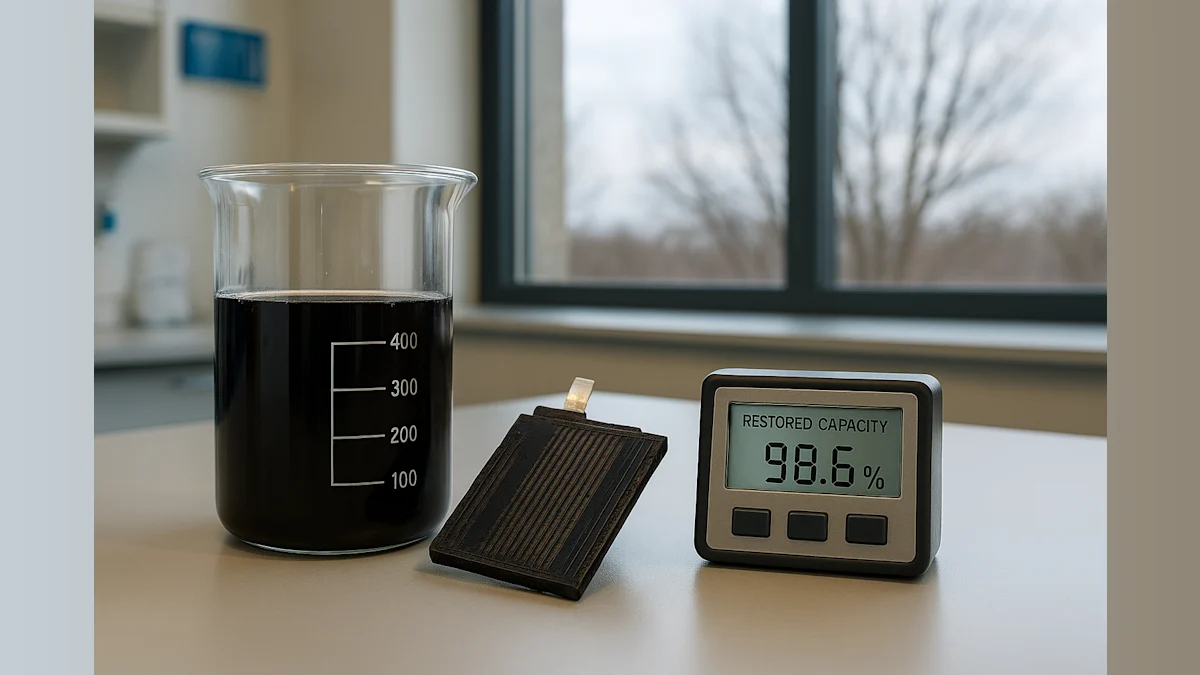
As electric vehicles proliferate across the United States and China, a wave of retired lithium-ion battery packs is heading toward landfills. Many of those packs still hold a charge and discharge at roughly 70 to 80 percent of their original maximum capacity, yet the prevailing industrial response has been to destroy them. Scientists at Cornell University have now demonstrated a less destructive alternative.
The conventional approach, known as pyrometallurgy, begins by shredding batteries into a corrosive mixture. Extreme heat is then applied to isolate cobalt, lithium, nickel, aluminum, and manganese so those materials can be reused. The Cornell team's method, called Direct Electrode-to-Electrode Regeneration, or DEER, takes a different path: it extracts the electrodes from the battery apparatus and treats them in an electrochemical bath.
According to the researchers, electrodes treated this way can recover up to 95 percent of their maximum charge. The mechanism targets the root cause of capacity loss. After many cycles of charging and discharging, a thick layer called solid electrolyte interphase, or SEI, accumulates on the electrodes and restricts the movement of electrons. Immersing the electrodes in a bath of 1,3-dimethyl-2-imidazolidinone, or DMI, strips away that SEI layer. The electrodes, having regained nearly all of their potential, can then be placed back into the battery pack.
Nachiket Mhatre, writing at Slashgear, described the result: "This process not only reverses interphase growth, but also leaves a thin lithium fluoride layer that slows down SEI growth in subsequent cycles."
In testing, batteries cleaned of SEI retained their charge longer than new batteries straight from the factory. When those batteries eventually lost substantial charging potential a second time, another DMI bath restored range again, though the recovery was less pronounced than the first treatment.
The method has limits. Batteries can lose capacity for reasons other than SEI accumulation on the electrodes. If structural damage or lithium loss is the culprit, DEER cannot restore the battery.
Cost is another factor favoring the Cornell approach. DEER runs $15.25 per kilogram of batteries, compared with $26.31 per kilogram for traditional pyrometallurgy. The DMI solution accounts for approximately 62 percent of the total cost, so recovering and reusing that solution in future applications could lower the price further.
The Cornell authors wrote in the study presenting the DEER method: "This electrode-level regeneration framework provides a scalable pathway toward closed-loop battery manufacturing with substantially reduced cost, energy consumption, and greenhouse gas emissions, supporting more sustainable electrification at the system level."