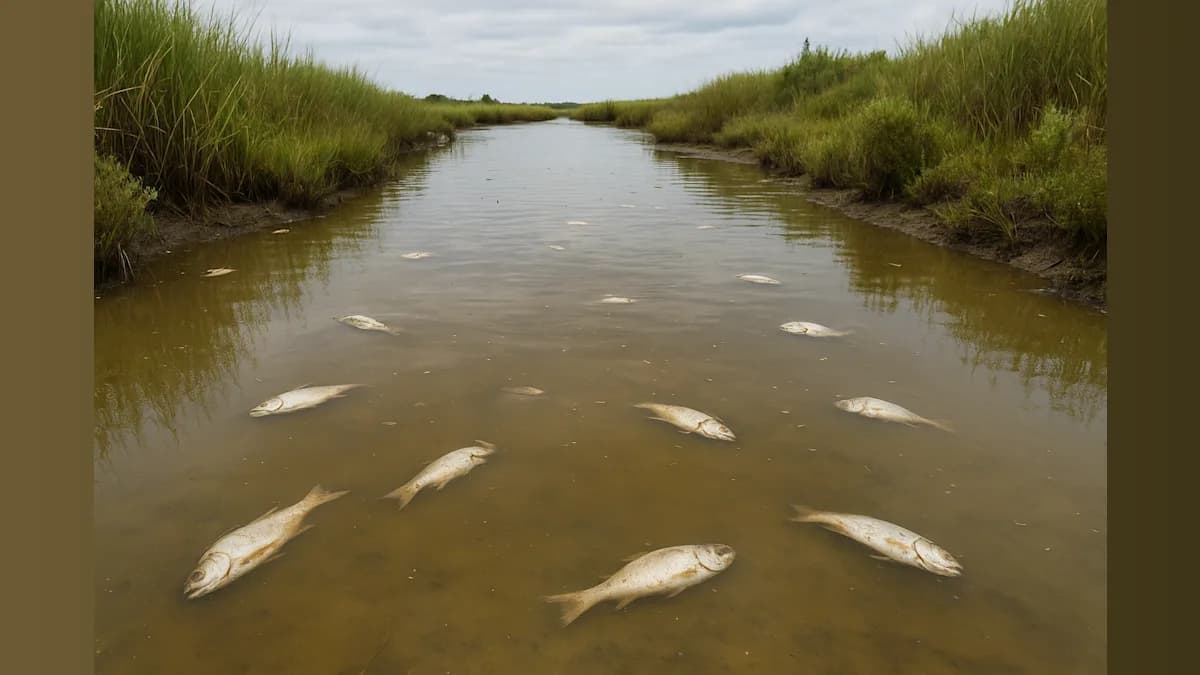
LITTLE EGG HARBOR — Thousands of dead fish are again filling lagoons in Little Egg Harbor Township, creating an overpowering stench and marking what residents say is the fourth fish kill in the local lagoon system since the beginning of summer.
The latest die-off is affecting the Osborn Island section of the township, where thousands of small peanut bunker have died over the past several days.
Residents told NBC10 Philadelphia that this week's event is the largest of the four they have experienced this summer.
For people living along the lagoons, the smell of decomposing fish has become so severe that some are keeping their windows and doors closed despite the August heat.
But while the latest die-off is particularly severe, the problem is not new.
A massive fish kill struck the same general area in July 2024, when tens of thousands of dead fish accumulated in an Osborn Island lagoon. Residents at the time said similar incidents had been occurring multiple times a year.
DEP Points to Warm Water, Low Oxygen
The New Jersey Department of Environmental Protection is not investigating the latest incident, according to a DEP spokesman quoted by NBC10.
State officials say these types of fish kills can occur when warm water, poor circulation and large concentrations of fish combine to reduce dissolved oxygen in the water.
The fish essentially suffocate.
That's similar to what DEP found following the massive 2024 kill.
At the time, DEP Fish & Wildlife said poor water quality caused by warmer temperatures and low dissolved oxygen was responsible for the deaths. State officials characterized that particular event as isolated and said tidal flow would eventually remove most of the dead fish.
Residents, however, were already disputing the idea that the problem was isolated.
One Osborn Island resident told FOX 29 in 2024 that fish kills had been occurring two or three times annually for approximately three years. The July 2024 event was reportedly the second fish kill that month alone.
Now, two summers later, residents say they have experienced four separate kills this summer.
'It Is a Repeating Problem Here'
The head of an environmental organization working in the area says Little Egg Harbor's lagoon system has become a particular trouble spot.
“There are other incidents of fish kills throughout lagoon systems in Barnegat Bay, but I would say this is the worst one,” Save Barnegat Bay Executive Director Britta Forsberg told NBC10. “And it's been a repetitive situation in this particular lagoon system.”
Save Barnegat Bay has been working with Little Egg Harbor Township and homeowners to find a longer-term solution.
Forsberg said the organization is looking at potential grant funding and possible improvements near the mouth of the lagoon.
“But it is a repeating problem here and ultimately turns into a health hazard,” she said.
Resident Says Lagoons Need Dredging
Wuss believes one of the underlying problems is inadequate circulation caused by the condition of the lagoons.
“It really needs to be dredged,” Wuss said. “There's not enough water coming in to keep enough oxygen and flow coming in.”
The concern is that large schools of peanut bunker enter the shallow lagoon system and become vulnerable when warm summer water and poor circulation cause oxygen levels to fall.
The combination can become particularly dangerous during hot weather because warmer water naturally holds less dissolved oxygen.
Wuss said the recurring kills are undermining one of the primary reasons people choose to live along the Shore.
“The whole reason you live down the New Jersey shores [is] to be on the water, and when you can't go out and enjoy the water, I mean, it's really bad,” he told NBC10.
Warning Signs Earlier This Summer
There were also concerns earlier this summer about conditions in the broader Little Egg Harbor-Great Bay ecosystem, although those reports did not establish a connection to the current fish kills.
In June, regional fishing reports described unusually poor fluke fishing in portions of Great Bay and raised possible concerns about water quality and the amount of bait and other marine biomass in the area.
Those observations were from anglers and fishing reports rather than a scientific finding, and they should not be interpreted as evidence that the same conditions caused the lagoon die-offs.
The broader Barnegat Bay-Little Egg Harbor estuary has long been the subject of state and federal research into nutrient loading, water quality and ecosystem health. NJDEP continues to study nutrient enrichment and its effects on the estuary, while the U.S. Geological Survey has conducted modeling and research designed to help guide restoration and water-quality management.
Similar Scene in 2024
The current situation bears striking similarities to what residents experienced two years ago.
During the July 2024 event, dead fish became so densely packed in portions of the lagoon that aerial photographs made the surface appear covered by a solid mass.
Residents complained that the odor penetrated their homes, while large numbers of seagulls descended on the neighborhood to feed on the fish.
Some residents said they couldn't comfortably spend time outside.
Two years later, many of the same complaints have returned.
This time, however, the frequency is adding urgency to calls for a more permanent solution.
Little Egg Harbor has applied for grant funding to investigate potential improvements, according to information provided to NBC10. Save Barnegat Bay said it is also working with township officials and homeowners on possible solutions.
The township is reportedly not removing the dead fish because of insurance issues. A local commercial fisherman has volunteered to assist with providing some relief, according to Save Barnegat Bay.
For residents dealing with their fourth reported fish kill of the summer, the larger concern is no longer simply how to clean up the latest round of dead bunker.
It's what can be done to prevent a fifth.

About the Author
Karen Johnson
With over 30 years of news experience in major markets like Los Angeles, Denver, and Columbus, Karen now covers our area for South Jersey NewsBeat. She also brings her articulate and conversational news delivery to WOND radio listeners every weekday. Her background includes work with the NBC Radio Network, and she thrives in fast-paced news environments.