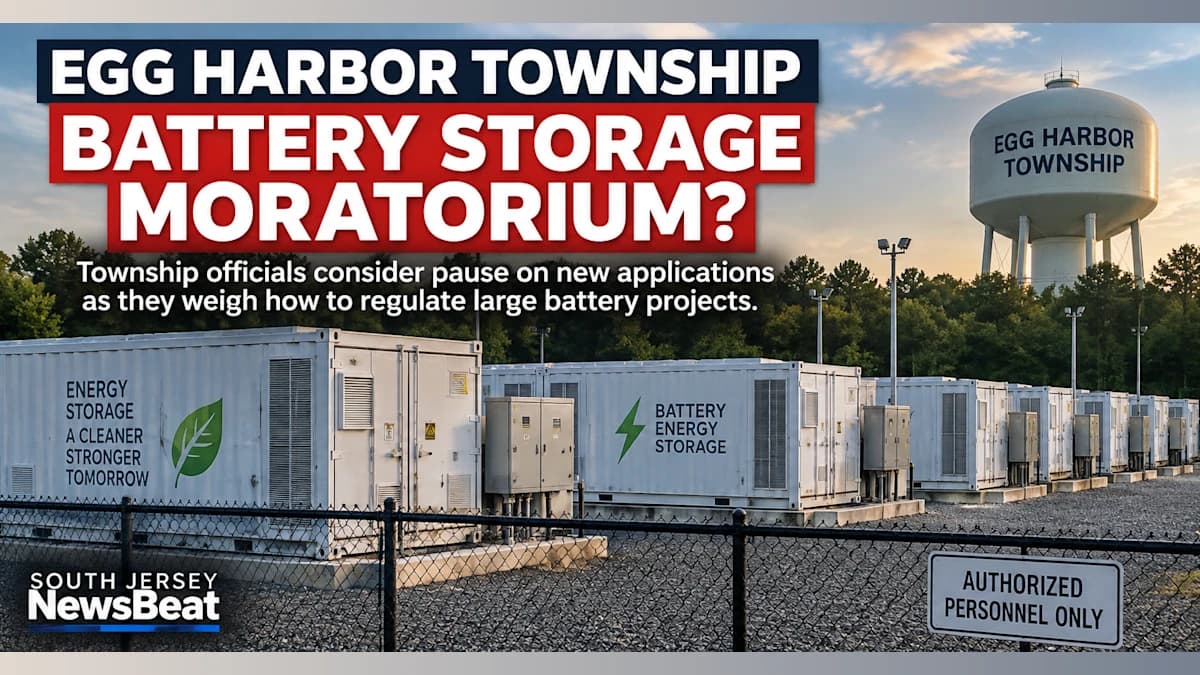
EGG HARBOR TOWNSHIP — Egg Harbor Township officials are considering temporarily shutting the door on new applications for large battery energy storage projects while the township determines how — and where — the rapidly expanding technology should be permitted.
The Township Committee is scheduled to consider a resolution Wednesday imposing a moratorium on the acceptance of applications for battery energy storage systems, commonly known as BESS.
The proposed pause comes after weeks of local discussion over how Egg Harbor Township should regulate large battery installations, which store electricity and release it when demand on the power grid increases.
The issue has moved quickly.
In August, township officials introduced Ordinance 23, which would amend Egg Harbor Township's zoning regulations to specifically address battery energy storage systems.
According to a report on the Aug. 12 Township Committee meeting, the proposal would prohibit BESS facilities in the township's conventional zoning districts and restrict them to township-owned property, subject to safety requirements and setbacks.
Committeeman Paul Hodson said at the time there had been interest in developing battery-storage facilities in Egg Harbor Township.
The New Jersey Pinelands Commission confirms that it received Egg Harbor Township's draft Ordinance 23 on Aug. 13. The commission lists the ordinance as an amendment to the township zoning code adding regulations for battery energy storage systems and amending prohibited uses.
As of Wednesday morning, the Pinelands Commission lists the ordinance's status as “pending local adoption and submission.”
Special meeting held last week
The issue received additional scrutiny last week.
Egg Harbor Township called a special Township Committee meeting for Sept. 10 devoted primarily to discussion of battery energy storage regulations.
That unusual afternoon meeting came less than a week before the proposed moratorium is scheduled to be considered.
The township has not publicly identified a specific battery-storage development as the reason for the proposed pause, and South Jersey NewsBeat found no documentation Wednesday morning establishing that a particular project prompted the action.
However, the sequence — introduction of a new zoning ordinance in August, a special meeting devoted to battery storage last week and consideration of an application moratorium Wednesday — shows township officials are taking a closer look at how large storage facilities should be handled before additional proposals move forward.
New Jersey pushing for more battery storage
The local discussion comes as New Jersey is simultaneously accelerating battery-storage development statewide.
The state has established a goal of 2,000 megawatts of energy storage by 2030 through the Garden State Energy Storage Program.
In March, the New Jersey Board of Public Utilities awarded incentives to three large-scale battery projects totaling 355 megawatts and opened another solicitation for 645 megawatts of storage.
State officials say large batteries can store electricity when it is plentiful and return it to the grid during periods of high demand, increasing reliability and potentially reducing wholesale electricity costs.
Gov. Mikie Sherrill has also made additional energy generation and storage part of her administration's response to high electric costs. In March, she signed legislation intended to accelerate the state's storage program and expand the pool of projects eligible for incentives.
Last month, the BPU moved ahead with another approximately 150 megawatts of distributed storage as part of the program's next phase.
Safety among issues surrounding large batteries
Large battery installations have also prompted local debates over fire safety, emergency response, setbacks and appropriate locations.
The BPU itself has acknowledged those concerns. In its rulemaking for New Jersey's storage program, the agency said large-scale systems can present risks including thermal runaway, chemical exposure, fire and electrical hazards if they are not properly designed, operated and maintained.
The agency also said those risks can be addressed through proper installation, monitoring, inspections, maintenance, trained personnel, emergency-response plans and fire-suppression systems.
Those concerns have become increasingly relevant as the state attempts to dramatically expand storage capacity.
Egg Harbor Township's existing zoning ordinance already regulates other large energy uses. For example, power-generating facilities are permitted under certain conditions on properties of at least 25 acres, while large ground-mounted solar arrays have their own lot-size, setback and landscaping requirements.
Battery storage, however, presents a relatively new land-use question.
Decision could come Wednesday
The Township Committee's regular meeting is scheduled for 5 p.m. Wednesday at the Egg Harbor Township Municipal Building.
If approved, the moratorium would give township officials additional time to determine how battery-storage applications should be handled while the municipality works through its proposed regulations.
The duration and precise scope of the proposed moratorium should become clearer when the resolution is considered Wednesday.
South Jersey NewsBeat will update this story following the Township Committee's action.

About the Author
Karen Johnson
With over 30 years of news experience in major markets like Los Angeles, Denver, and Columbus, Karen now covers our area for South Jersey NewsBeat. She also brings her articulate and conversational news delivery to WOND radio listeners every weekday. Her background includes work with the NBC Radio Network, and she thrives in fast-paced news environments.