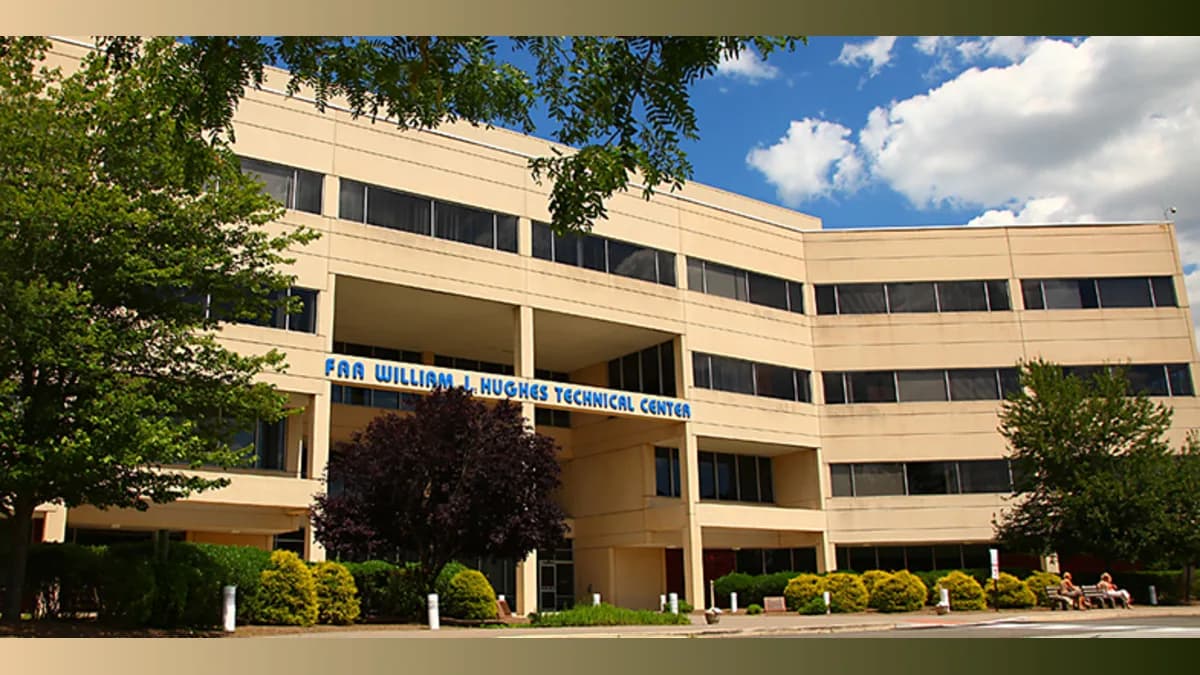
EGG HARBOR TOWNSHIP — About 4,500 people report to work each day at the sprawling federal aviation campus surrounding Atlantic City International Airport, but its impact on the South Jersey economy extends far beyond the gates.
Retired Col. Jon Schliefer says the broader economic activity generated by the campus supports more than 9,000 full-time jobs, making the federal aviation complex one of Atlantic County's most significant economic engines.
Schliefer joined Dr. Eric Niederman, director of the William J. Hughes FAA Technical Center, Saturday on The Gabe Staino Show on WOND for a wide-ranging discussion about the facility, aviation technology and its role in the South Jersey economy.
“On a given day, around 4,500 people come inside the fence,” Schliefer said. “But the economic trickle-out effect, there's actually over 9,000 full-time jobs because of those 4,500 people and supporting those activities.”
A 5,000-Acre Campus
The size and scope of the operation can be surprising even to longtime South Jersey residents.
The federal campus encompasses approximately 5,000 acres, Niederman said — roughly the size of a small town.
And the FAA Technical Center is just one part of it.
“We have a number — not only the FAA — we have the Air National Guard, Jersey Devils, the Transportation Security Lab, which is part of Department of Homeland Security, the Atlantic City Coast Guard Rescue Station,” Niederman said.
The campus also includes the U.S. Marshals Service, Federal Air Marshals, Transportation Security Administration's canine detection program, Army Corps of Engineers, Atlantic City International Airport and the National Aerospace Research and Technology Park.
The airport itself serves a dual role as an operating commercial airport and as “a research and development airport and a smart airport technology testbed,” Niederman said.
Federal Investment Ripples Through Local Economy
Schliefer said the economic impact isn't limited to the scientists, engineers, air traffic experts and other federal employees working on the campus.
He pointed to a recent expansion associated with the modernization of the nation's air traffic control system.
“The largest laboratory expansion has occurred within the last 12 months as it relates to this brand new air traffic control system, specifically with the voice system,” Schliefer said.
Creating that laboratory required much more than FAA engineers.
“Somebody had to build this new laboratory,” Schliefer said. “Somebody had to put up the glass walls in the server room. Somebody had to build the slat wall. Somebody had to put in the carpet, the electric.”
“All that stuff is felt in our local economy as that work is accomplished,” he said.
Schliefer also pointed to construction at the 177th Fighter Wing as another example.
“That's not out-of-state jobs,” he said. “That's right here.”
‘There Is a Job on Our Campus for You’
One misconception Niederman and Schliefer want to dispel is that someone needs to be a pilot, air traffic controller or aerospace engineer to build a career in aviation.
Schliefer said the campus employs people with an enormous range of skills.
“There's something for everyone, right?” he said. “You're a graphics designer. You're an environmentalist. Are you a computer scientist? Whatever. Guaranteed, there is a job on our campus for you.”
“And if it's not on our campus, that trickle-out effect for those other jobs, ancillary jobs and support, it's absolutely there.”
Niederman echoed that message.
The Technical Center alone has employees representing every engineering discipline, he said, but its workforce extends well beyond engineering.
“We have a fantastic metal shop. We have a master carpenter on the staff. We have accountants,” Niederman said.
“We have lawyers, just such a range.”
There are even aviation careers connected to medicine.
Niederman said the FAA has federal flight surgeons who certify pilots and experts who study crash dynamics and ways to make accidents more survivable.
“So there's such a range of opportunities,” he said. “Our challenge is to expose students and let them know what the possibilities are and why they can really make a contribution.”
Building the Next Generation of South Jersey's Aviation Workforce
That effort starts early.
Niederman said the Technical Center's aviation STEM outreach stretches from kindergarten through graduate school and postdoctoral programs.
The center also runs a monthly mentoring program in which every high school in Atlantic County is represented, including some homeschooled students.
Participants visit monthly and learn about different aspects of aviation, including airport rescue and firefighting, materials science and air traffic control.
The program also reaches into classrooms.
Schliefer said the Tech Center's STEM program reaches more than 8,800 students in an average year.
“We reach out to over 8,800 students a year when we bring them on,” Schliefer said. “We do everything we can to show engagement and get them aligned to their talents and skill sets.”
More than 100 FAA STEM ambassadors also visit classrooms to expose students to aerospace-related subjects, he said.
Niederman said the goal isn't simply to teach children about airplanes. It's to show them that aviation encompasses far more career paths than they may realize.
“A lot of times when students think about aviation, they think about maybe a pilot, maybe an air traffic controller in a tower, maybe a flight attendant,” Niederman said. “They don't realize all the other types of jobs.”
A South Jersey Facility With National Impact
The William J. Hughes Technical Center has operated in Atlantic County since 1958 and has played a role in generations of aviation safety and technology advancements.
Niederman said the work happening behind the gates often goes unnoticed even by people who have lived nearby for decades.
He knows from experience.
Niederman grew up in Philadelphia and loved aviation as a child, but said he had no idea the Technical Center existed.
Today, thousands of people work on the campus every day, thousands more jobs are supported by its economic activity and technology developed and tested there eventually affects air travelers across the country.
Niederman said that's one of the things that makes him proudest about leading the Technical Center.
“Just the passion of the people that we have, their proficiency, their expertise, and just all the contributions that I don't think people recognize,” Niederman said.
“I'm just incredibly proud of the safety record that we have and the things that we're doing to advance transportation and advance the country.”

About the Author
Peter Killeen
A 25-year radio news veteran, Peter covers South Jersey for NewsTalk 1400 & 92.3 WOND radio. Known for his concise and impactful delivery, he ensures listeners and readers stay informed without unnecessary filler.