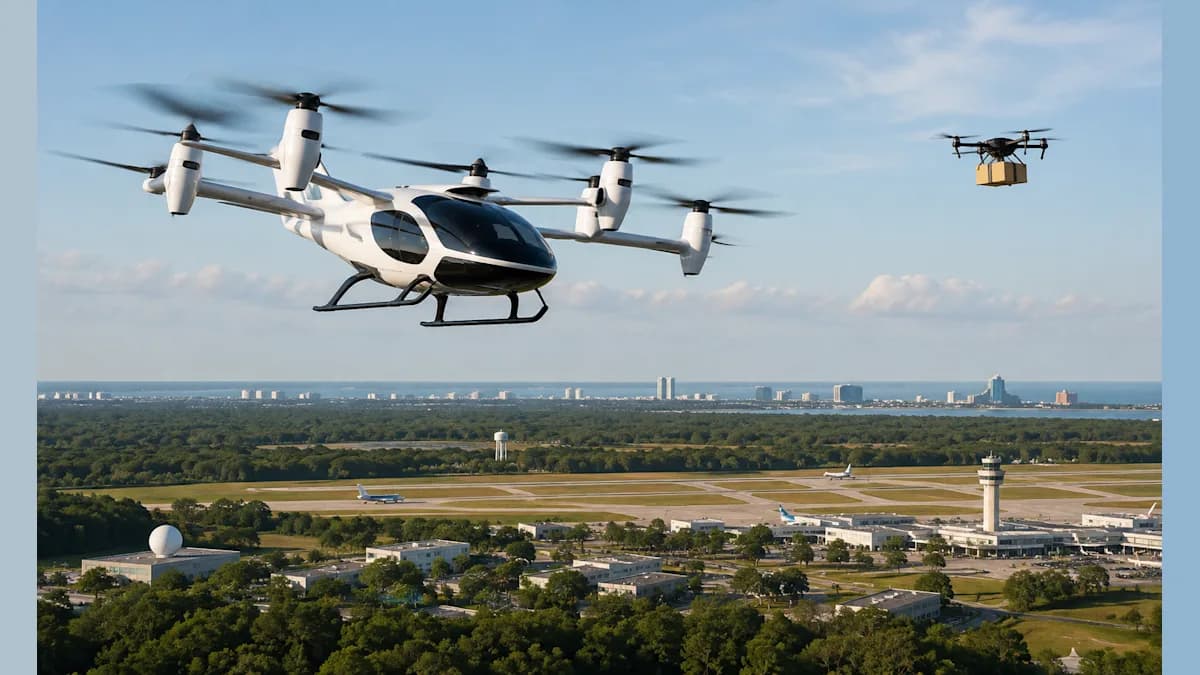
EGG HARBOR TOWNSHIP — Flying taxis carrying passengers above traffic. Drones delivering medicine or packages to your doorstep within an hour. Air traffic controllers managing airports using cameras and digital displays instead of relying solely on the view from a traditional tower.
It may sound like science fiction, but some of the technology expected to transform American aviation is already being tested and evaluated at the William J. Hughes FAA Technical Center in Atlantic County.
Dr. Eric Niederman, director of the FAA Technical Center, and retired Col. Jon Schliefer discussed the rapidly changing future of aviation Saturday on The Gabe Staino Show on WOND, describing a transportation system that could look dramatically different within the next several years.
Niederman said the Technical Center has been involved in virtually every major advancement in American aviation for nearly seven decades.
“We've been, really, since 1958, a couple months older than the FAA itself,” Niederman said. “Every single aviation innovation, safety improvement, advancement in the air traffic control system has been either developed, conceptualized, tested, matured, fielded, and then we support the technology once it's in the field.”
And what's coming next could be among the biggest changes yet.
‘Flying Ubers’ Could Change Transportation
Asked what he sees as the most important developments over the next five to seven years, Niederman quickly pointed to electric air taxis.
“I think air taxis, this idea of sort of flying Ubers,” Niederman said. “If you remember the Jetsons, you know, it's sort of what the metaphor is.”
The aircraft, commonly known as electric vertical takeoff and landing aircraft, or eVTOLs, use multiple rotors and are being designed to transport small numbers of passengers.
“There are multi-rotors, like eight rotors,” Niederman said. “They can hold four to six people. They take off vertically. They're electric. They're very quiet.”
Niederman believes their impact could extend far beyond aviation.
“I think that's really going to change transportation,” he said. “It is going to change aviation.”
Then he went further.
“I think it is really possibly going to change the world if you think about how the car changed the U.S. and our society,” Niederman said.
The aircraft could supplement existing forms of transportation rather than simply replace helicopters or other services, Niederman said.
“I think it's going to be just an expansion of the transportation system and the options,” he said.
Drone Delivery Could Be Even Closer
While passenger air taxis may attract more attention, Schliefer said smaller unmanned aircraft could produce changes consumers experience much sooner.
“The use of small drones, small UASs in the future” will affect consumers, Schliefer said.
One obvious application is delivery.
“Package delivery service is what you can anticipate,” he said.
That could include everything from ordinary purchases to medicine.
“It isn't a leap, right, to believe that within one hour from you ordering something on your phone, it arrives at your house,” Schliefer said. “So now is that going to be with a standard driver or is that going to be with a small UAS that drops it off in your driveway?”
And Schliefer offered a striking prediction about how soon that could become commonplace.
“That's something that's absolutely a reality that could happen within the next five years easily.”
But Who Controls All That Traffic?
Adding potentially thousands of drones and air taxis to the sky creates another problem: how to safely manage them alongside traditional aircraft.
Niederman said that is precisely the kind of challenge facing the FAA.
“As there's more traffic, more drones at a low altitude, as there's air taxis sort of between 400 feet where commercial airlines are flying and there's more commercial airline operations and then there's a whole bunch of things at high altitude like supersonic aircraft and flying dirigibles that can loiter and then commercial space operations,” Niederman said, the question becomes how all of them safely share the airspace.
“How do we make sure that all these things have access to the national airspace and that we maintain the unprecedented level of safety?” he said. “That is absolutely the mission of the Tech Center and the mission of the agency.”
New technologies including artificial intelligence, edge computing and advanced surveillance systems could be part of the answer.
“We have a system that really started before radar,” Niederman said, noting that early aviators once navigated using bonfires on the ground.
“Then we went to radar. Now we've gone to satellite systems and now we're thinking what's the next level? How do we use edge computing? How do we use artificial intelligence? How do we use new types of surveillance systems?”
Digital Air Traffic Control Towers Already Being Tested
One futuristic technology isn't years away at the FAA Technical Center.
It's being tested now.
Schliefer described digital or remote towers, where cameras and digital technology can provide air traffic controllers with views of an airport rather than requiring controllers to rely exclusively on windows in a conventional brick-and-mortar tower.
“Think of a remote tower, right, like a camera on a stand,” Schliefer said.
The technology could potentially be used at airports that don't currently have conventional control towers or as a supplement to existing towers.
“We're testing those things right now, this very moment on our campus,” Schliefer said.
Niederman said digital towers could improve safety at airports that currently don't have towers.
“If we could install that, for instance, in an airport that doesn't currently have a tower, now we have a safer operation,” he said.
Schliefer emphasized that the technology isn't designed to eliminate the human air traffic controller.
“All these technologies, they're tools, right?” he said. “And it's not replacing an air traffic controller or a human. It's a tool in their toolkit to do their job better so that the American public can fly safer.”
Aviation's Future, Developed in Atlantic County
For Niederman and Schliefer, much of what sounds futuristic to the public has been discussed and studied for years inside the Technical Center.
“We're in this third revolution of innovation,” Schliefer said.
And much of that revolution is taking shape behind the gates of a sprawling federal complex that thousands of South Jersey residents drive past without realizing what happens inside.
Niederman admitted he once had no idea himself.
He grew up in Philadelphia with a fascination for airplanes but said he didn't know the Technical Center existed.
“There's just so much work that's done, and so much of it is just heads-down, hands-on work,” Niederman said.
Today, he runs the facility helping determine how some of the most futuristic ideas in transportation can safely become reality.

About the Author
Peter Killeen
A 25-year radio news veteran, Peter covers South Jersey for NewsTalk 1400 & 92.3 WOND radio. Known for his concise and impactful delivery, he ensures listeners and readers stay informed without unnecessary filler.