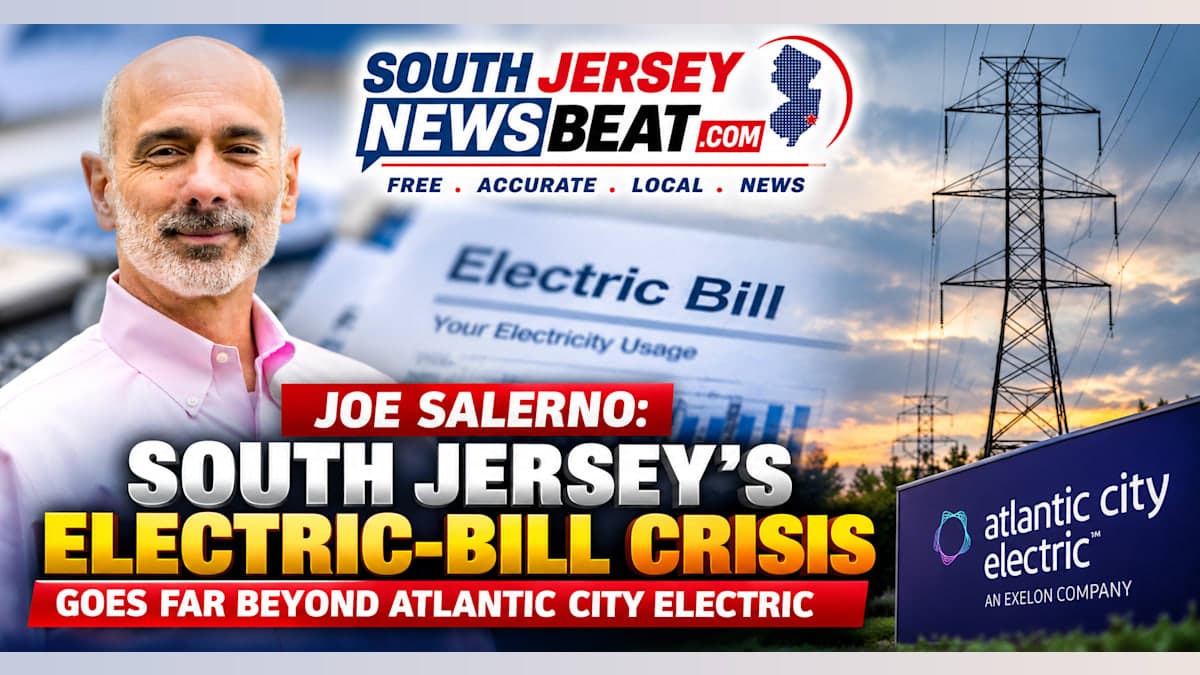
Joe Salerno challenges Rep. Jeff Van Drew's approach to rising electric bills as a state investigation confirms that power shortages and the regional electricity market are driving costs higher.
ATLANTIC COUNTY, N.J. — As South Jersey residents continue struggling with high electric bills, former congressional candidate Joe Salerno says the region's energy crisis cannot be explained simply by blaming Atlantic City Electric, its smart meters or the utility's billing practices.
Salerno, a Democrat who unsuccessfully challenged U.S. Rep. Jeff Van Drew in 2024, offered a detailed examination of the electricity market during an October 28 appearance on Off The Press with Scott Cronick on News Talk 1400 & 92.3 WOND.
His central argument: New Jersey and the broader Mid-Atlantic region have failed to develop enough electricity generation to keep pace with growing demand, creating shortages that are pushing wholesale electricity costs higher.
"The fundamental reason our rates are up is because we don't have enough supply to meet rising demand, especially local supply," Salerno said.
The argument is supported in significant respects by a major New Jersey Board of Public Utilities investigation released in August, which concluded that the regional electricity market is struggling to deliver reliable power at affordable prices.
But Salerno's criticism of the political response also comes against a complicated backdrop: A federal audit released earlier this year found actual accounting violations and transmission overbilling by Atlantic City Electric, although regulators have not established that those findings explain the sharp increases in household bills.
Together, those developments highlight two distinct questions facing South Jersey residents: Why has electricity become so expensive, and has their utility charged them correctly?
Salerno Challenges Van Drew's Approach
During the interview, Salerno criticized Van Drew's repeated attacks on Atlantic City Electric and his emphasis on smart meters and alleged billing irregularities.
Salerno argued that focusing primarily on the utility has distracted residents from the larger electricity supply problem.
"No one's apologizing for higher electric rates," Salerno said. "I mean, the rates are up 50% since 21."
That cumulative figure was Salerno's estimate and was not independently established during the interview.
He said the more important issue is identifying the structural causes of higher prices rather than offering voters a single company to blame.
"The easy story is Atlantic City Electric ripped you off," Salerno said.
He accused Van Drew of using public frustration with electricity bills for political advantage.
"He finds a grievance, right? Then he finds a scapegoat and then he attacks that scapegoat and pounds his chest that I'm your champion," Salerno said.
Those comments represent Salerno's political assessment, not an established finding about Van Drew's motives.
Van Drew has maintained that his investigations and public criticism are necessary because constituents have reported unexpectedly high bills, disputed electricity usage and concerns about smart meters.
The congressman has repeatedly pressed Atlantic City Electric and federal regulators for answers.
During an October 26 appearance on The Don Williams Show on WOND, Van Drew defended his efforts and pointed to the federal audit as evidence that the utility had engaged in improper practices.
"They were caught cheating. They were caught breaking the law because of the audit I asked," Van Drew said during that interview.
The audit did identify accounting violations and overbilling at the transmission level, but it did not establish that Atlantic City Electric's residential smart meters were inaccurate or that those violations caused the broader surge in household electricity bills.
State Investigation Supports the Supply-and-Demand Argument
Salerno's explanation is consistent with several major findings in an August 2026 report from the New Jersey Board of Public Utilities.
The report, titled An Investigation of PJM's Capacity Market, examined the electricity market operated by PJM Interconnection, which coordinates wholesale electricity and grid reliability across 13 states and the District of Columbia.
The state concluded that PJM's current market structure is failing to attract new electricity generation quickly enough while protecting customers from extreme price increases.
According to the report, PJM's capacity auction prices climbed from $28.92 per megawatt-day for the 2024-25 delivery year to $269.92 for 2025-26.
They rose further to $329.17 for 2026-27 and $333.44 for 2027-28 before reaching $325 for 2028-29 under a temporary price cap.
Those figures are wholesale capacity-market prices, not the per-kilowatt-hour rates appearing directly on residential electric bills.
Nevertheless, the increases have significant implications for consumers.
The Board of Public Utilities says capacity costs account for approximately 15% to 20% of a typical customer's electricity bill.
The agency also reported that New Jersey electricity bills increased approximately 20% in 2025, driven substantially by rising costs in PJM's capacity market.
"New Jersey ratepayers deserve a clear explanation of why their bills are rising and what can be done about it," BPU President Ben Hertz-Shargel said when the report was released.
"The fastest way to lower bills is getting new power generation built."
That conclusion closely resembles Salerno's central argument.
Why Electricity Costs Are Rising
During the WOND interview, Salerno explained that New Jersey's electricity system operates through a competitive wholesale market.
Power generators sell electricity into a regional system, while utilities such as Atlantic City Electric deliver that electricity to homes and businesses.
Electric bills reflect several categories of costs, including generation, transmission and distribution.
Salerno focused particularly on PJM's capacity market.
Unlike the market for electricity being consumed at a particular moment, the capacity market pays power suppliers to commit resources that will be available during future periods of high demand.
Those commitments are intended to ensure that enough generation exists to keep the lights on during heat waves and other stressful conditions.
But when demand grows faster than the available supply, the price of securing that capacity rises.
PJM's own July 2026 auction results reinforced that concern.
The regional grid operator reported that its latest auction secured approximately 6,831 megawatts less than its reliability requirement for the 2028-29 delivery year.
PJM cautioned that the shortfall does not mean widespread outages are inevitable, but it leaves the system with less protection against unexpected conditions.
The grid operator also acknowledged that electricity demand continues to grow faster than supply.
Salerno said the current market structure creates another problem: Power companies contemplating multibillion-dollar generating facilities need confidence that they will earn sufficient revenue over many years.
Short-term capacity commitments may not provide that certainty.
The New Jersey BPU reached a similar conclusion, recommending expanded opportunities for longer-term contracts to encourage investment in new power generation.
Data Centers Add to the Pressure
One factor receiving increased attention from regulators is the rapid growth of data centers, particularly facilities supporting artificial intelligence and other computing operations.
PJM's forecasts anticipate substantially higher electricity demand across the region in the coming decades.
According to the August BPU report, PJM projected summer peak demand rising from approximately 156 gigawatts in 2026 to 183 gigawatts by 2030.
The report identified data center development as a major contributor to the expected increase.
That growing demand creates competition for available generation capacity.
New Jersey regulators have recommended that large new electricity users bear more responsibility for the costs they create rather than shifting those expenses to existing residential and business customers.
The state has also taken legislative steps aimed at protecting ratepayers from infrastructure costs associated with major new electricity users.
For South Jersey households, the concern is straightforward: Even residents who never use a data center can be affected by higher regional electricity prices if new demand grows faster than the supply needed to serve it.
Power Plant Closures Also Enter the Debate
Salerno also pointed to the retirement of electricity-generating facilities, including the former B.L. England plant in Upper Township and the Oyster Creek nuclear generating station in Ocean County.
He argued that the loss of existing generation, combined with difficulties building replacement facilities, has contributed to New Jersey's energy challenges.
Salerno discussed past efforts by former Gov. Chris Christie and former state Senate President Steve Sweeney to encourage new electricity generation through programs supporting natural gas plants and offshore wind development.
He said the state failed to maintain an adequate balance between retiring older facilities and bringing new resources online.
Those decisions span multiple administrations and involve economic, environmental, regulatory and legal considerations.
It would be inaccurate to attribute the current electricity shortage exclusively to one governor, political party or energy policy.
The BPU's August report identified several overlapping problems, including barriers to developing new generation, uncertainty surrounding future demand and weaknesses in PJM's market structure.
Salerno also questioned whether proposed small modular nuclear reactors could provide meaningful near-term relief.
South Jersey NewsBeat previously reported on Holtec International's proposal to develop new nuclear reactors at the former Oyster Creek site.
That proposal could eventually add substantial generation capacity, but it remains a long-term undertaking requiring regulatory approvals, financing and construction.
It does not offer an immediate solution to residents' current electric bills.
What About Atlantic City Electric's Federal Audit?
Although Salerno believes the supply crisis deserves more attention, Atlantic City Electric has faced legitimate scrutiny over its financial practices.
As South Jersey NewsBeat previously reported, a Federal Energy Regulatory Commission audit covering 2021 through 2025 identified five areas of noncompliance and issued 22 recommendations.
Federal auditors found that the utility improperly accounted for certain employment-discrimination settlement payments, overstating its transmission revenue requirement and overbilling transmission customers.
A separate finding involving materials and supplies also raised the possibility of additional transmission overbilling.
The audit required further analysis to determine financial impacts and potential refunds.
However, the findings did not establish that every residential customer was overcharged, did not identify a specific residential refund amount and did not determine that smart meters were responsible for higher household bills.
Atlantic City Electric has accepted the audit recommendations and said it is completing the required analysis.
The company has also emphasized that the federal review concerned transmission accounting and did not directly determine whether residential electric bills were improperly calculated.
That distinction matters.
The fact that wholesale electricity prices have risen does not excuse improper utility accounting.
Likewise, the existence of accounting violations does not prove that those violations caused the much larger increases customers have experienced in recent years.
Both issues can be real without being the same problem.
Nor'Easter Nick Previously Challenged the Weather Explanation
South Jersey NewsBeat's earlier reporting also documented concerns raised by meteorologist Nor'Easter Nick Pittman, who has spent years questioning Atlantic City Electric's explanations for higher bills.
Pittman previously told South Jersey NewsBeat that he compared historical temperature records with customers' electric bills and disputed suggestions that unusually hot weather could fully explain the increases.
"I found that bills, in some cases, were 50% less several years ago when it was actually hotter," Pittman said.
He also cautioned against interpreting the federal audit as a promise of substantial residential refunds.
"It's unclear if residential bills are impacted and it seems extremely limited in scope," Pittman said of the audit.
Salerno offered a different interpretation of the weather issue during Wednesday's interview, arguing that higher electricity rates combined with increased air-conditioning use can produce especially large bill increases.
Weather can influence how much electricity a household consumes, while wholesale prices and regulated charges influence how much that electricity costs.
Determining what caused an individual customer's bill to rise requires examining both usage and rates.
Neither Salerno's general explanation nor Pittman's analysis establishes the cause of every disputed residential bill.
Salerno Acknowledges Van Drew Has Delivered for South Jersey
Despite his sharp criticism of Van Drew's handling of electricity issues, Salerno acknowledged that the congressman has helped secure federal resources for the district.
"I don't think anybody can reasonably say that he's not good at bringing money back to the district," Salerno said.
Later in the interview, Salerno also credited Van Drew's involvement with the Atlantic City Housing Authority and federal funding for Atlantic City road improvements.
His criticism centered less on whether Van Drew has accomplished anything for South Jersey and more on whether the congressman's approach to the electricity crisis addresses its underlying causes.
Van Drew has argued that federal oversight and public pressure are necessary to hold Atlantic City Electric accountable and protect customers.
Salerno contends that the more lasting solution requires changes to how electricity is generated, purchased and planned for across the region.
What Would Actually Lower Electric Bills?
New Jersey regulators have identified several potential reforms.
The Board of Public Utilities is calling for changes to PJM's capacity market, including longer-term investment arrangements that could encourage new generating facilities.
The state also wants stronger protections preventing large new electricity users from transferring disproportionate costs to existing customers.
PJM has been working on reforms intended to accelerate new generation and address its projected reliability shortfalls.
New Jersey's February 2026 electricity auction produced relatively stable supply-rate expectations for the new service period beginning June 1, although that does not erase the increases customers experienced previously or guarantee that every household's total bill will remain unchanged.
The state's broader challenge is finding ways to increase supply, manage demand and contain costs without compromising reliability.
For Salerno, that is the conversation he believes South Jersey should be having.
"We have not built enough electricity generation and we needed to fix it," he said.
He also criticized both major political parties for focusing on blame rather than solutions.
"It became clear by 2022 and yet we decided it's better to fight, better for Democrats to point at Republicans and Republicans to point at Democrats than to solve problems for residents," Salerno said.
For the hundreds of thousands of South Jersey households served by Atlantic City Electric, the immediate question remains when those broader reforms — and the ongoing scrutiny of the utility itself — will translate into meaningful relief on monthly bills.
Joe Salerno appeared October 28 on Off The Press with Scott Cronick, airing weekdays from 4 to 6 p.m. on News Talk 1400 & 92.3 WOND.

About the Author
Peter Killeen
A 25-year radio news veteran, Peter covers South Jersey for NewsTalk 1400 & 92.3 WOND radio. Known for his concise and impactful delivery, he ensures listeners and readers stay informed without unnecessary filler.