Former Atlantic City mayor says his campaign documented suspicious ballot activity years before Craig Callaway was convicted in a separate federal election fraud case.
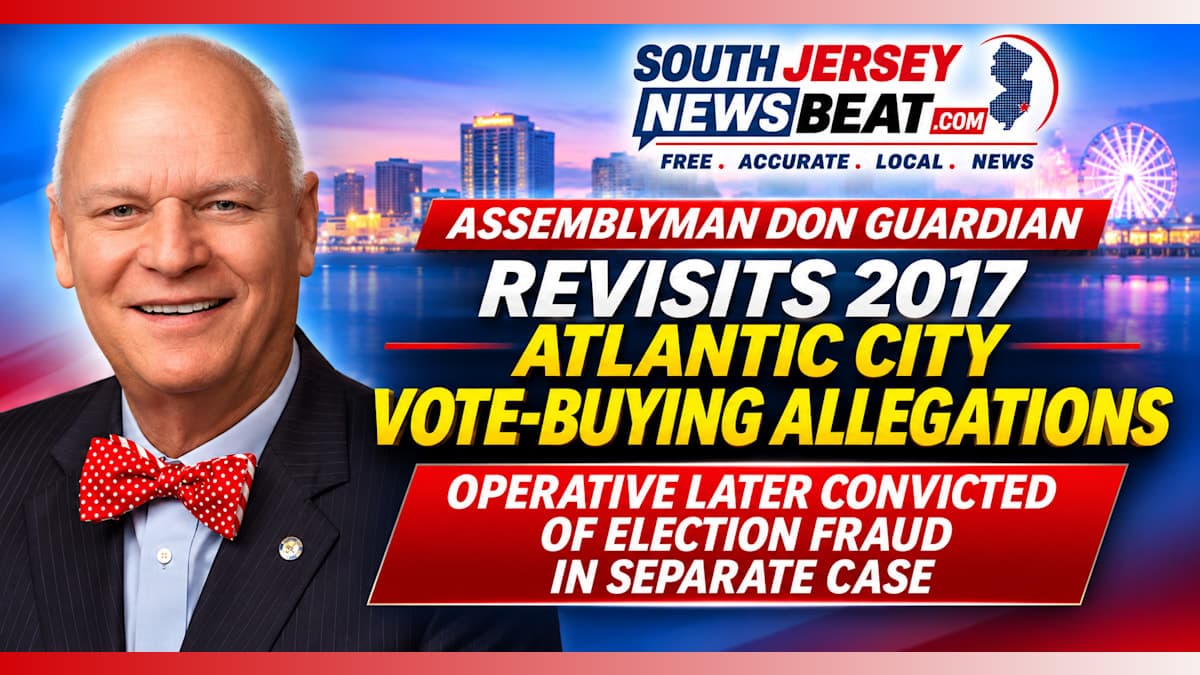
ATLANTIC CITY, N.J. — New Jersey Assemblyman and former Atlantic City Mayor Don Guardian is revisiting allegations of vote buying and ballot manipulation during his unsuccessful 2017 reelection campaign, nearly a decade after his campaign hired private investigators to document suspected election misconduct.
Speaking Friday while guest hosting The Lorry Young Show on News Talk 1400 & 92.3 WOND, Guardian described an undercover investigation that he said uncovered people being paid to participate in questionable voting activities and others being pressured to support particular candidates.
His comments take on additional significance because Craig Callaway, the longtime Atlantic City political operative identified in the 2017 investigation, was subsequently convicted in federal court of orchestrating a fraudulent mail-in ballot operation during the 2022 general election.
Callaway pleaded guilty in February 2025 and was sentenced that July to two years in federal prison.
The federal conviction involved the 2022 election, not Guardian's 2017 mayoral race. No court finding reviewed by South Jersey NewsBeat establishes that Callaway committed election fraud in 2017 or that the outcome of that election was affected by illegal activity.
Nevertheless, Guardian's renewed comments raise questions about what became of the evidence his campaign presented to authorities nine years ago.
Guardian Describes Undercover Investigation
Guardian said his concerns about election integrity stem from his personal experience as Atlantic City's mayor.
"I'm coming to you from a very, very specific area," Guardian told listeners. "Because when I ran for mayor, I'm sorry, when I re-ran for mayor, I became aware of a lot of illegal activity that was happening in Atlantic City."
Guardian said he was aware that candidates frequently allege fraud after losing elections, so he decided to investigate suspected misconduct before voters went to the polls.
"I knew that every time someone loses, they always say that there's voter fraud," he said.
Guardian said his campaign hired retired New Jersey State Police officers and an election-law firm to investigate.
"What I did is I hired a couple of retired state police officers with a law firm that specializes in voter fraud," he said.
"We put equipment that both gave you an audio and visual location. And we found out that people were being paid to vote."
Guardian alleged that investigators recorded individuals being directed to complete ballots in particular ways.
"We were able to video and tape individuals that were forcing people to check certain boxes, then sign their name, put it in the envelope, sign their name again, and they got paid for it," he said.
He also described an alleged operation involving transportation from Atlantic City to Mays Landing.
"We had video and audio that showed you that there were groups that were bringing people from Atlantic City to Mays Landing to vote," Guardian said.
"Before they got off the bus, they had to show you how they were going to vote. And if they were voting for me, they were voting for any other Republican, they were not allowed off the bus."
Those are Guardian's allegations. The available public record does not independently establish every detail of the activity he described.
2017 Investigation Was Documented at the Time
Guardian's account is supported in significant respects by reporting published during the 2017 election campaign.
On October 31, 2017, The Philadelphia Inquirer reported that two retired State Police investigators, Lou DiJoseph and Tim Witkoski, had been hired by Guardian's campaign to investigate suspected ballot misconduct.
The newspaper reported that its journalist accompanied the investigators as they equipped an informant, Rodney Cotton, with a recording device and followed him during an undercover operation.
Cotton, then 51, said he received $30 from Callaway after obtaining a messenger ballot at the Atlantic County Clerk's Office in Mays Landing.
Instead of delivering the ballot to the voter who had requested it, as required by law, Cotton said he handed it directly to Callaway.
The Inquirer reported that Cotton also described receiving instructions about how to complete his own ballot.
At the time, New Jersey law permitted voters to designate authorized messengers to retrieve mail-in ballots. Paying someone to serve as a messenger was not itself illegal, but the messenger was required to deliver the ballot to the voter.
The Guardian campaign alleged that the operation went beyond lawful ballot assistance.
On November 3, 2017, Guardian held a news conference outside the Atlantic County Clerk's Office and released a 16-page investigative report, along with audio and video material.
The report included witness statements alleging that individuals had been offered money in connection with voting.
Guardian's campaign maintained that the activity benefited his Democratic opponent, Frank Gilliam Jr.
Callaway denied wrongdoing at the time and accused Guardian's campaign of attempting to suppress minority votes.
Gilliam also denied involvement in the alleged operation and characterized Guardian's accusations as politically motivated.
Guardian lost the November 2017 mayoral election to Gilliam.
The allegations did not result in a successful challenge to the election outcome.
What Happened to the Evidence?
During Friday's WOND broadcast, Guardian said his campaign presented its findings to law enforcement authorities.
"We had videotaped all this," Guardian said. "I did a press conference so that we could get the news media out there to help us, to show us that this was going on and this was going to absolutely affect in a very negative way what the results would be."
"And then we gave it to our county prosecutor."
Guardian said he was dissatisfied with the response.
"At the time, our county prosecutor was not able to do anything. He said he didn't want to get involved. And then we went to the attorney general and things."
The Inquirer reported in November 2017 that Guardian's campaign had met with the Atlantic County prosecutor. Prosecutors and state officials declined to comment publicly at the time.
South Jersey NewsBeat has not independently established whether the 2017 evidence resulted in a formal criminal investigation, what conclusions authorities reached or whether any related case was closed.
The absence of a known prosecution does not establish that authorities failed to investigate the allegations.
Callaway Later Admitted to Fraudulent Ballot Scheme
More than five years after Guardian's investigation, federal prosecutors established that Callaway operated a fraudulent mail-in ballot scheme during the November 2022 general election.
According to the U.S. Attorney's Office for New Jersey, Callaway and individuals working under his direction approached people in Atlantic City and offered them approximately $30 to $50 to serve as purported authorized messengers for voters seeking mail-in ballots.
The individuals went to the Atlantic County Clerk's Office, presented completed applications and obtained ballots in the names of other voters.
Instead of delivering those ballots to the voters, they turned them over to Callaway or his associates.
Federal prosecutors said many of the ballots were ultimately cast in the names of people who later confirmed that they had not voted and had not authorized anyone else to vote on their behalf.
Some of those fraudulent ballots were counted in the election.
On February 13, 2025, Callaway pleaded guilty before U.S. District Chief Judge Renée Marie Bumb in Camden.
On July 23, 2025, he was sentenced to 24 months in federal prison and three years of supervised release.
Federal prosecutors described the operation as an effort to deprive New Jersey residents of a fair election.
The investigation involved the FBI, Atlantic County Prosecutor's Office, Atlantic City Police Department, New Jersey State Police and other federal agencies.
The methods established in the 2022 case bear similarities to allegations raised during Guardian's 2017 investigation, particularly the use of paid ballot messengers who obtained ballots for other voters.
However, the two matters involved different elections, and Callaway's federal guilty plea did not resolve the earlier allegations.
Calls for Changes to Ballot Messenger Rules
Following Callaway's sentencing in 2025, then-Atlantic County Democratic Chairman Michael Suleiman called for legislation prohibiting payments to people who collect or deliver mail-in ballots on behalf of voters.
Suleiman said stronger safeguards were necessary to prevent similar abuses.
"There will be other desperate candidates on both sides of the aisle who will be eager to pay ballot harvesters," Suleiman said in a statement reported by BreakingAC.
He urged lawmakers to approve legislation barring payments to ballot messengers and bearers.
The debate over paid messengers reflects a distinction between lawful assistance to voters and fraudulent interference with their ballots.
New Jersey's vote-by-mail system permits authorized individuals to help voters obtain and return ballots, subject to legal requirements intended to protect the voter's choices and the integrity of the process.
Callaway's 2022 conviction demonstrated how those procedures could be exploited when ballots were obtained and cast without voters' authorization.
Guardian Raises New Concerns Ahead of Election Day
Guardian's comments came as New Jersey voters prepared for Tuesday's general election.
During his WOND appearance, he also discussed concerns about the state's automatic voter registration system and proposals by Republican lawmakers to strengthen election safeguards.
Guardian said he supports making voting accessible while ensuring that people who are not eligible cannot cast ballots.
"I think we're all against anything that's going to suppress voter registration," he said.
"You can vote by mail. You can do early voting."
But he argued that election officials must also ensure that registration and voting requirements are enforced.
"We do have to take provisions to make sure that people that are not allowed to vote should not be able to vote," Guardian said.
His comments about the 2017 investigation were part of a broader discussion about election administration and public confidence in the voting process.
For Atlantic City, they also revived a controversial chapter in local politics involving allegations that vulnerable residents were being exploited by political operatives seeking control over mail-in ballots.
Nearly nine years later, the central unresolved question is what authorities determined after receiving the evidence gathered by Guardian's campaign.
Callaway's subsequent conviction establishes that he participated in a fraudulent election operation in 2022.
It does not establish that the 2017 allegations were proven, that Gilliam was involved in illegal activity or that Guardian's reelection defeat resulted from fraud.
South Jersey NewsBeat will continue seeking information about the disposition of the 2017 allegations and any subsequent changes to New Jersey's ballot messenger safeguards.
Assemblyman Don Guardian discussed election integrity and his 2017 Atlantic City mayoral campaign while guest hosting The Lorry Young Show, heard weekdays from 1–2 p.m. on News Talk 1400 & 92.3 WOND.

About the Author
Karen Johnson
With over 30 years of news experience in major markets like Los Angeles, Denver, and Columbus, Karen now covers our area for South Jersey NewsBeat. She also brings her articulate and conversational news delivery to WOND radio listeners every weekday. Her background includes work with the NBC Radio Network, and she thrives in fast-paced news environments.