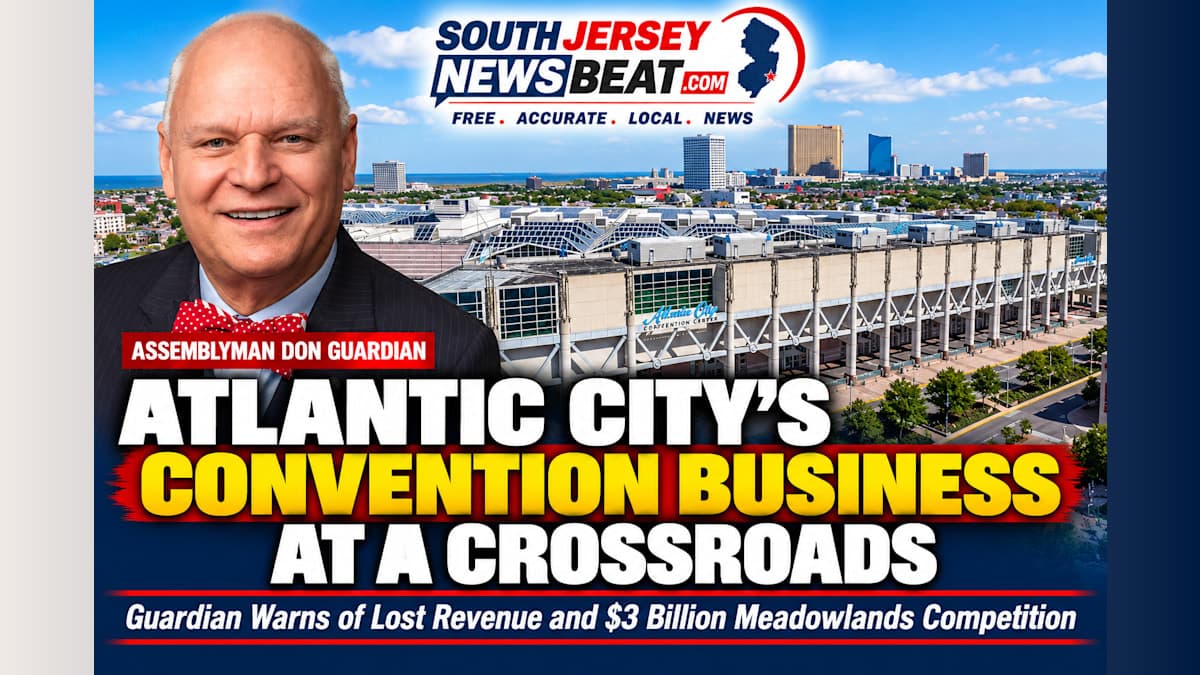
Assemblyman says New Jersey should preserve the Sheraton's 500 hotel rooms and modernize Atlantic City's Convention Center before considering a competing facility in North Jersey.
ATLANTIC CITY, N.J. — Assemblyman Don Guardian is warning that Atlantic City's convention industry faces a potentially damaging combination of lost business, an uncertain future for its primary convention hotel and a proposed $3 billion convention complex in the Meadowlands that could compete for some of the same events.
During an October 21 appearance on The Lorry Young Show on News Talk 1400 & 92.3 WOND, the former Atlantic City mayor said preserving a full-service, 500-room hotel connected to the Atlantic City Convention Center is essential to protecting one of South Jersey's most important economic engines.
Guardian said Visit Atlantic City had provided information identifying approximately $120 million in convention business that Atlantic City would lose over the next three years because of concerns surrounding its convention hotel.
"Now, Visit Atlantic City just gave us all of the conventions that they have lost in the next three years because we don't have a first-class 500-room hotel," Guardian said. "And it amounts to $120 million of lost business."
The warning follows an even larger figure disclosed publicly by Visit Atlantic City President and CEO Gary Musich.
At a recent Stockton University tourism forum, Musich said Atlantic City had already lost an estimated $147 million in convention and meeting business following the announcement that the Sheraton Atlantic City Convention Center Hotel could close in December.
The figures were reported in different settings and may reflect different booking periods or calculations. They should not be added together without further clarification from Visit Atlantic City.
Together, however, they underscore growing concerns about the financial consequences of uncertainty surrounding the Convention Center's adjoining hotel.
Why 500 Hotel Rooms Matter
Guardian said convention industry professionals have made clear that Atlantic City needs a major hotel directly connected to the Convention Center.
He described a review conducted by approximately 30 convention promoters who visited Atlantic City to evaluate its strengths and weaknesses.
"They spent three days and they did an analysis on our Convention Center and convention business," Guardian said.
"And the number one issue that they had was having a 500-room first-class hotel physically connected to the Convention Center."
Guardian said the hotel serves two different needs.
Smaller conventions may require approximately 500 rooms in one location, while organizers of larger events need accommodations convenient to the Convention Center for production crews, staging personnel, audiovisual specialists and other workers.
"The second part is for our larger conventions, the people that set them up, the staging, the sound, the audio, the visual, all of that want to be connected," he said.
"They don't want to be in a casino hotel. So you have to have that 500-room hotel."
The Sheraton currently has 502 rooms and is connected to the Convention Center by a pedestrian walkway.
Its owner, LINY Investor LLC, has proposed a redevelopment that would retain approximately 252 renovated hotel rooms while converting the remainder of the property into 130 age-restricted residential units.
The estimated $100 million project would require substantial state tax incentives.
Guardian opposes reducing the number of hotel rooms.
"So the state should be supporting the 500-room hotel, not killing it," he said.
A Dispute Over the Sheraton's Future
The hotel's owner, developer Tom Scannapieco, has argued that the Sheraton cannot remain financially viable in its current form.
Scannapieco has said the Convention Center does not generate enough large, multiday events to consistently support a 500-room hotel.
His redevelopment proposal is intended to renovate the property while creating residential revenue that would help sustain the building without an ongoing operating subsidy.
Atlantic City Mayor Marty Small has supported the redevelopment concept, while convention industry representatives and several regional elected officials have argued that reducing the room inventory would damage the city's ability to compete for future events.
The owner has warned that the hotel could close December 15 if a workable financial solution is not reached.
Guardian said he has urged Gov. Mikie Sherrill's administration not to support a conversion that substantially reduces the number of hotel rooms.
He also acknowledged that preserving the property may require a different ownership or operating arrangement.
"Now, who should run it? Maybe this guy. Maybe somebody else, another individual, private property," Guardian said.
"Maybe it should belong to the CRDA. Maybe it should belong to the state of New Jersey or Visit Atlantic City. I see the problems in each of those scenarios."
Regardless of ownership, he said, the hotel's role must be preserved.
"The point is it has to be returned back to a first-class 500-room hotel," Guardian said. "It needs a national corporation to be running it. It needs to be connected to the Convention Center."
The Economic Stakes Are Substantial
Guardian pointed to Visit Atlantic City's 2025 convention statistics to demonstrate how much business the industry generates for the resort.
The tourism organization independently confirmed that Atlantic City hosted 205 meetings, conventions and trade shows in 2025.
Those events produced:
533,242 attendees
328,067 hotel room nights
Approximately $362.3 million in estimated economic impact
Guardian cited those figures during his WOND interview.
"Half a million people came just because of conventions," he said.
"And 328,000 hotel rooms were booked through the Convention Center."
He said convention spending supports businesses throughout the resort, including restaurants, bars, hotels, retailers and transportation services.
"It's a huge positive impact for our restaurants, for our bars, any place that's serving the community," Guardian said.
"So the Convention Center is critical and this hotel is critical."
The figures also illustrate why convention business has become increasingly important as Atlantic City prepares for additional casino competition from New York.
While casinos remain the resort's largest tourism attraction, conventions help generate hotel stays, restaurant spending and other economic activity beyond gambling.
Guardian Says the Convention Center Needs Modernization
The Sheraton is only part of Guardian's concern.
He said New Jersey must also address aging infrastructure at the Atlantic City Convention Center, which opened in 1997.
Guardian described a facility that remains structurally sound but has fallen behind competing convention destinations in appearance, technology and visitor amenities.
"The Convention Center there looks nice. Structurally, it's very sound as a building," he said.
But he said convention professionals offered a less flattering assessment of its interior.
"They said it looks like a 1990s mall."
Guardian said visitors expect modern seating areas, convenient electrical outlets and reliable internet connectivity.
"You've got to have seating nodes. You have to be able to plug in your phone or your laptop," he said.
He also criticized the facility's internet capabilities.
The Convention Center does offer wired and wireless internet services, including complimentary Wi-Fi in public areas and meeting rooms. The underlying issue raised by Guardian and other officials is whether those services meet the needs of modern conventions.
The Casino Reinvestment Development Authority has undertaken some infrastructure improvements, including a major energy project involving the Convention Center and Boardwalk Hall.
Guardian nevertheless believes broader modernization is necessary.
He argued that the state should prioritize updating an established convention facility before investing in another major convention complex elsewhere.
A $3 Billion Competitor in the Meadowlands
The debate is becoming more complicated because of a major proposal in North Jersey.
The Meadowlands Chamber has developed plans for a convention and entertainment complex at the former Izod Center site in East Rutherford, near MetLife Stadium and the American Dream entertainment complex.
The approximately $3 billion proposal includes a 300,000-square-foot exhibition hall, a 60,000-square-foot ballroom, 100,000 square feet of meeting space, a 6,000-seat arena and a 1,000-room headquarters hotel.
The project has been promoted as a way to attract conventions and corporate events to the New York metropolitan region.
Supporters argue that the area has substantial unmet demand for convention space and that a Meadowlands facility could capture events currently going to other destinations.
A market analysis commissioned by project proponents estimates that the development could generate approximately $30.4 billion in additional economic activity over 30 years.
Those are projections, not guaranteed returns.
The project has not received final financing and construction approvals.
Guardian questions whether New Jersey should support such a development while Atlantic City's existing Convention Center needs substantial investment.
"Right now, the Convention Center in Atlantic City is the state of New Jersey Convention Center," Guardian said.
"The Meadowlands says, hey, we'd like to have a Convention Center and we need $3 billion from the state of New Jersey, taxpayers' money to build it."
He challenged the basic premise.
"Now, why would you build a second Convention Center in the state of New Jersey when we have one that is very competitive with life-size conventions?"
Would Meadowlands Attract New Business or Divide Existing Business?
The central disagreement concerns where the proposed Meadowlands facility would find its customers.
Supporters believe its proximity to New York City, major transportation networks, hotels and entertainment attractions would allow it to compete for events that currently bypass New Jersey.
The Meadowlands Chamber's analysis identifies potential demand for additional meeting and event space in the metropolitan region.
Guardian disputes the idea that the facility could substantially draw conventions away from Manhattan.
"They say they're going to be able to steal business from New York City," he said.
"I'm going to tell you that anyone that's looking at Jacob Javits Center, that's the Convention Center in Manhattan, you're going there because it's Manhattan."
Guardian argued that many convention attendees choose New York City partly because of its attractions and entertainment opportunities.
He believes a Meadowlands convention center would instead compete with Atlantic City for events already held in New Jersey.
He cited statewide conventions involving municipal officials, educators, trade associations and other organizations.
"You would split that in half," Guardian said.
"So the state of New Jersey would not make any more money. They would split all of the business between two properties, and the end result was both properties would need to be subsidized because they would both lose money."
That is Guardian's assessment of the potential impact, not an established financial outcome.
Whether the Meadowlands project would primarily attract new business or divert events from Atlantic City remains a central unanswered question.
Guardian Questions a Connection to North Jersey Casinos
Guardian also suggested the Meadowlands convention proposal could eventually become connected to renewed efforts to authorize casino gambling outside Atlantic City.
New Jersey voters rejected a constitutional amendment in 2016 that would have permitted casinos in North Jersey.
Any future expansion would require another change to the state's constitutional restrictions.
Guardian argued that adding convention facilities and hotel rooms to the Meadowlands could increase pressure for casino authorization.
"This is just a plug to get casinos in the Meadowlands," he said.
That interpretation is disputed territory.
The current Meadowlands convention proposal is being promoted on its own economic and tourism merits. No evidence establishes that it is an approved casino development or that its proponents have secured authorization for gambling.
Guardian acknowledged that neither a new North Jersey casino authorization nor the Meadowlands convention center had received final approval.
He said there was no immediate legislative proposal moving forward to establish the convention complex.
However, a bill introduced in the state Senate in January would direct the New Jersey Sports and Exposition Authority to study the feasibility of a Meadowlands convention center.
That measure is distinct from final authorization or funding for construction.
Bipartisan Discussions With the Governor
Guardian said he, state Sen. Vince Polistina and Assemblywoman Maureen Rowan have separately discussed Atlantic City's convention needs with Gov. Sherrill's administration.
"The governor's office has been very, very responsive to all three of us," he said.
"We have met with the governor's staff separately and explained how important the 500-room hotel was."
Guardian said he believes the administration understands the importance of Atlantic City's convention, tourism and casino industries.
He declined to reveal details of private conversations with the governor's office.
"But I think at this point, the governor is very supportive of industry in South Jersey and realizes that we really do depend on conventions, on tourism, on casinos," he said.
The Sheraton dispute has brought together officials from both political parties, including Atlantic County leaders and members of the region's legislative delegation.
Their common concern is that Atlantic City could lose an important economic asset if the Convention Center hotel closes or substantially reduces its room inventory.
Could the Convention Center Become an Educational Resource?
Guardian also proposed connecting the hotel and Convention Center more closely with hospitality education programs.
He pointed to Atlantic Cape Community College, Stockton University and other institutions offering hospitality-related training.
"We should be giving students the opportunity to work in the industry, to get their feet wet," Guardian said.
"So let's make it part of a curriculum for higher education."
Such partnerships could provide hands-on experience for students while supporting Atlantic City's hospitality workforce.
Guardian said the city's convention facilities should be treated as long-term economic infrastructure rather than isolated buildings.
A Decision About New Jersey's Priorities
For Atlantic City, the immediate issue is whether the Sheraton can remain open as a full-service convention hotel.
The larger question is how New Jersey intends to support its convention industry over the next decade.
Atlantic City already has an established Convention Center, thousands of hotel rooms, a casino and entertainment industry, and a record of attracting hundreds of thousands of convention visitors.
The Meadowlands proposal offers a different opportunity: a new facility in the densely populated New York metropolitan market, designed to attract additional meetings, exhibitions and entertainment events.
Both approaches have supporters.
But Guardian believes New Jersey should strengthen its existing convention investment before taking on another major project.
"If you already own a Convention Center that people like and are coming to, just bring it up to date," he said.
"It needs a little fixture, but building a second Convention Center makes no sense."
For Atlantic City's business community, the stakes are immediate.
The Sheraton's future remains uncertain, Visit Atlantic City has identified substantial lost business, and convention planners are making decisions years in advance.
Guardian's argument is that those losses could become increasingly difficult to reverse if the city fails to preserve its hotel capacity and modernize the Convention Center.
"And so we need a Convention Center," he said. "A second Convention Center makes no sense."
Whether state officials agree will help determine how New Jersey allocates future convention and tourism investments — and whether Atlantic City can protect an industry that generated more than $362 million in estimated economic activity last year.
About the Author
Paul Kelly
Paul Kelly is a contributor to LocalBeat, covering local news and community stories.