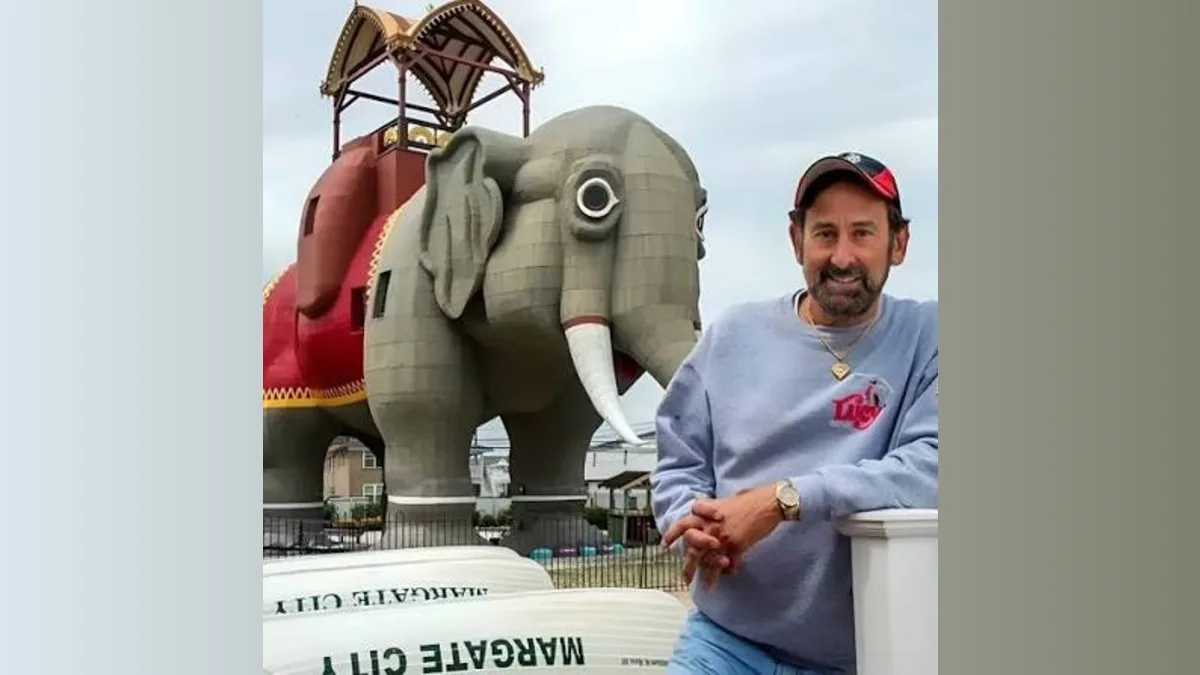
MARGATE — Richard Helfant's relationship with Lucy the Elephant began long before he became the man responsible for protecting one of the Jersey Shore's most recognizable landmarks.
It began with a seventh-grader, a teacher, some candy — and an elephant facing the wrecking ball.
Helfant, now executive director and CEO of the Save Lucy Committee, recalled the unlikely path during an appearance on Off the Press with Scott Cronick on WOND, where Atlantic City Councilman Jesse Kurtz was serving as guest host.
“I grew up in Margate, you know, born in Atlantic City, grew up in Margate,” Helfant said.
His earliest memories of Lucy stretch back to childhood.
“As a young kid, as a 5-year-old kid, my mom would bring me to the elephant,” Helfant said. “It's 1962.”
What he remembers isn't the carefully restored landmark visitors see today.
“I remember how derelict it was,” Helfant said. “It was all broken apart. You know, it had that musty smell that buildings at the Shore sometimes have.”
Then came the devastating March 1962 storm.
“In '62, it was condemned after the March storm,” Helfant said, “and it sat there and continued to just deteriorate further.”
Saving Lucy from the wrecking ball
By 1969, Helfant said, the family that owned Lucy was preparing to sell the property for construction of a high-rise condominium building.
Lucy was in the way.
“They were going to tear down the elephant,” Helfant said.
Local residents decided they weren't going to let that happen.
A grassroots preservation effort spearheaded by Sylvia and Ed Carpenter and Josephine Harron worked with Margate to find a new home for the enormous structure.
The challenge was raising enough money to move it.
That's where a seventh-grade Helfant entered Lucy's history.
A teacher named Julius Woods, whom Helfant describes as his mentor and “one of the finest human beings I've ever known,” was among the original Save Lucy Committee members.
Woods recruited his students to help.
“[He] got some of his students to go door-to-door throughout Margate, selling candy to raise money to save her from the wrecking ball,” Helfant said.
“So that's when my relationship with Lucy really started, in seventh grade,” he said, “and I've been, you know, part of her one way or another ever since.”
Lucy was ultimately moved to her current location in July 1970. The Save Lucy Committee says the structure was sufficiently stabilized to resume public tours in 1974, and Lucy was designated a National Historic Landmark in 1976.
From student fundraiser to Lucy's leader
Helfant's involvement didn't end with the candy sale.
He said Woods helped instill a lifelong interest in civic and charitable work that continued through high school and adulthood.
“I'm so grateful to, first of all, to Mr. Woods, who got me started in wanting to do things civically and charitably,” Helfant said.
“I believe it's so important to give back to the community that has given so much to me,” he said, “and that's what drives me.”
Years later, the Save Lucy organization reached another turning point.
Helfant said that around 2000, state officials encouraged the previously volunteer-driven organization to develop a more formal professional structure if it wanted to continue pursuing grants.
“Up to that point, it was all run by volunteers,” Helfant said. “And not to diminish their role — they saved her from the wrecking ball. They brought her back to life.”
A job description was created and advertised.
“I was one of the eight applicants that applied for it,” Helfant said. “The selection committee chose me.”
And the kid who had once knocked on Margate doors selling candy to save Lucy eventually became the person overseeing her future.
“Being with Lucy for 28 years, I don't think I've ever gone to work a day in my life,” Helfant said. “I love what I do. I'd rather be there than any place.”
“It's just been an extraordinary life experience that I'll treasure forever.”
‘There's only one’
Helfant's enthusiasm becomes especially evident when he's asked why someone who has never visited Lucy should care about a giant wooden elephant built in the 19th century.
“There's a lot of reasons,” Helfant said.
“First of all, she's a National Historic Landmark,” he said. “She is an iconic part of Americana. For us locally, she's a part of our heritage and our history.”
But then comes his simpler sales pitch.
“There are statues all over the country and all over the world, and there are museums, and there are artifacts and cultural things,” Helfant said, “but there's only one giant six-story elephant on the planet, and that's our Lucy.”
Lucy was constructed in 1881 by Philadelphia inventor and entrepreneur James Lafferty as the Elephant Bazaar, originally intended in part to attract attention to local real estate. Today, she stands six stories high along the Margate beachfront.
Helfant said Lucy's influence on the development of the Shore went beyond novelty.
“Lucy was so influential and so much a part of the development of the Jersey Shore back in the late 1800s and early 1900s,” Helfant said.
He said Lucy's popularity helped lead to the extension of rail service down Atlantic Avenue.
“It was because of the curiosity of Lucy that they built that railroad,” Helfant said. “That's all documented.”
Still captivating children 145 years later
What seems to matter most to Helfant, however, isn't Lucy's designation or place in architectural history.
It's what happens when a child sees her for the first time.
“For first-timers, when they first pull up, especially when there's a carload of kids, Jesse, and they pull up, and they get out of the car, and they look up at this giant six-story elephant, their mouths drop wide open,” Helfant said.
“They're in such awe of her grandiose splendor and the magic that is Lucy.”
Helfant said that reaction has endured even as the world around Lucy has changed dramatically.
“To America, she's 145 years old,” he said. “She's older than the Statue of Liberty. She's older than the Brooklyn Bridge.”
But, he added, “the best thing about her, and I can't say it enough, is to see the faces of kids when they arrive for the first time.”
Lucy is now preparing for yet another chapter, including a new visitor center and major interior restoration.
For Helfant, preserving the landmark is ultimately about making sure another generation gets the same opportunity he had as a child.
“We have to keep her relevant and vital,” he said. “She has to stay healthy and strong for generations yet to come.”
And Helfant still has one favorite invitation for people who haven't made the trip.
“Come visit Lucy,” he said, “the only elephant in the world you can walk through and come out alive.”

About the Author
Karen Johnson
With over 30 years of news experience in major markets like Los Angeles, Denver, and Columbus, Karen now covers our area for South Jersey NewsBeat. She also brings her articulate and conversational news delivery to WOND radio listeners every weekday. Her background includes work with the NBC Radio Network, and she thrives in fast-paced news environments.