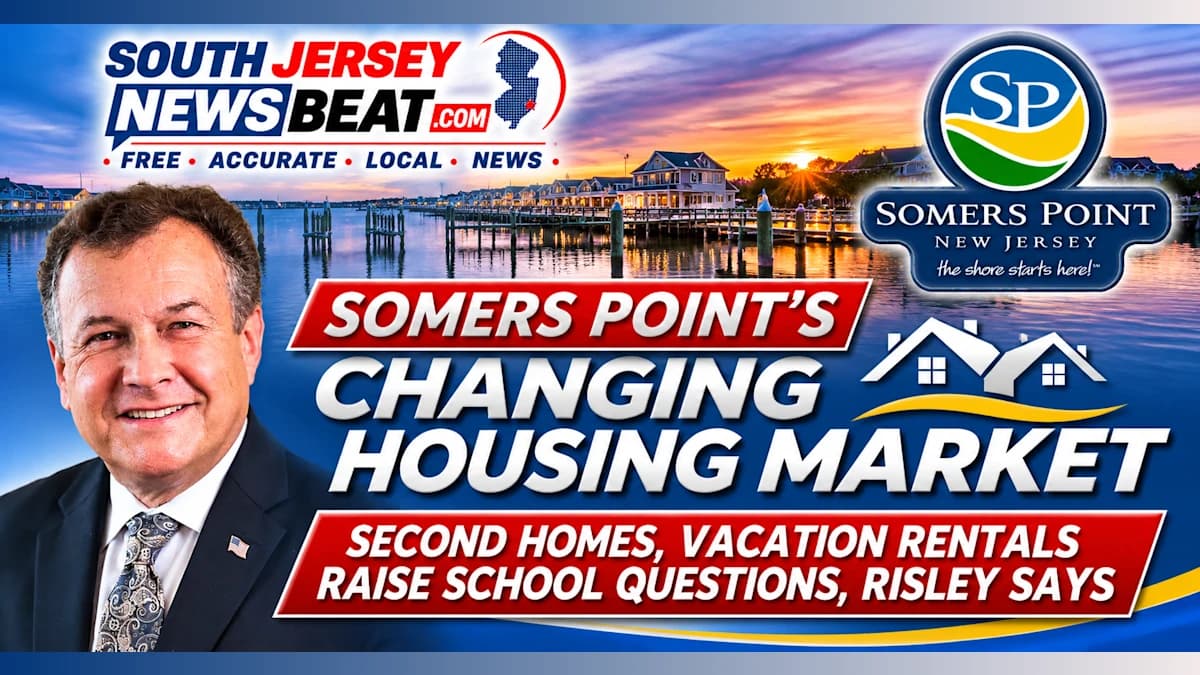
Atlantic County Commissioner John Risley weighs in as new housing data, school funding pressures and short-term rental restrictions highlight changes in the shore community.
SOMERS POINT, N.J. — Is Somers Point gradually becoming more like the neighboring resort communities along the Jersey Shore?
That question is gaining attention as second-home ownership, vacation rentals and declining school enrollment raise concerns about the future of a city traditionally known for its year-round residential neighborhoods.
The issue surfaced during an October 29 appearance by Atlantic County Board of Commissioners Chairman John Risley on Klein Time with Dan Klein on News Talk 1400 & 92.3 WOND.
A caller named Dominic, who said he operates a business in Somers Point, described what he believes is a growing trend of houses being purchased as vacation properties rather than primary residences.
"In Somers Point, we see a lot of homes selling, a lot of them becoming Airbnbs, second homes for people from other parts of the country, other parts of the state," the caller said.
He questioned what the changing housing market could mean for public schools, local taxes and the character of the community.
"I wonder how these new second homeowners come into our area, how will their view that they don't want to pay as much taxes, how do we balance out these new second homebuyers with our need to have services like schools and things with lower enrollment?"
His observations are anecdotal, but an examination of municipal housing records, school enrollment figures and recent City Council actions shows that Somers Point is already confronting several of the issues he raised.
Nearly 700 Homes Identified as Seasonal Properties
According to Somers Point's 2025 Housing Element and Fair Share Plan, the city had an estimated 5,730 housing units in 2023, based on U.S. Census Bureau American Community Survey data.
Of those, approximately 1,010 were classified as vacant, including 698 units identified as being used for seasonal, recreational or occasional purposes.
That means seasonal properties represented approximately 12% of the city's total estimated housing stock.
The figures demonstrate that second homes and seasonal properties already account for a meaningful portion of the local housing market.
However, the data does not establish how many properties have recently been converted from year-round residences to vacation homes, nor does it demonstrate that such conversions are accelerating.
Those questions would require comparisons with earlier Census estimates and municipal property records.
The housing plan also identified a substantial rental market, with more than 2,000 renter-occupied units.
Not every rental property is a vacation rental, and a property used seasonally is not necessarily advertised through Airbnb or another short-term rental platform.
Still, the housing figures help explain why the future of residential neighborhoods has become a recurring topic in Somers Point.
City Already Tightened Short-Term Rental Rules
Somers Point officials have been debating the impact of vacation rentals for several years.
In June 2025, City Council voted 4-3 to increase the minimum permitted stay at short-term rental properties from three nights to seven nights.
The change took effect at the end of 2025.
The ordinance followed extensive public debate over whether short-term rentals benefit the local economy or undermine the residential character of established neighborhoods.
Supporters argued that longer minimum stays would reduce frequent guest turnover and help preserve neighborhood stability.
Opponents said the restrictions could hurt property owners, discourage tourism and reduce business for restaurants and other local establishments.
Council President Charlie Haberkorn, who cast the deciding vote, described the measure as a compromise between homeowners seeking quieter neighborhoods and property owners operating legitimate rental businesses.
The city's regulations require rental properties to be registered and short-term rental operators to obtain mercantile licenses.
The rules also establish occupancy limits, inspection requirements and restrictions on how properties may be rented.
Somers Point's experience reflects a broader challenge facing communities near the Jersey Shore: balancing tourism-related economic opportunities with the needs of permanent residents.
School Enrollment Has Fallen Sharply
Perhaps the most significant long-term question involves the city's public schools.
Somers Point's school district has experienced a substantial enrollment decline over the past 15 years.
In June 2026, the Ocean City Sentinel reported that the district's enrollment had fallen from 1,092 students in 2010 to approximately 580 students in 2025, excluding preschool.
That represents a decline of nearly 47%.
State Department of Education school performance reports also document declining enrollment in more recent years.
The district reported 760 students in the 2022-23 school year and 735 in 2023-24, including preschool.
The decline has created challenges for a district that must continue maintaining school buildings, staffing classrooms and providing services even as the number of students decreases.
The district operates Dawes Avenue School and Jordan Road School, serving students through eighth grade.
Students generally attend Mainland Regional High School after completing eighth grade.
School officials have not established that vacation-home purchases are the principal cause of declining enrollment.
Lower birth rates, demographic changes, housing affordability and families relocating to other communities may also contribute.
Nevertheless, the growing presence of seasonal housing raises questions about how many homes remain available to families with school-age children.
Financial Pressures Have Already Reached the Classroom
Somers Point's enrollment challenges are occurring alongside serious school funding pressures.
In June 2026, Board of Education President Staci DiMattia Endicott called for changes to New Jersey's school funding formula, warning that the district was struggling with rising operating expenses and reductions in state support.
According to the Ocean City Sentinel, the district lost more than $4 million in state aid over seven years under changes associated with New Jersey's school funding law.
The district's 2026-27 budget totaled approximately $20.4 million.
To address a budget shortfall exceeding $1 million, school officials eliminated 11 positions and reduced spending in several areas.
Those cuts followed the elimination of 23 positions over the previous two years.
The district also increased its local tax levy by more than 7% for the 2026-27 budget.
School officials identified rising health insurance and utility costs as additional pressures.
The financial situation complicates the suggestion that fewer students necessarily translate into lower property taxes.
While declining enrollment may reduce certain expenses, many school costs remain even when fewer children attend.
Buildings still require maintenance, classrooms still need teachers, and districts must meet state educational requirements.
Reductions in enrollment can also affect state aid, potentially shifting more financial responsibility to local property owners.
Risley: Second Homes Still Pay Property Taxes
Risley, who previously served on Somers Point City Council, acknowledged that the community has long attracted buyers from outside the area.
He recalled meeting residents who originally came from Philadelphia and other communities while visiting the Jersey Shore.
"Summers Point was originally populated by a lot of folks that lived in Philadelphia, and they would come down to the shore," Risley said, using the city's name as transcribed during the interview.
He said the shift toward seasonal ownership could affect school enrollment.
"The one thing it will do, it will lower the school population, which means that less expenses, you know, less expenses for the local residents."
However, he also emphasized that vacation properties are subject to the same basic property assessment principles as other residential homes.
"Whether the person owns a B&B or a regular home, the assessment's the same. The assessment's going to be the same," Risley said.
"The tax assessor is going to value that by the current market value. There's no special classification."
In other words, a homeowner who uses a property only during the summer generally remains responsible for property taxes even if no children from that household attend local schools.
That can create a larger taxable property base relative to the number of students attending school.
But it does not guarantee lower tax bills, particularly when school districts face reductions in state funding and rising operating costs.
A Debate Over the City's Identity
The questions raised during Risley's interview are not entirely new.
During Somers Point's 2025 debate over short-term rentals, residents and business owners publicly disagreed about the city's direction.
Some expressed concern that an increasing number of vacation properties could make it harder to maintain stable, year-round neighborhoods.
Others argued that short-term rentals help support restaurants, shops and other businesses that depend on visitors.
At the time, some speakers also questioned whether the community was becoming less affordable for younger families.
Those concerns extend beyond rental regulations.
If more homes are purchased as second residences, fewer properties may be available to permanent residents, depending on the overall housing supply and market conditions.
Higher property values can benefit existing homeowners while making it more difficult for first-time buyers to enter the market.
Meanwhile, a smaller year-round population of children can affect schools, youth sports and other community organizations.
The relationship is complicated, however, and the available data does not establish that vacation rentals alone are driving those changes.
What Happens Next?
Somers Point now faces several questions that could shape its future.
How many residential properties are being purchased as second homes rather than primary residences?
How many short-term rental licenses are currently active, and has that number increased or decreased since the seven-night minimum stay took effect?
Are housing prices making it harder for families with children to remain in the community?
And how will declining enrollment affect the school district's finances over the next several years?
Municipal rental registration records, property sales information and updated Census data could help answer those questions.
For now, the available evidence points to a city with a substantial seasonal housing market, a school district experiencing significant enrollment and financial pressures, and elected officials already wrestling with how to balance tourism and residential life.
The caller's question to Risley captured the larger issue facing Somers Point.
Can the city continue welcoming visitors and vacation-home owners while preserving the year-round neighborhoods, schools and community institutions that have long defined it?
The answer may help determine what Somers Point looks like in the years ahead.
About the Author
Paul Kelly
Paul Kelly is a contributor to LocalBeat, covering local news and community stories.