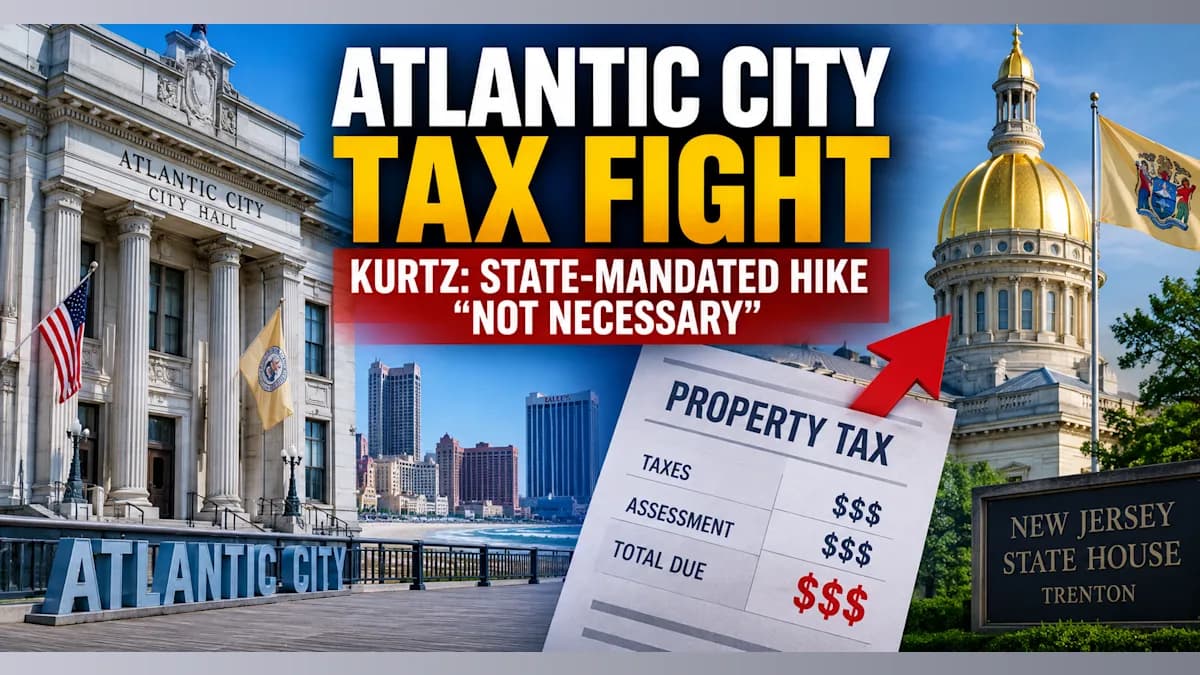
Atlantic City Councilman Jesse Kurtz is calling on state officials to abandon a requirement that forced the city to raise taxes this year, arguing that Atlantic City’s improving finances no longer justify an automatic increase.
Kurtz, the city’s 6th Ward councilman, said during an appearance on Off The Press with Scott Cronick on WOND that he wants local officials to begin lobbying the state now — months before Atlantic City begins work on its next municipal budget.

“I’ve got my eye on next year,” Kurtz said. “I think that we have collectively — state legislative delegation, local leaders, important people like you, Scott — we all have a few months to get the ear of the state people and get them to knock off that mandatory two percent tax increase for next year.”
The dispute stems from Atlantic City’s continued participation in New Jersey’s Transitional Aid program and broader state fiscal oversight.
Earlier this year, Atlantic City officials proposed a 2026 budget that would have reduced the municipal tax rate by 2.3 cents. The state rejected that proposal and instead required municipalities receiving Transitional Aid, including Atlantic City, to impose a 2% tax increase. The city’s 2026 budget totals about $283.8 million, including grants.
Mayor Marty Small Sr. publicly expressed disappointment when the requirement was announced in May, noting that it ended a streak of six consecutive municipal tax decreases.
The issue gives Kurtz an unusual ally: the Small administration itself had wanted to cut taxes this year.
Kurtz: Improved Finances Should Matter
Kurtz’s argument is that the state requirement does not adequately account for how much Atlantic City’s financial position has improved.
“I’m on the side of we should be making our budget decisions around keeping the budget flat or decreasing the rate,” Kurtz said.
He said Atlantic City should continue working to make its tax rate more competitive with surrounding Shore communities while finding other ways to pay for infrastructure and services used by millions of visitors each year.
Independent financial data give some weight to Kurtz’s argument that Atlantic City is in a substantially different fiscal position than it was during its crisis a decade ago.
In January, Moody’s Ratings upgraded Atlantic City’s issuer rating from Ba1 to Baa3, returning the city to investment-grade status for the first time in more than a decade.
The city also reported approximately $228 million in outstanding debt, down from more than $500 million at its peak, with about $71 million representing direct city debt.
That marks a dramatic turnaround from the financial emergency that led New Jersey to assume extraordinary oversight powers in 2016.
State Control Isn't Going Away
But Atlantic City remains under unusually extensive state supervision.
The Municipal Stabilization and Recovery Act allowed the New Jersey Department of Community Affairs to intervene in Atlantic City’s finances beginning in November 2016.
That oversight was extended once in 2021 and again this year. On Jan. 20, then-Gov. Phil Murphy signed legislation extending the state’s authority over Atlantic City for another six years.
Kurtz said he believes the state should use that authority more flexibly rather than treating a tax increase as a box that must be checked each year.
“There’s a bunch of requirements that are in the annual transitional aid agreement that are basically best practices,” Kurtz said. “A lot of them are good.”
But, he added, “On the list of the state’s best practices this time around was a mandatory two percent increase, and that — that’s not a best practice.”
He said an automatic increase is particularly difficult to justify when residents and businesses are already dealing with higher costs.
“That’s not a good recipe either for working-class people who live here and want to stay here with rising costs or for businesses that have diminishing bottom lines,” Kurtz said.
Transitional Aid Has Been Shrinking
Another fact strengthening Kurtz’s case is how sharply Atlantic City’s reliance on Transitional Aid has declined.
State records show Atlantic City received about $3.3 million in Transitional Aid in 2019, approximately $2.8 million in 2020, $2.4 million in 2021, $2 million in 2022, $1.7 million in 2023 and roughly $1.47 million in 2024.
The state itself has previously said Atlantic City’s reliance on Transitional Aid had been “substantially reduced if not eliminated” as the city’s finances improved.
That does not mean the state has concluded Atlantic City no longer needs oversight. In fact, the Legislature and governor did the opposite by extending state supervision.
But it does demonstrate that the scale of the city’s direct Transitional Aid dependence has fallen considerably from earlier years.
‘Your Reward ... Is We’re Going to Raise the Taxes’
Kurtz was particularly critical of the message he believes the requirement sends after years of better audits, debt reduction and improved credit ratings.
“If you look over the last several years spanning three mayoral administrations ... the financial controls have improved,” Kurtz said. “The amount of audit findings have decreased, the amount of smart financial decisions have increased.”
He then framed the issue more pointedly.
“If you’re improving the local finances, it’s just — it’s an insult for the state to then force a tax increase,” Kurtz said. “Oh, hey, your reward for doing good financial behavior is we’re going to raise the taxes of working people and everybody else.”
“That’s not good policy and it’s not necessary,” he added.
Atlantic City’s Complicated Fiscal Picture
The state does have reasons to remain cautious.
Atlantic City’s finances remain unusually dependent on the casino industry, state policy and the structure governing casino property-tax payments.
Moody’s noted when it restored the city’s investment-grade rating that Atlantic City’s credit profile still carries uncertainty related to how casinos are taxed and the potential volatility that changes could create for city revenue.
The city also faces significant infrastructure needs, an issue Cronick raised with Kurtz during the interview.
Kurtz acknowledged there is more capital work needed than can be covered through the existing budget and grants.
“There’s considerably more capital improvements that need to take place than the money that we have in the budget and the money we’ve collected in grants,” he said.
But he rejected the idea that an automatic annual tax increase is the solution.
Kurtz said Atlantic City needs a financial model that recognizes its unusual burden as a city of roughly 30,000 residents serving tens of millions of visitors annually.
He argued that more revenues generated by visitors should ultimately be directed toward the cost of providing municipal services and infrastructure rather than relying primarily on residential and commercial property taxpayers.
Fight Over 2027 Starts Early
Kurtz said the debate should begin now rather than when next year’s budget is already being finalized.
He called for the mayor, council, Atlantic County officials and the region’s state legislative delegation to press state officials for different terms in the next Transitional Aid agreement.
“We need to be able to have the strong budget management and not be forced to take an unnecessary two percent increase next year,” Kurtz said.
Whether the state will agree remains to be seen.
But after six consecutive years of tax-rate reductions, a return to investment-grade credit and a sharp decline in Transitional Aid, Kurtz is arguing that Atlantic City has earned the right to be judged on its current finances — rather than the crisis that brought Trenton into City Hall a decade ago.

About the Author
Peter Killeen
A 25-year radio news veteran, Peter covers South Jersey for NewsTalk 1400 & 92.3 WOND radio. Known for his concise and impactful delivery, he ensures listeners and readers stay informed without unnecessary filler.