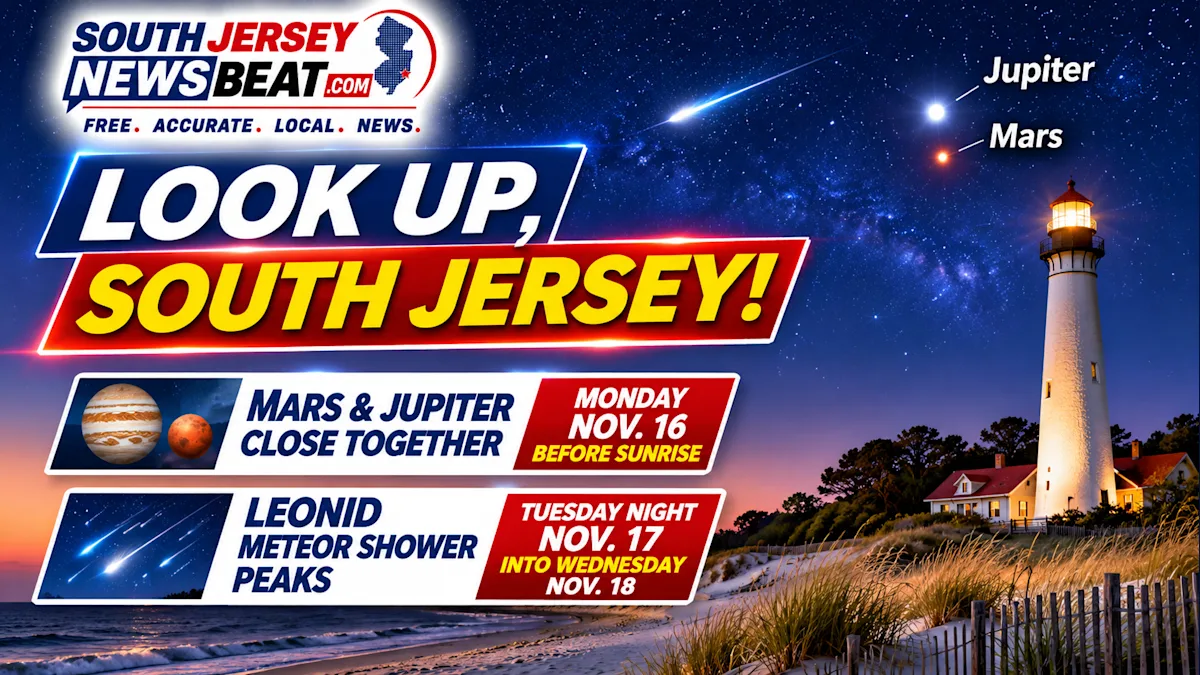
Mars and Jupiter will appear unusually close together before dawn Monday, followed by the peak of the Leonid meteor shower Tuesday night into Wednesday morning.
SOUTH JERSEY — Residents of Atlantic and Cape May counties will have two opportunities to witness celestial events this week, as Mars and Jupiter appear unusually close together in the early morning sky and the annual Leonid meteor shower reaches its peak.
NASA is encouraging skywatchers to look up during the coming days, when the planetary pairing and meteor shower could provide impressive views without requiring a telescope.
The first event arrives before sunrise Monday, November 16, when Mars and Jupiter will appear separated by just 1.2 degrees in the sky.
That's a little more than the apparent width of two full moons placed side by side.
The planets aren't actually moving close to each other in space. Instead, their positions in their respective orbits will make them appear unusually close together when viewed from Earth.
For South Jersey residents, the best viewing opportunity will be approximately 4 to 5:30 a.m. Monday, although the planets will remain relatively close for several mornings afterward.
Look toward the southern sky, where Jupiter will appear as a brilliant white point of light. Mars, which has a distinctive reddish-orange appearance, will be noticeably dimmer.
Both planets should be visible without binoculars or a telescope, provided cloud cover doesn't interfere.
Leonid Meteor Shower Peaks Tuesday Night
The second major event comes Tuesday night, November 17, into the early morning hours of Wednesday, November 18, when the Leonid meteor shower reaches its annual peak.
According to NASA, the Leonids could produce approximately 15 meteors per hour under ideal viewing conditions.
Actual sightings will depend on cloud cover, light pollution and the observer's location. Residents in brightly illuminated areas may see considerably fewer meteors.
The best opportunity to watch will be after midnight and before dawn Wednesday, particularly after the moon has set.
The Leonids occur each November when Earth passes through a trail of debris left behind by Comet 55P/Tempel-Tuttle.
As tiny particles from the comet enter Earth's atmosphere at tremendous speeds, they heat up and create the bright streaks commonly called shooting stars.
Despite the name, these streaks are not stars falling from the sky.
The meteors appear to originate from the constellation Leo, which gives the shower its name, although they can be seen in different parts of the sky.
The Leonids have occasionally produced spectacular meteor storms in past centuries, but astronomers are not predicting that kind of extraordinary display this year.
Instead, viewers can expect a more typical meteor shower, with occasional bright streaks crossing the sky.
Where to Watch in South Jersey
Residents hoping to see the meteor shower should seek locations with minimal artificial lighting and a wide, unobstructed view of the sky.
Atlantic and Cape May counties offer several areas that may provide better viewing conditions than densely developed neighborhoods.
Potential viewing areas include the less-developed portions of the Cape May County coastline, rural areas of western Atlantic County and locations near the Pinelands.
Cape May Point and rural sections of Upper Township may also offer opportunities to escape some of the brighter lights associated with Atlantic City, Wildwood and other developed communities.
However, observers should use only areas legally accessible during overnight hours. Some beaches, parks and wildlife areas have restrictions on nighttime access.
Coastal residents should also be prepared for chilly November temperatures and potentially stronger winds near the ocean.
Tips for Seeing the Meteor Shower
NASA recommends allowing approximately 30 minutes for your eyes to adjust to darkness.
Avoid looking at bright cellphone screens, headlights or other artificial lights while watching.
A telescope isn't necessary for meteor viewing. In fact, using one can make it more difficult to spot meteors because telescopes limit the portion of the sky being observed.
Instead, find a comfortable location, look toward a broad section of the sky and be patient.
Meteors can appear sporadically, with several minutes passing between sightings.
The best viewing conditions generally occur under clear skies away from city lights.
Another Celestial Event Coming November 24
November's astronomical attractions won't end with the meteor shower.
NASA says the full moon on November 24 will also be a supermoon, the first in a series of three consecutive supermoons.
A supermoon occurs when a full moon coincides with a point in the moon's orbit that brings it relatively close to Earth, making it appear somewhat larger and brighter than an average full moon.
For South Jersey residents, the coming week offers several opportunities to enjoy the night sky, whether watching two planets appear nearly side by side or hoping to catch a shooting star streaking overhead.
The key dates to remember are Monday morning, November 16, for Mars and Jupiter, and the early morning hours of Wednesday, November 18, for the Leonid meteor shower.
As with any skywatching event, clear weather will be essential.

About the Author
Karen Johnson
With over 30 years of news experience in major markets like Los Angeles, Denver, and Columbus, Karen now covers our area for South Jersey NewsBeat. She also brings her articulate and conversational news delivery to WOND radio listeners every weekday. Her background includes work with the NBC Radio Network, and she thrives in fast-paced news environments.