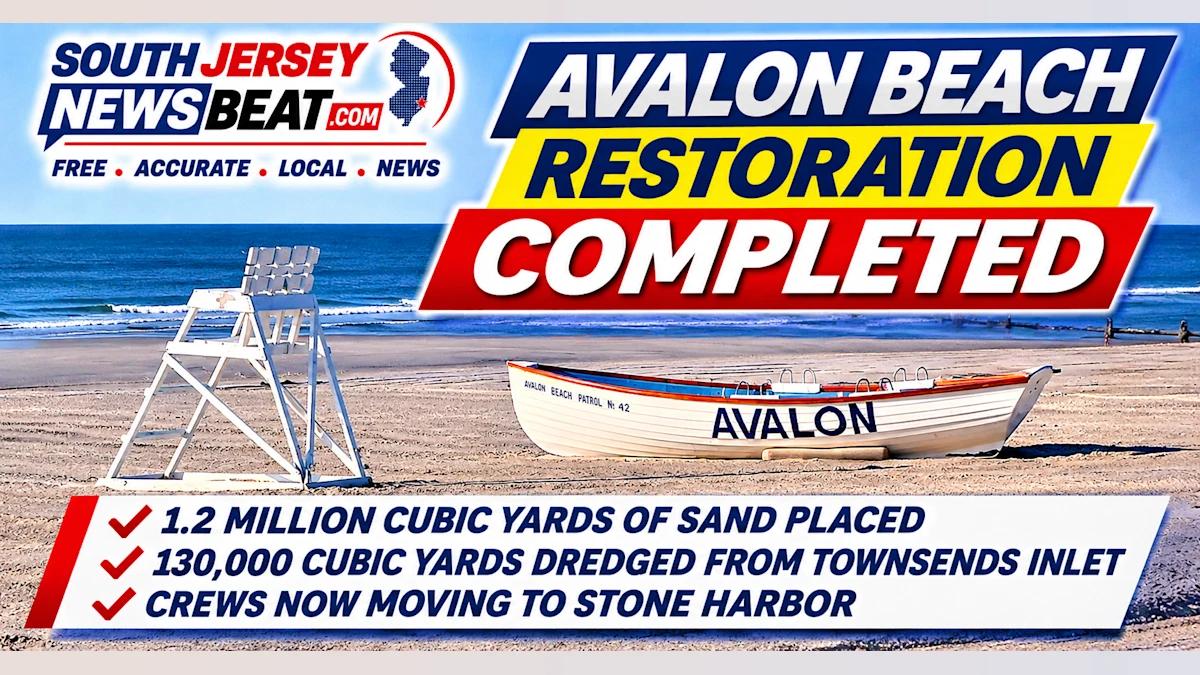
More than 1.2 million cubic yards of sand restore Avalon's northern beaches, while emergency dredging clears a navigation channel in Townsends Inlet.
AVALON, N.J. — One of the largest beach restoration efforts in Avalon's history has been completed, with more than 1.2 million cubic yards of sand placed along the borough's northern shoreline and a separate dredging operation removing approximately 130,000 cubic yards of material from Townsends Inlet.
The projects represent a major investment in coastal storm protection and boating safety, with equipment now transitioning to neighboring Stone Harbor for the next phase of beach replenishment.
According to the Borough of Avalon, the beach restoration project placed 1,201,259 cubic yards of sand along the northern beaches, making it the largest maintenance beach fill in borough history.
The project was conducted by Norfolk Dredging Company under a contract awarded by the U.S. Army Corps of Engineers.
The work began in September and continued through October, despite interruptions caused by rough ocean conditions and mechanical issues.
In addition to rebuilding the beaches, crews conducted a separate dredging operation in Townsends Inlet to remove a sandbar that had created navigation concerns near the Townsends Inlet Bridge.
Approximately 130,000 cubic yards of sand were removed from the channel, according to the borough's latest update.
That material was also placed on Avalon's beaches, providing an additional source of sand for coastal protection.
Largest Maintenance Beach Fill in Avalon History
Avalon's northern beaches have experienced significant erosion in recent years, particularly during coastal storms and periods of unusually high surf.
The replenishment project was designed to widen the shoreline and restore protective beach elevations, helping reduce the potential for storm damage to nearby properties and infrastructure.
The U.S. Army Corps of Engineers awarded a $15.8 million contract to Norfolk Dredging Company in June for periodic beach nourishment in Avalon and Stone Harbor.
The project involves pumping sand from offshore and inlet borrow areas through pipelines onto the beaches, where heavy equipment spreads and grades the material.
The work also includes dune restoration and improvements to beach access infrastructure in designated areas.
Avalon's portion of the federally sponsored beach fill was fully funded by the federal government, with no local cost share for the main replenishment project.
The original plan called for approximately 941,000 cubic yards of sand to be placed on Avalon's beaches.
Additional sand was subsequently authorized, including approximately 100,000 cubic yards intended to address erosion caused by a late-September coastal storm.
By the end of October, the borough reported that more than 1.2 million cubic yards had been placed along its northern shoreline.
The project concentrated on beaches between approximately Ninth and 25th streets, an area that has experienced some of the borough's most significant erosion.
Emergency Dredging Addresses Townsends Inlet Navigation Concerns
While the beach restoration project was underway, Avalon and neighboring Sea Isle City worked with county and state officials to address another longstanding problem: the accumulation of sand in the Townsends Inlet navigation channel.
A substantial sandbar near the Townsends Inlet Bridge had made passage increasingly difficult for recreational boaters and commercial vessels.
The situation prompted a cooperative effort involving Avalon, Sea Isle City, Cape May County, the Cape May County Bridge Commission, the New Jersey Department of Environmental Protection, the U.S. Army Corps of Engineers and Norfolk Dredging.
In October, Avalon Borough Council approved an agreement authorizing the removal of up to 135,800 cubic yards of material from the channel.
The project was designed to create a navigation passage approximately 150 feet wide.
Rather than bringing in a separate dredging operation, officials arranged to use equipment already working in Townsends Inlet for Avalon's beach restoration project.
That approach allowed the communities to address the navigation problem while placing the removed sand on Avalon's beaches.
The emergency dredging project was estimated to cost approximately $1.6 million, with Avalon and Sea Isle City agreeing to share the municipal expense.
Cape May County and the county Bridge Commission also participated in the cooperative agreement.
According to the borough, approximately 130,000 cubic yards of sand had been removed from the navigation channel as the operation concluded.
Boating Access Has Significant Economic Importance
Improving navigation through Townsends Inlet is more than a recreational concern.
The waterway provides an important connection for boaters traveling between Avalon and Sea Isle City, as well as commercial vessels operating in the surrounding coastal waters.
Avalon officials have estimated that activity associated with the inlet generates between $15 million and $21 million annually.
Sand accumulation in the channel can create hazardous conditions, particularly during periods of low tide.
The dredging operation was intended to improve safe passage while helping protect the boating and marine-related businesses that depend on access to the inlet.
However, the project does not permanently resolve the problem.
Townsends Inlet is a dynamic coastal environment where currents and tides continually move sand, potentially causing navigation channels to fill in again.
Borough officials have identified the need for a long-term maintenance strategy involving the agencies responsible for coastal waterways and navigation.
One challenge is that no single government agency has responsibility for routine maintenance dredging of the channel.
The cooperative agreement that made the emergency project possible could provide a framework for future discussions about maintaining safe navigation.
Equipment Moving to Stone Harbor
With work wrapping up in Avalon, the dredging operation is shifting south to Stone Harbor.
Stone Harbor is preparing for its own beach replenishment project, which is expected to place more than 500,000 cubic yards of sand along portions of the borough's shoreline.
The work is part of the broader federal coastal protection effort involving the Seven Mile Island communities.
Construction equipment and staging materials are being moved into Stone Harbor as crews prepare to begin pumping sand.
Residents and visitors may notice increased construction activity and temporary beach access restrictions near the work areas.
In Avalon, beach paths between 12th and 14th streets remained closed during the final stages of the operation.
The borough said equipment was expected to be relocated to Stone Harbor by November 14, with all Avalon beach paths reopened by that time.
The schedule remains subject to weather, equipment availability and final demobilization activities.
Why Beach Replenishment Matters
Beach replenishment is one of the primary methods used by coastal communities to reduce storm-related damage.
By widening beaches and rebuilding protective dunes, the projects create additional space for waves to lose energy before reaching roads, homes and other structures.
The added sand also helps restore recreational beaches that support tourism and property values.
However, replenishment is not a permanent solution.
Sand naturally moves along the coastline through wave action, currents and storms, requiring periodic maintenance to preserve protective beach widths.
That challenge is particularly significant along the Jersey Shore, where coastal communities face recurring erosion and increasingly costly storm damage.
Avalon's latest project demonstrates both the scale of the work required to maintain its beaches and the importance of cooperation among local, county, state and federal agencies.
For Avalon residents, the immediate result is a substantially restored northern shoreline and an improved navigation channel.
For Stone Harbor, the focus now turns to completing the next phase of coastal protection work before the 2027 summer tourism season.
The completion of the Avalon project marks a significant milestone in ongoing efforts to protect Seven Mile Island from coastal storms while preserving the beaches and waterways that are central to the local economy.

About the Author
Peter Killeen
A 25-year radio news veteran, Peter covers South Jersey for NewsTalk 1400 & 92.3 WOND radio. Known for his concise and impactful delivery, he ensures listeners and readers stay informed without unnecessary filler.