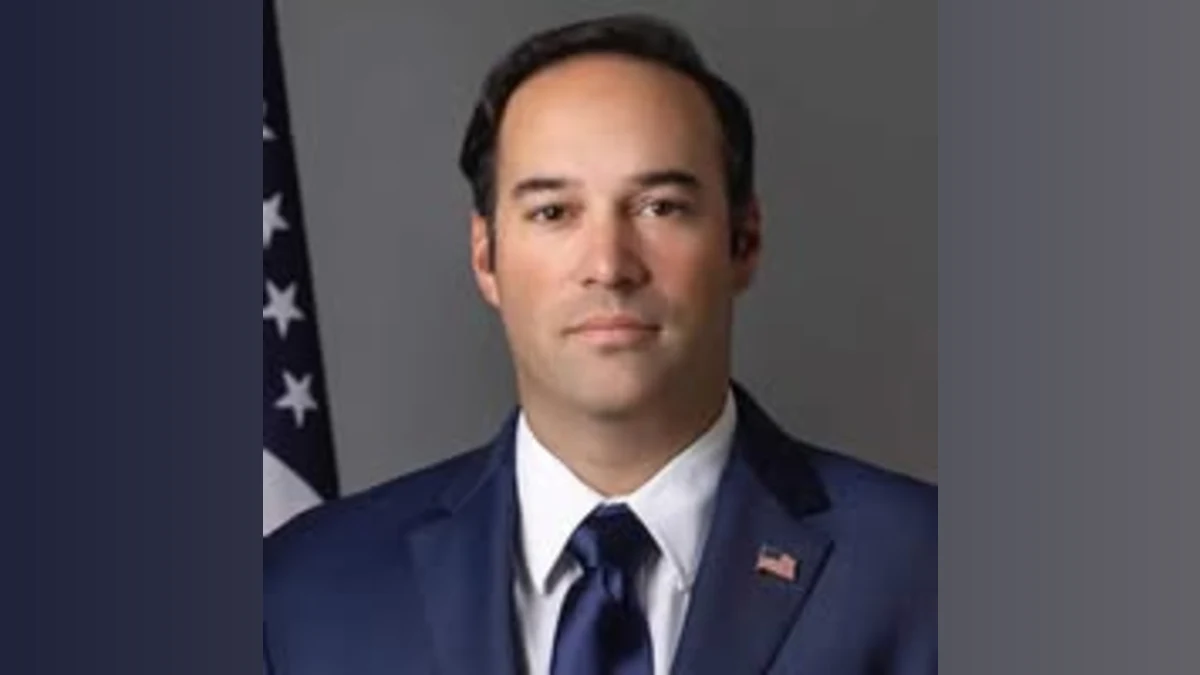
EDITOR'S NOTE: The following commentary summarizes views expressed by Brian T. Fitzherbert, president and treasurer of Liberty and Prosperity, during an appearance on “Talking With Anne” on WOND. The opinions and conclusions are Fitzherbert's and do not necessarily reflect the views of South Jersey NewsBeat.
Brian T. Fitzherbert believes the United States has another powerful weapon to wield against Iran — and it doesn't necessarily require bombs, missiles or American troops.
It's America's economic power.
Appearing with host Anne Baker on Talking With Anne on WOND, Fitzherbert argued that the Trump administration should use the enormous economic leverage of the United States not only against Iran, but also against countries, businesses and other entities that provide financial or material support to Tehran.
In Fitzherbert's view, the United States should force those countries to make a choice.
“If you're friends with the United States, we expect you to act accordingly,” Fitzherbert said.
Countries that choose to continue providing Iran with a lifeline, he argued, should understand that doing so could affect their economic relationship with the United States.
Fitzherbert said the strategy increasingly appears to involve using economic pressure while retaining military force as an option if circumstances warrant it.
“For now, the economic squeeze is going to be put on these other countries,” Fitzherbert said.
‘Economic warfare’
Fitzherbert pointed to Treasury Secretary Scott Bessent as a central figure in that approach.
He argued that sanctions and other economic measures shouldn't stop with governments directly supporting Iran. They could potentially extend throughout financial and material supply chains involving entities that help sustain the Iranian government.
Fitzherbert specifically mentioned precious metals, cryptocurrency, logistics, aerospace, aviation and technology as areas where economic pressure could be applied.
“If there are individuals up and down this financial and material supply chain that impact any of those areas ... then there's going to be some pain,” Fitzherbert said.
His argument rests on a straightforward proposition: Few countries can afford to lose access to the American economy.
“If you go head-to-head with the United States one-on-one economically, you are going to lose,” Fitzherbert said.
Alliances don't eliminate disagreements
Fitzherbert also argued that America's relationships with other countries shouldn't be viewed as permanent or unconditional.
Even allies sometimes pursue interests contrary to those of the United States, he said.
That doesn't mean Washington should sever relationships with difficult partners, according to Fitzherbert. Intelligence gathering, military cooperation, diplomacy and other national-security considerations sometimes require the United States to continue dealing with governments it doesn't completely trust.
“You still have to work with people that make it a very difficult situation or environment,” Fitzherbert said.
Fitzherbert said that philosophy requires avoiding both extremes.
“You can't go full isolationist, but you also cannot go full neocon either,” he said.
A warning about pushing allies too far
Canada became Fitzherbert's principal example.
He strongly defended President Donald Trump's willingness to use tariffs and other economic leverage in trade negotiations, arguing that the United States should demand reciprocal treatment from its trading partners.
But Fitzherbert also acknowledged a potential danger.
Push an ally too far, he said, and it may seek a closer relationship with one of America's principal geopolitical competitors.
“When you put someone in a corner and they thought that you were their friend, what are they going to do?” Fitzherbert said. “They're going to reach out for help and support elsewhere, no matter where it comes from.”
That could mean China or Russia.
Fitzherbert said policymakers therefore need to consider not merely the immediate effect of economic pressure but what could happen several moves later.
“We have to anticipate two, three, four, five steps down the road,” he said.
Fitzherbert wants New Jersey to act on Chinese property purchases
Fitzherbert also brought the national-security discussion closer to home.
He called for New Jersey to restrict Chinese nationals from purchasing real estate, particularly because of concerns about foreign ownership of property near sensitive U.S. installations.
“Take it to the local level,” Fitzherbert said. “It should be so simple. It is in other states. It's not in New Jersey.”
“Prevent Chinese nationals from buying real estate in the United States,” he added. “Plain and simple.”
Fitzherbert contended that foreign purchases of houses, farmland or other property near military facilities can raise intelligence and national-security concerns.
Those comments represented Fitzherbert's policy position during the interview, rather than a finding that any particular New Jersey property transaction poses such a threat.
Iran and the Strait of Hormuz
Fitzherbert believes Iran's ability to disrupt traffic through the Strait of Hormuz gives Tehran substantial leverage because of the waterway's importance to global energy supplies.
He argued that disruption there eventually reaches American consumers through energy and transportation costs.
“It affects the oil at the pump because it's affecting the overall global supply,” Fitzherbert said.
Fitzherbert said economic pressure can be sustained through sanctions and other measures, while military options remain considerably more difficult and costly.
His larger argument is that Iran should face pressure from multiple directions until its government abandons its nuclear-weapons ambitions and other policies opposed by the United States.
He also expressed skepticism that negotiations alone will resolve the conflict, contending that Iran has used negotiations as a delaying tactic.
Bringing it back to New Jersey
For South Jersey residents, Fitzherbert said the most visible consequence of international instability may ultimately be the price displayed at the neighborhood gas station.
He acknowledged that Americans are feeling an economic “crunch” and said increased fuel prices work their way into grocery and other consumer prices because businesses must pay more to transport goods.
“When you're at the grocery store, that's part of the gas increase,” Fitzherbert said.
Fitzherbert argued New Jersey has tools of its own that could reduce those costs.
Among them, he advocated a temporary state gasoline-tax holiday and reconsidering New Jersey's prohibition on motorists pumping their own gasoline.
“All these things could be done on the state level, just in New Jersey as an example,” Fitzherbert said.
Whether those proposals would produce the savings Fitzherbert anticipates is a separate policy question.
But his broader position is clear: Economic policy and national security cannot be separated.
From sanctions against Iran to tariffs involving allies and adversaries to gasoline policy in New Jersey, Fitzherbert argues that economic leverage is increasingly one of America's most important instruments of power.
And he believes the United States should be willing to use it.
EDITOR'S NOTE: This article summarizes commentary by Brian T. Fitzherbert during his appearance on WOND's “Talking With Anne.” The views expressed are Fitzherbert's and do not necessarily reflect the views of South Jersey NewsBeat. Publication in the Opinion section does not constitute an endorsement of those views.

About the Author
Opinion/Commentary
ABOUT OPINION: The South Jersey NewsBeat Opinion section provides a forum for commentary and differing viewpoints on issues of public interest. Opinions expressed belong to the individual authors or commentators and do not necessarily reflect the views of South Jersey NewsBeat.