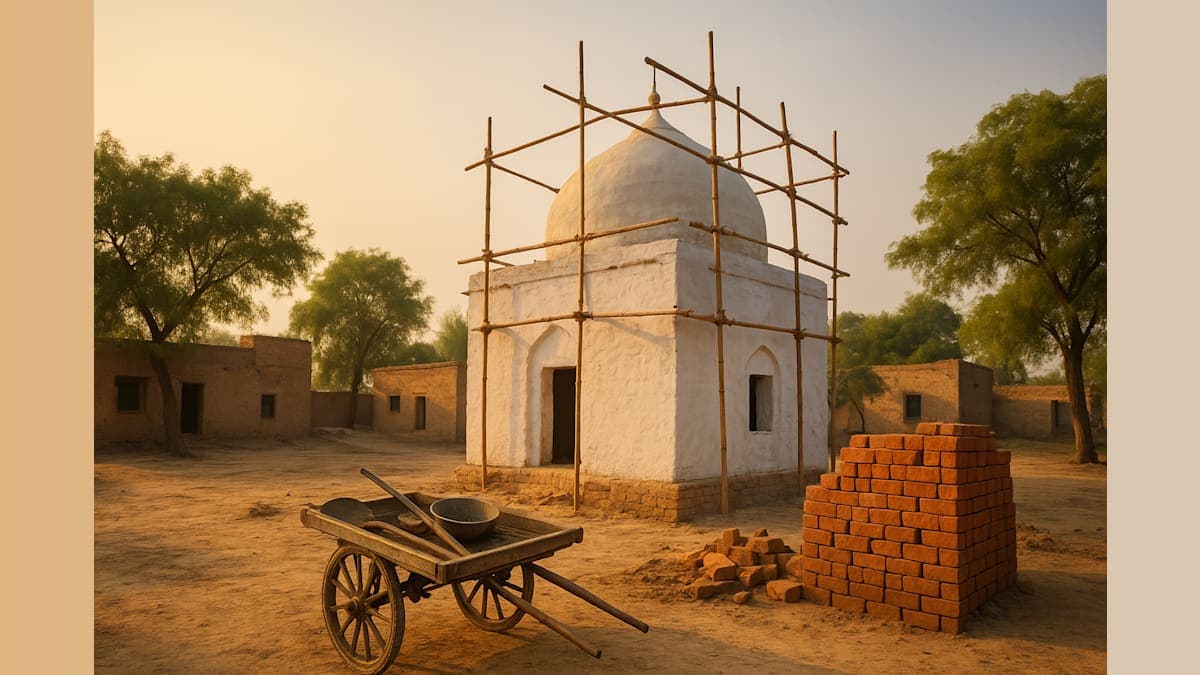
In the Indian state of Punjab, Muslim residents are witnessing an unusual form of neighborly repair: Sikhs and Hindus are organizing the reconstruction of old mosques that were destroyed in the upheaval that followed Partition. The efforts, detailed in a Guardian photo essay from the villages of Jakhiwal, Punawal, and Umarpura, involve both the restoration of existing structures and the construction of new ones from the ground up, in more than one case on land donated by a neighbor of a different faith.
The work carries particular weight because many of those leading it are old enough to remember the violence that accompanied the division of the region, when one portion of Punjab was assigned to Pakistan and another to India, splitting families and homes, sometimes literally, in two.
In Jakhiwal, Bibi Rajinder Kaur, a 77-year-old Sikh woman, encouraged her grandson to give land for a new mosque. In Punawal, Jaspal Sharma, 48, who comes from a family of Hindu priests, made a similar donation. When the mosque was finished in February, Sharma hosted a feast for the entire village to mark the completion.
Sharma said the call to prayer, which is silenced in some Western countries, gives the village what he described as a lively atmosphere. He told the Guardian's Cheena Kapur that the contribution was not limited to his family. "And it wasn’t just us; everyone in the village, Hindus and Sikhs together, contributed what they could," Sharma told the Guardian. "Some gave money; others donated bricks and cement."
In Umarpura, Sikh residents pitched in to restore an antique Muslim shrine. Sukhjinder Pander, one of the men who contributed his labor, described a local ethic that transcends the wider country's tensions. "We live as one and no matter what happens in the rest of the country, the mood here is that of love and unity. Punjab’s conscience cannot tolerate cruelty against a being, irrespective of caste and religion," Pander told the Guardian.
Pander also noted that religious observance in the area is shared rather than segregated, telling the Guardian that "Eid and Gurpurab [Sikhs’ most holy festival] are celebrated by both communities with the same fervor."
The phenomenon is not confined to these three villages. India Tomorrow reported three years ago on a separate set of villages where residents carried out comparable gestures of tolerance and support for neighbors of other faiths. India is frequently cited as evidence that democracy can function amid extraordinary linguistic, racial, and religious diversity, with constitutional guarantees of equal protection for all. Yet in Punjab, residents are demonstrating that such coexistence does not depend on courts or statutes. It is embedded in the daily life of the landscape, enacted neighbor to neighbor.