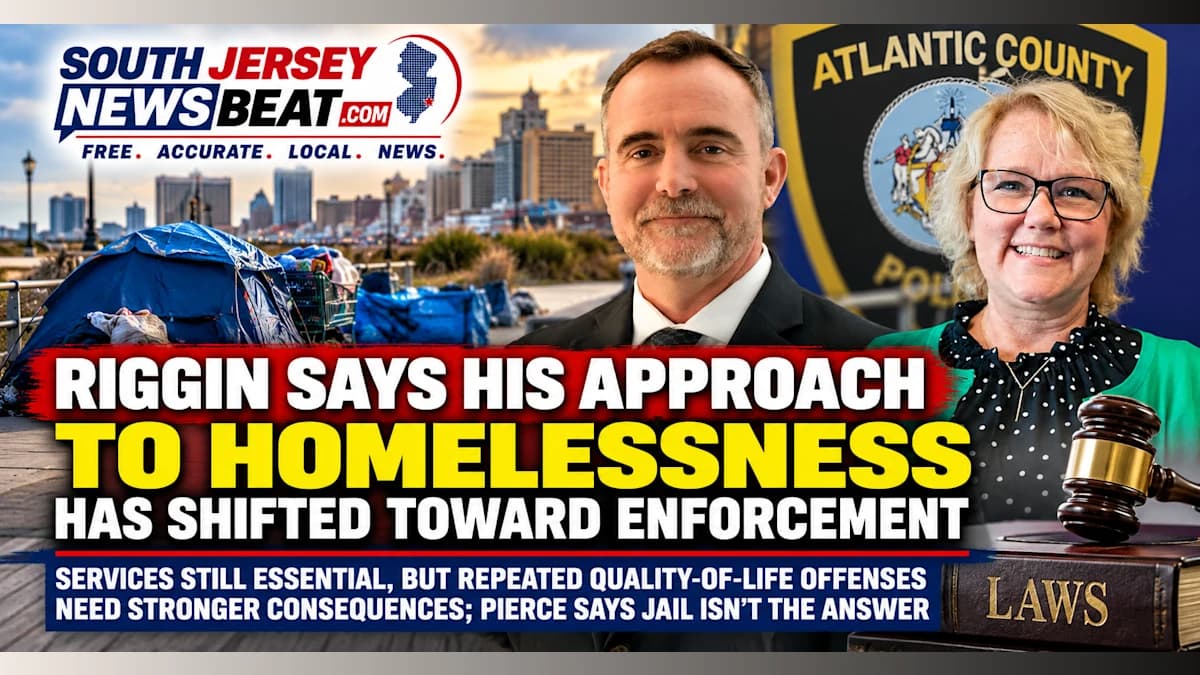
ATLANTIC CITY — Atlantic County sheriff candidate Sean Riggin says his thinking on homelessness has shifted toward greater enforcement, arguing that communities need stronger tools to deal with people who repeatedly commit quality-of-life offenses while refusing offers of assistance.
But Riggin, Atlantic City's public safety director and the Democratic challenger to Republican Sheriff Joe O'Donoghue, said enforcement represents only one side of an approach he believes must also include greater access to mental-health care, addiction treatment, housing assistance and individualized social services.
“I came in with a very different opinion than the one that I have now,” Riggin said Wednesday on Off The Press with Scott Cronick on News Talk 1400 & 92.3 WOND.
Riggin credited retired Atlantic City Deputy Police Chief Bridget Pierce, whom he has selected to serve as undersheriff if he wins in November, with helping shape his current position.
“I think Bridget has helped me craft a lot of where I am today, which is, you know, further on to the enforcement side than I was when I started a couple of years ago,” Riggin said.
Riggin: Services Aren't Enough by Themselves
Riggin said homelessness should not be viewed simply as an Atlantic City problem because people experiencing homelessness, addiction and mental illness can be found throughout the county and state.
The first priority, he said, should be getting meaningful assistance to people on the street.
“We have to find ways to push real help to these people as far as like social services and social work and like give them individual case management,” Riggin said.
But he said there also needs to be an answer for people who repeatedly refuse those services while committing offenses that affect surrounding neighborhoods and businesses.
“If we've got people that just do not want the help and continue to create quality of life issues in our communities, then we need to craft some laws that are going to put some teeth behind those petty disorderly persons offenses,” Riggin said.
He specifically mentioned panhandling and said some individuals accumulate numerous municipal citations without the citations changing their behavior.
“Right now we've got people showing up to court with 12 and 15 open tickets,” Riggin said. “They're getting a $10 fine, you know, with a payment plan. And it's just not working.”
South Jersey NewsBeat has not independently verified Riggin's characterization of those municipal court cases.
Outreach Workers Say Most Initially Reject Help
The difficulty Riggin describes — people declining assistance — is something Atlantic City outreach workers have discussed publicly as well.
In August, South Jersey NewsBeat reported that Lou Gasparini of Rising Tides Outreach estimated approximately six out of every 10 unhoused people approached by his organization initially turn down assistance.
But Gasparini said outreach workers don't stop after the first rejection.
“We just persist and persist until we either get help for somebody,” Gasparini told Klein Time with Dan Klein.
Gasparini estimated the program was achieving what he called a 32% to 40% monthly success rate in Atlantic City's Chelsea neighborhood — meaning approximately one out of every three people contacted was connected with meaningful assistance such as detoxification, rehabilitation, housing assistance or reunification with family.
He emphasized that the figure does not mean those individuals permanently escape homelessness or addiction.
“We can just keep helping and helping and hope that something clicks in somebody's head like it did for me,” Gasparini said.
That same program also illustrates how Atlantic City has attempted to combine accountability with treatment.
Gasparini described a program involving businesses, outreach workers, the municipal court and social-service providers in which some people receiving citations can ultimately have fines dismissed if they meaningfully engage with services.
Pierce: Jail Isn't the Answer Either
Pierce said she agrees that communities need a different approach, but emphasized the shortage of long-term mental-health treatment.
“No one wants to see somebody unhoused,” Pierce said. “Obviously, we have a housing problem, but we also have a severe mental health problem.”
Pierce said some people need a level of extended treatment that is difficult to obtain through the current system.
“The people with those mental health issues just don't have a hospital to go to,” Pierce said.
She distinguished that from short-term hospital or crisis services, describing instead a place where someone could remain and receive treatment for an extended period.
But Pierce was equally clear about what she does not view as the solution.
“Jail's not the place either,” she said.
Atlantic City Already Building a Services-Based System
Atlantic City has significantly expanded its homelessness response in recent years.
The New Jersey Department of Community Affairs announced a three-year coordinated plan in late 2024 aimed at addressing unsheltered homelessness in the city through street outreach, improved shelter access, health care, housing and prevention.
The initiative brings together Atlantic City, Collaborative Support Programs of New Jersey, AtlantiCare, Jewish Family Service and the Atlantic County Continuum of Care. The state says the effort includes real-time tracking of the unsheltered population, targeted street outreach, mobile health services, improved shelter access and expanded housing and prevention programs.
CSPNJ also provides outreach in Atlantic County, connecting people with services that can include mental-health and substance-use treatment, identification documents, benefits, medical care and housing assistance. The organization describes its approach as low-barrier and housing-first.
Atlantic City's Boardwalk Improvement Group also combines outreach with enforcement of quality-of-life ordinances. The city says the initiative addresses issues including homelessness, encampments, aggressive Boardwalk performers, bicycle violations, smoking and open-container violations.
Possible Changes to State Law
Riggin said Assemblywoman Maureen Rowan has been involved in discussions with Atlantic City officials about possible changes on the enforcement side.
“I want to give a shout out to Assemblywoman Maureen Rowan, because she has been working with us in Atlantic City to talk about some of these issues and figure out what can we do on the enforcement end?” Riggin said.
He said the broader question is how enforcement can be used to steer people toward care while outreach organizations provide the other side of the equation.
South Jersey NewsBeat could not identify a currently filed bill corresponding to the changes Riggin described.
Riggin said he does not envision the Sheriff's Office creating another homelessness organization if he is elected.
Instead, he said he wants the department to support programs that already exist and ask individual police chiefs what assistance they need.
“I think there are a million programs out there right now,” Riggin said. “I think we need to pick some and go with them.”
His preference, he said, is to put additional resources behind programs that can demonstrate they're already working.
“Let's get behind the programs that we have and find ways to make them work.”
Riggin said he sees the Sheriff's Office's role as supporting those organizations and local police departments rather than leading a new social-service program.
The larger question, he said, is how to balance helping people experiencing homelessness with addressing the impact persistent quality-of-life problems can have on communities.
Sean Riggin and Bridget Pierce made their comments on Off The Press with Scott Cronick, heard Monday through Friday from 4 to 6 p.m. on News Talk 1400 & 92.3 WOND.

About the Author
Peter Killeen
A 25-year radio news veteran, Peter covers South Jersey for NewsTalk 1400 & 92.3 WOND radio. Known for his concise and impactful delivery, he ensures listeners and readers stay informed without unnecessary filler.