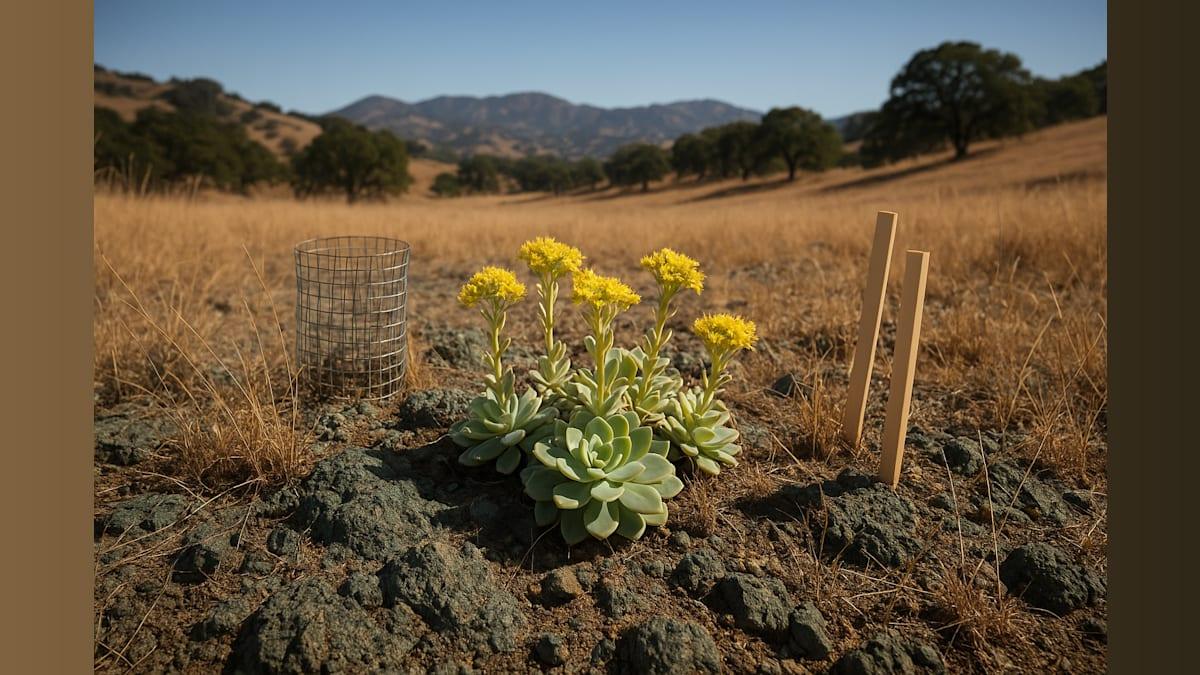
SANTA CLARA, Calif. — Santa Clara University scientists and students are mounting a multifaceted campaign to rescue a federally endangered wildflower that exists in just one place on Earth: the Coyote Valley Region of Santa Clara County. The Santa Clara Valley dudleya (Dudleya setchellii), commonly called the Santa Clara Valley "liveforever," is a flowering succulent that serves as a vital food source for pollinators and ranks among the most poached wild plants in California.
The plant's nickname reflects its remarkable resilience. It can appear shriveled and dead for months, then revive almost instantly with even a trace of rain, plumping back up and producing pale yellow flowers. Beyond poaching, the species faces threats from climate change and habitat loss.
Dr. Justen Whittall and his students routinely collect the plant's minuscule seeds from the flowers of wild specimens, then analyze them in the laboratory at Santa Clara University to assess genetic diversity. Using the most diverse specimens, the team has successfully bred the plant in captivity for eventual release into the wild. They also monitor known wild populations to determine which pollinators depend on the plant's infrequent flowering for food, and they urge the public not to remove dudleya from natural areas.
Whittall's colleague, Professor Stephen McCabe, has pursued a different tack: a market-based strategy. He hybridized the plant into colorful varieties for sale to plant nurseries, a "flooding the market" approach intended to reduce demand for wild, poached dudleya and its more modest colorations.
"The minimum is to prevent the extinction of a species and at best we might even improve its current status," Whittall told CBS.
The efforts of Whittall, McCabe, and their students represent a local response to a global problem: the illegal trade in rare plants. By combining genetic research, captive propagation, pollinator monitoring, public education, and market intervention, the Santa Clara University team is working to ensure that the liveforever, as its name suggests, endures.