
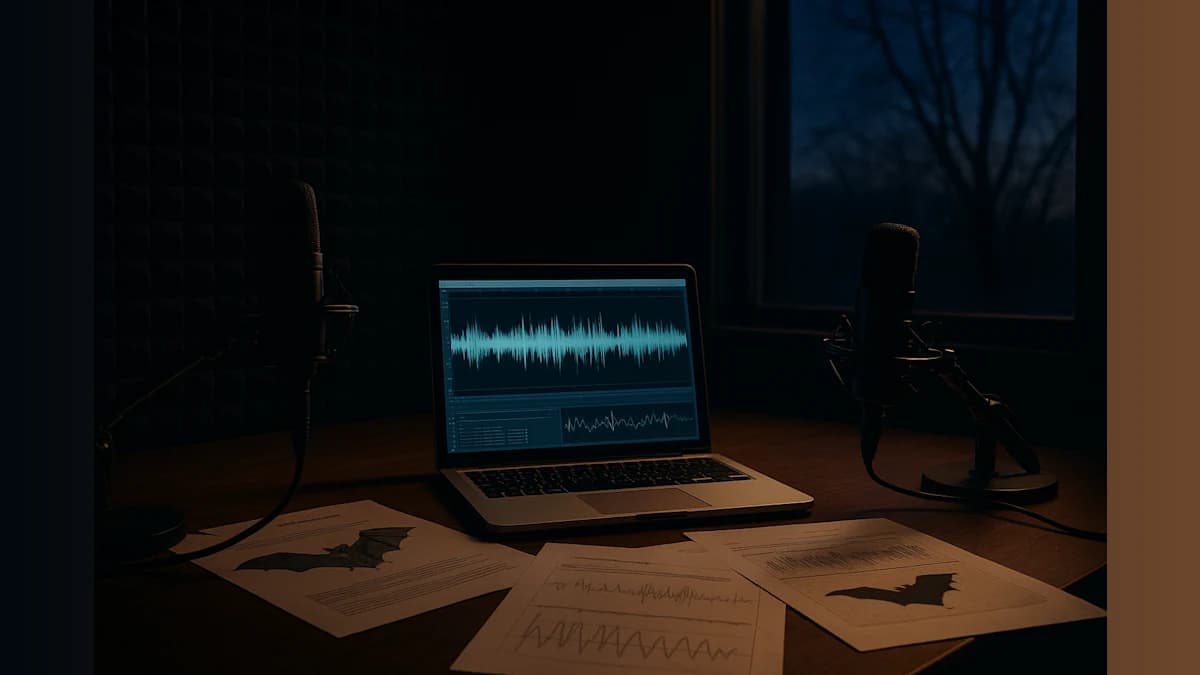
Two Scottish artists have released an album that reimagines the ultrasonic world of bats as pulsing electronic dance music, transforming echolocation calls into beats and melodies that challenge listeners to reconsider one of nature's most maligned creatures.
Echo in the Dark, created by Hanna Tuulikki and Tommy Perman, translates the normally inaudible calls of eight bat species into club-ready tracks. The album blends processed bat recordings with human voice to forge what the creators describe as a hybrid sound world bridging two species.
The project originated in 2022 when Hospitalfield, an arts venue in Arbroath, Scotland, commissioned Tuulikki to develop work inspired by bats following community bat walks held during Covid lockdowns. She envisioned dance music built from echolocation sounds and brought Perman aboard as collaborator.
Using heterodyne bat detectors to make ultrasonic frequencies audible to human ears, the artists discovered a sonic landscape rich with clicks, buzzes, and rhythmic patterns that bear striking resemblance to synthesized electronic music.
"It was an easy yes from me," Perman, who has extensive experience merging natural sounds with electronic instruments, told Positive News. "What you hear is extraordinary – clicks, buzzes, rhythms and warbles that could easily be mistaken for samples from electronic dance music. That realisation felt like an invitation we couldn't ignore."
The duo recorded some bat calls themselves and issued an open call for additional recordings. Working alongside Tayside Bat Group, they ultimately gathered sounds from 13 of the 18 bat species found in the UK. Eight species made the final cut for the album, their vocalizations processed into rhythmic foundations, melodic elements, and atmospheric textures.
Perman admitted he initially expected different bat species to sound largely alike, but the diversity proved remarkable. "The lesser horseshoe bat produces the most beautiful rippling calls that wouldn't be out of place on a dub record, while the Daubenton's bat creates amazing syncopated rhythms that sound like a jazz drummer," he told Positive News.
Before becoming a studio album, the project debuted as outdoor "silent bat raves" where audiences danced through headphones at dusk while actual bats flew overhead. The music has since been refined and expanded into a full-length release available on vinyl and digital formats. Glasgow independent label KIN-TU released the album on Thursday, August 28.
Beyond its musical innovation, the album addresses a conservation challenge. Bats play essential roles in ecosystems yet remain burdened by negative associations and superstition. Perman cited a recent Bat Conservation Trust survey revealing that 46 percent of people in the UK harbor negative feelings toward bats.
Rather than lecturing audiences, the artists harness the communal power of dance music to shift perceptions. "Dance music has always been a space where people can come together, lose themselves in the moment, and feel part of something bigger," Perman told Positive News. "We hope the album can use that power to nurture a different kind of relationship with the more-than-human world – one rooted in curiosity and care rather than fear."
The ultimate goal remains modest but meaningful. Perman expressed hope that listeners unfamiliar with bats might finish the album with changed attitudes. "If it sends even a handful of listeners out into the night to listen for bats, or to support bat conservation, that feels like a genuinely positive outcome," he told Positive News.
The project demonstrates how creative approaches can bridge the gap between human culture and wildlife conservation, using the universal language of rhythm and melody to foster appreciation for creatures often viewed with unwarranted suspicion.