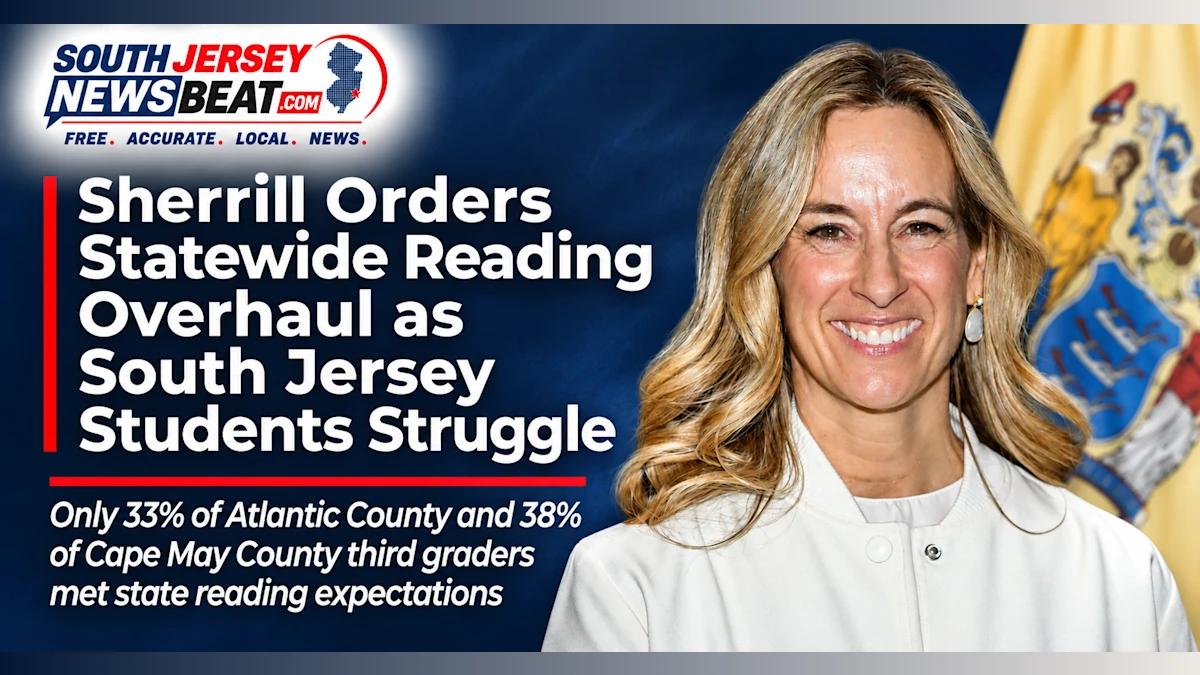
Only 33% of Atlantic County third graders and 38% of Cape May County third graders met state English language arts expectations in 2025, highlighting the need for improved literacy instruction.
Gov. Mikie Sherrill has signed an executive order directing a statewide overhaul of reading instruction in New Jersey's public schools, an initiative that could have significant implications for South Jersey communities where student literacy rates remain substantially below the statewide average.
Sherrill signed Executive Order No. 30 on Monday, November 23, in North Brunswick, directing the New Jersey Department of Education to develop a comprehensive strategy to improve reading proficiency, strengthen teacher training and close persistent academic achievement gaps.
Despite New Jersey's reputation as one of the nation's leaders in public education, nearly half of the state's students in grades three through nine are not meeting grade-level expectations in English language arts, according to the governor's office.
In portions of South Jersey, the problem is considerably more pronounced.
"Too many students are falling behind in reading, and we have to act early to change that," Sherrill said.
Atlantic and Cape May Counties Trail Statewide Average
Data compiled by Advocates for Children of New Jersey illustrate the literacy challenges facing South Jersey schools.
During the 2024–2025 school year, the percentage of third graders who met or exceeded expectations on the state's English language arts assessment was:
Atlantic County: 33%
Cape May County: 38%
Cumberland County: 20%
Salem County: 31%
Camden County: 39%
Gloucester County: 42%
Burlington County: 44%
Statewide: 45%
Atlantic County's proficiency rate was 12 percentage points below the statewide average, while Cape May County trailed by seven points.
Cumberland County recorded the lowest percentage among New Jersey's 21 counties, with only one in five third graders meeting or exceeding state expectations.
Although the figures remain concerning, both Atlantic and Cape May counties demonstrated some improvement from the previous school year.
Atlantic County's third-grade English language arts proficiency rate increased from 29% in 2024 to 33% in 2025. Cape May County improved from 37% to 38% during the same period.
Cumberland County's rate declined from 21% to 20%.
The assessments measure broader English language arts skills, including reading comprehension and writing, rather than simply whether a child can read.
Nearly Three-Quarters of Atlantic City Third Graders Fall Short of State Expectations
More recent data presented to the Atlantic City Board of Education on November 17, 2026, underscore the challenges facing the city's public schools.
According to the district's presentation of spring 2026 state assessment results, approximately 25.4% of Atlantic City's third graders met or exceeded expectations in English language arts.
That compares with 27.4% in 2025 and approximately 28% in 2024.
The results mean that nearly three-quarters of Atlantic City's third-grade test takers fell short of the state's proficiency benchmark this spring.
Across all tested grade levels in Atlantic City, approximately 29% of students met or exceeded English language arts expectations in 2026, compared with nearly 33% in 2025.
The 2026 results came from the state's new adaptive assessment, while earlier results were based on the previous version of the New Jersey Student Learning Assessment.
Performance also varied significantly among individual schools.
The district highlighted Richmond Avenue School for exceeding statewide English language arts benchmarks across all tested grade levels.
Several other Atlantic City schools demonstrated improvement in individual grades, even as the district's overall proficiency rate declined.
The contrasting results suggest that examining successful instructional practices within individual schools could help inform efforts to improve performance elsewhere in the district.
Why Third-Grade Reading Proficiency Matters
Sherrill's executive order places particular emphasis on ensuring students develop strong reading skills by the end of third grade.
Education officials consider that period an important milestone because students increasingly rely on their reading abilities to understand material in mathematics, science, social studies and other subjects as they advance through school.
Children who struggle with literacy during their early elementary years can face additional academic difficulties as classroom instruction becomes more demanding.
The governor's office also acknowledged that achievement gaps remain particularly pronounced among economically disadvantaged students, multilingual learners and students with disabilities.
The new initiative seeks to identify struggling students earlier and provide additional assistance before those difficulties become more significant.
New Reading Instruction Standards and Materials
Under Sherrill's executive order, the Department of Education must produce a statewide literacy improvement strategy within 90 days.
The department will also be required to establish a list of approved reading screening tools within 180 days.
At least one approved screening option must be available to school districts at no cost. Districts will eventually be required to select their screening tools from the state's approved list.
Within 360 days, the department must complete a review of early literacy classroom materials and identify programs supported by scientific research.
School districts will initially be encouraged to use the approved materials, while the state examines the potential costs and feasibility of making their adoption mandatory.
The directive builds upon bipartisan literacy legislation enacted in August 2024.
Greater Emphasis on the Science of Reading
The administration's initiative emphasizes an approach commonly known as the Science of Reading, which draws on research into how children develop literacy skills.
Rather than relying on a single instructional technique, the approach combines systematic instruction in letter sounds, phonics, spelling, vocabulary, reading fluency and comprehension.
It also emphasizes identifying individual learning needs and adjusting instruction accordingly.
"Strong readers are built through intentional instruction," New Jersey Education Commissioner Dr. Lily Laux said.
The state intends to help teachers identify students who need additional support and provide interventions tailored to their specific difficulties.
Additional Training and Support for Teachers
The executive order also directs education officials to review how prospective teachers are prepared to teach reading.
The state will examine educator certification requirements and seek to expand the availability of qualified reading specialists.
Teachers already working in classrooms will receive additional support through professional development initiatives.
A regional literacy coaching pilot program will also be established to help educators interpret assessment results, adjust classroom instruction and evaluate student progress.
For South Jersey school districts, the availability of regional literacy coaches could provide additional expertise to support existing classroom teachers and reading specialists.
However, the administration has not yet announced which districts will participate in the pilot program or how many coaches will be available.
State Exploring Intensive Summer Reading Camps
One provision of the executive order could eventually provide additional educational opportunities outside the traditional school year.
The Department of Education has been directed to develop a plan within 90 days for a possible statewide summer program offering intensive reading instruction to students performing below grade level.
Students could be identified through literacy screenings conducted near the end of the school year.
The state will examine how such a program could operate, including its feasibility and structure.
The executive order does not immediately establish summer reading camps in every district, and details regarding funding, locations, transportation and student participation remain undetermined.
Such programs could be particularly relevant in South Jersey communities where a substantial percentage of elementary school students are struggling to reach state academic benchmarks.
What South Jersey Parents Can Expect
The executive order does not immediately change classroom instruction in every New Jersey school.
Instead, it establishes deadlines for developing policies and resources that districts will use as the initiative moves forward.
Parents may eventually see changes in how schools assess reading skills, communicate assessment results and provide additional assistance to struggling students.
Families can review their individual school's academic performance through the New Jersey Department of Education's School Performance Reports.
Parents can also contact their children's teachers or school administrators to learn more about existing literacy screening programs, reading intervention services and academic support opportunities.
For Atlantic, Cape May and Cumberland counties, the central question will be whether the state's new initiative produces measurable improvements in classrooms where many students continue to fall short of statewide expectations.
With nearly two-thirds of Atlantic County third graders and four out of five Cumberland County third graders falling below the state's English language arts proficiency benchmark in 2025, the results of the initiative could have lasting implications for South Jersey's students, families and communities.

About the Author
Karen Johnson
With over 30 years of news experience in major markets like Los Angeles, Denver, and Columbus, Karen now covers our area for South Jersey NewsBeat. She also brings her articulate and conversational news delivery to WOND radio listeners every weekday. Her background includes work with the NBC Radio Network, and she thrives in fast-paced news environments.