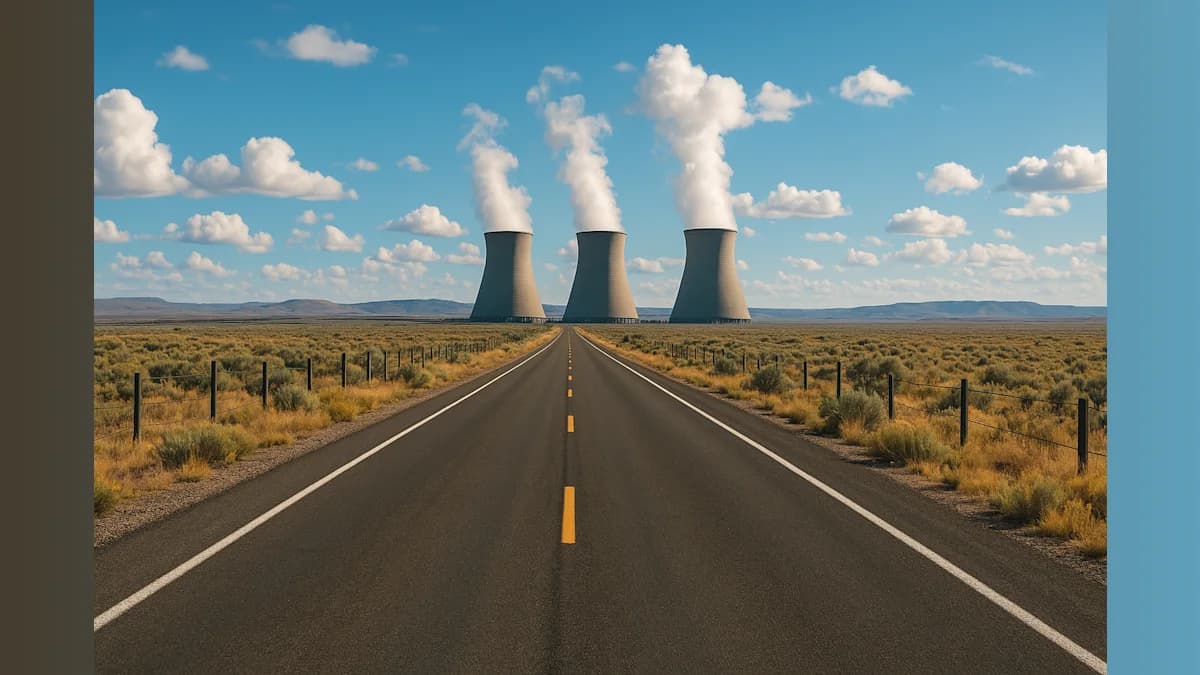
The tiny community of Atomic City, Idaho stands in stark contrast to national sentiment on nuclear power. While a March Gallup poll revealed that most Americans remain opposed to nuclear energy plants in their neighborhoods, this town of 52 residents embraces its proximity to the nation's atomic testing grounds.
Vickie O'Haro owns the Atomic City Bar & Store and Atomic Motor Raceway, establishments that serve workers from Idaho National Laboratory, the federal facility that has tested nuclear energy technologies since 1949. The laboratory sprawls across 900 square miles of high desert sagebrush, covering an area nearly the size of Rhode Island.
"I live 10 miles away, and I'm fine," O'Haro told NPR. "I'm not glowing in the dark, you know? There's nothing to be scared of."
Her bar attracts regulars from the laboratory, where she knows their drink orders by heart. The establishment serves cold beers and shots called atomic bombs, fitting refreshments given the clientele's workplace. Inside, dollar bills plaster the walls alongside a Don't Tread On Me flag, and patrons still smoke indoors.
The community's comfort with nuclear technology comes as the industry experiences renewed momentum nationwide. President Donald Trump accelerated new nuclear projects, and this summer marked a significant milestone when three companies at Idaho National Laboratory, along with one facility in central Utah, activated new reactor designs.
Among these developments, startup company Deployable Energy recently achieved a critical milestone at the laboratory. The company's test reactor reached criticality, meaning it sustained a nuclear chain reaction for the first time and proved the design's viability for future electricity generation.
"This could be a real turning point for the energy future," Lance Maul, chief operating officer at Deployable Energy, told NPR. He characterized the achievement as a "real moment in history for the nation."
The company pursues a fundamentally different approach from traditional nuclear power plants. Rather than constructing massive, expensive facilities that power a million homes, Deployable Energy focuses on micro reactors capable of serving approximately a thousand households.
"It's something deployable," Maul told NPR. "It's something that you can put on the back of a truck. It is a fundamentally different proposition."
Advocates for this technology envision mass-produced reactors powering remote communities, military installations, and artificial intelligence data centers. They position these systems as solutions to meet escalating American energy demands without carbon emissions.
The Trump administration has supported this vision. Last year, the Department of Energy expedited reactor permitting processes. According to NPR reporting, this acceleration eliminated hundreds of pages of regulations without public notification.
These regulatory changes have drawn criticism from safety experts. Edwin Lyman, Nuclear Power Safety Director at the Union of Concerned Scientists, expressed concerns about reduced standards governing radiation exposure, security protocols, and environmental contamination.
"I have no confidence in the Department of Energy and its oversight of this at all," Lyman told NPR.
Additional concerns stem from staffing reductions at the federal commission overseeing commercial nuclear development. ProPublica reporting revealed that the commission has lost hundreds of employees, particularly safety specialists, due to Trump administration budget cuts and subsequent resignations. This same commission will evaluate approval requests from companies currently testing their reactor designs.
"I don't think cutting corners when you're talking about nuclear safety is a good idea," Lyman told NPR. "I'm concerned about its impact on the communities around INL."
Back at the Atomic City bar, O'Haro remains unconcerned about safety risks. She trusts the laboratory workers who frequent her establishment to alert her to any dangers.
"If we weren't safe, my guys would tell me that we weren't safe," O'Haro told NPR.
When asked about the recent reactor activations at the nearby laboratory, she expressed enthusiasm about the developments occurring in her region.
"I think it's actually pretty cool to be happening in my backyard," O'Haro told NPR.
National polling data reveals a complex public perspective on nuclear energy. While the March Gallup survey showed majority opposition to nuclear plants in local communities, separate polling indicates growing support for the United States placing greater emphasis on nuclear power as part of the nation's broader energy strategy.