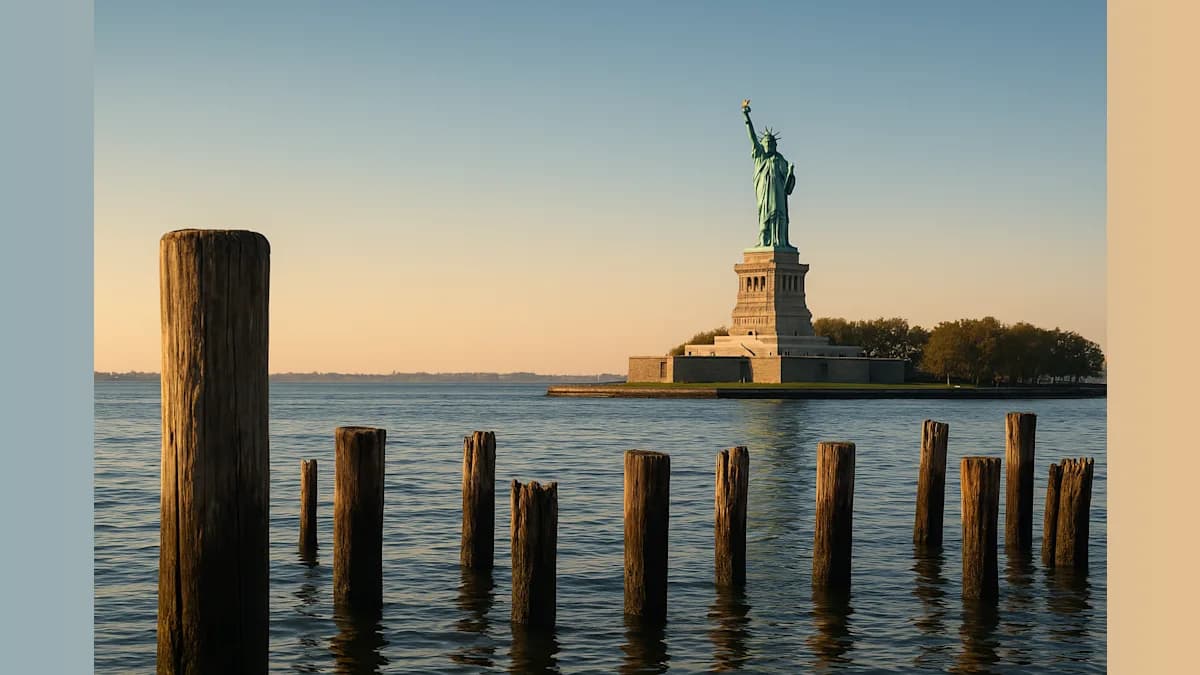
One hundred forty-one years ago today, the Statue of Liberty arrived in New York Harbor, marking a pivotal moment in American history. The monument, a gift from France, was transported across the Atlantic Ocean in 241 crates containing its steel skeleton and copper skin.
The statue was assembled on Bedloe's Island, which would later be renamed Liberty Island, and positioned on a pedestal to face southeast. This strategic alignment ensured that the monument would greet ships entering New York Harbor from the Atlantic Ocean, serving as a welcoming beacon to immigrants and visitors arriving in America.
The statue's origins trace back to the aftermath of the Civil War. Following the abolition of slavery and the Union's victory in 1865, prominent French anti-slavery law professor Edouard de Laboulaye conceived the idea as a way to honor American achievements. He also hoped the monument would inspire France to embrace democracy and end the repressive monarchy of the Napoleons, which the nation accomplished four years later.
Laboulaye enlisted sculptor Frédéric Auguste Bartholdi to design the statue, officially titled Liberty Enlightening the World. The United States agreed to fund the pedestal. Bartholdi inscribed the date of the Declaration of Independence, July 4, 1776, on the tablet representing justice and included a broken chain around the statue's feet as a symbol of freedom from oppression.
June 17 has witnessed numerous other significant historical events throughout the centuries. In 1631, Mughal emperor Shah Jahan began construction on the Taj Mahal following the death of his wife during childbirth. The ivory-white marble mausoleum, built on the southern bank of the river Yamuna in Agra, India, took 20 years to complete and cost approximately 32 million rupees. The 42-acre compound, which houses both Mumtaz Mahal and Shah Jahan himself, now attracts seven to eight million visitors annually.
In 1925, the first National Spelling Bee took place in Washington, DC, created by The Louisville Courier-Journal. Eleven-year-old Frank Neuhauser won the competition by correctly spelling gladiolus, a flower he had cultivated as a boy. He received $500 in gold pieces and was honored with a parade in Louisville. The E.W. Scripps Foundation acquired the rights to the event in 1941, transforming it into the Scripps National Spelling Bee, which continues today as the nation's largest and longest-running educational promotion.
The literary world also marks an important milestone on this date. In 1958, Things Fall Apart by Nigerian author Chinua Achebe was published in the United Kingdom by William Heinemann Ltd. The novel, which depicts pre-colonial life in Igboland and the arrival of European missionaries and colonial forces, has sold more than 20 million copies worldwide and has been translated into more than 50 languages. TIME Magazine included the work in its TIME 100 Best English-language Novels from 1923 to 2005.
In the realm of music, June 17, 1971, saw Carole King's Tapestry reach number one on the Billboard album chart, where it remained for 15 weeks. The album, featuring hits such as It's Too Late, I Feel the Earth Move, and You've Got a Friend, has sold over 25 million copies worldwide and earned four Grammy Awards. The iconic cover photograph, taken at King's Laurel Canyon home, shows her sitting in a window frame holding a tapestry she hand-stitched herself, with her cat, Telemachus, at her feet.
Perhaps one of the most consequential events in American political history began on June 17, 1972, when two young workers inadvertently set in motion the Watergate scandal. Bruce Givner, a UCLA intern at the Democratic National Committee headquarters in the Watergate Hotel, stayed late making phone calls, delaying the departure of burglars hired by the White House who were waiting across the street. Meanwhile, 24-year-old security officer Frank Wills, acting on what he described to investigators as a sixth sense, discovered duct tape on a basement door latch bolt 45 minutes before his scheduled rounds.
Five men, all working for President Nixon's Committee for the Re-election of the President, were arrested that night. The subsequent investigation by Washington Post reporters Bob Woodward and Carl Bernstein uncovered extensive corruption, wiretapping, enemies lists, and slush funds. The scandal ultimately led to the imprisonment of several powerful political conspirators and the resignation of the sitting president. The Watergate break-in also established a linguistic legacy, with every subsequent scandal of any type being tagged with the suffix gate to describe a conspiracy of wrongdoing.
Other notable events on June 17 include Hawaii's King Kamehameha III issuing the Edict of Toleration in 1839, granting Roman Catholics freedom to worship in the Hawaiian Islands; Amelia Earhart embarking on the first trans-Atlantic flight by a woman in 1928; and Iceland declaring independence from Denmark in 1944. In 1992, US President George H. W. Bush and Russian President Boris Yeltsin signed a Joint Understanding agreement on arms reduction, establishing the groundwork for the START II Strategic Arms Reduction Treaty.