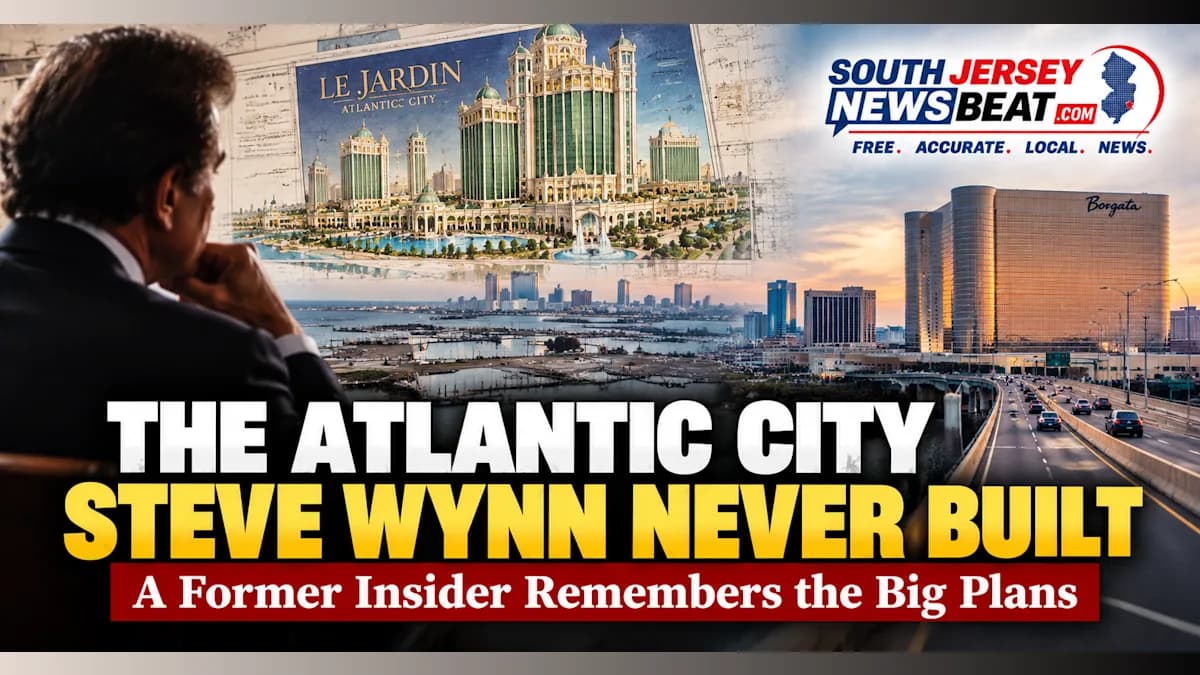
ATLANTIC CITY — Nearly 30 years ago, Obie Murray found himself in the middle of one of the biggest development gambles in Atlantic City history.
Steve Wynn was back.
The casino visionary who had opened the Golden Nugget on the Boardwalk in 1980, sold it seven years later and gone on to transform Las Vegas was planning a spectacular return to Atlantic City. This time, Wynn was looking beyond the Boardwalk toward a largely undeveloped section of the Marina District known as the H-Tract.
His proposed resort, Le Jardin, would never be built.
But the road Wynn insisted Atlantic City needed was built. The Marina District subsequently became home to Borgata. And Murray, who worked for Wynn's organization during that remarkable period, still remembers being there as the plans took shape.
“I used to work in Atlantic City for Steve Wynn,” Murray said while guest-hosting The AC Mike Lopez Show on News Talk 1400 and 92.3 WOND.
“My years back there, I spent about a year and a half working in there for what was the H-Tract development, now the Borgata, Atlantic City Connector, when I worked for Steve Wynn.”
For Murray, returning to the subject brought back plenty of memories.
“I love Atlantic City,” he said. “I miss it.”
Wynn Comes Back to Atlantic City
By the time Murray became involved, Wynn already had a long and complicated history with the resort.
Wynn opened the Golden Nugget Atlantic City in 1980. He sold the property in 1987 for $440 million as his attention increasingly shifted west. The Mirage followed in Las Vegas in 1989, Treasure Island in 1993 and Bellagio in 1998.
Then Wynn set his sights on Atlantic City again.
In July 1995, Wynn announced plans for Le Jardin, a roughly $1 billion casino resort on the city-owned H-Tract in the Marina District. A crucial part of the proposal was a new highway connection between the Atlantic City Expressway and the Marina District.
Murray arrived during that period.
“We're talking about the development we were doing back there,” Murray recalled. “That would have been about '96.”
“So we're talking about 30 years ago when I was down there doing that and when the pier was the arcades and was different, when you had the airstrip down there at the time.”
He remembers using that airstrip while working on the project.
“I remember using that quite a bit to fly around Atlantic City to do some work stuff,” Murray said. “We were doing some filming for the site.”
‘What Steve Wynn Wanted to Do in Atlantic City Was Fantastic’
Murray remembers Wynn as much more than a casino operator.
“Steve Wynn was a builder and had terrific, terrific insight and ideas,” Murray said.
Murray stopped short of relying on the often-used word “vision,” noting Wynn's well-known visual impairment, and instead described a developer who had a remarkably detailed idea of what he wanted to create.
“He has a whole plan on the playing board of what he wanted to do going forward in Atlantic City and Vegas,” Murray said.
“With Steve Wynn, what he wanted to do in Atlantic City was fantastic.”
The historical record backs up the sheer scale of the moment.
New Jersey's Casino Control Commission describes 1995 as a turning point when Mirage Resorts and other major gaming companies became interested in developing Atlantic City's Marina District.
Plans ultimately contemplated not simply one casino but potentially two or three casinos on the H-Tract.
The problem was getting people there.
The Road Wynn Wanted
Wynn made improved access to the Marina District a central part of his development plans.
The result was the Atlantic City-Brigantine Connector — a roadway and tunnel linking the end of the Atlantic City Expressway with the Marina District and providing easier access toward Brigantine.
It wasn't universally welcomed.
The project became a major political and legal battle, particularly because of its effect on Atlantic City's Westside neighborhood. Donald Trump's casino interests opposed the project before eventually changing position after an access ramp to Trump Marina was incorporated into the plans. Contemporary reporting put the Connector's cost at approximately $330 million, with Mirage contributing $110 million.
Construction began in 1998. New Jersey's Casino Control Commission says the roadway opened the Marina District to new casino development.
But there was an extraordinary twist.
By the time the road Wynn had pushed for opened, Wynn was gone.
MGM Grand acquired Mirage Resorts in 2000, ending Wynn's involvement with the company.
Le Jardin never opened.
Yet the Marina District transformation continued.
Construction of Borgata began in 2000, and the resort opened in 2003.
Today, drivers taking the Connector toward Borgata are traveling through an Atlantic City landscape whose transformation was set in motion during the Wynn era Murray remembers.
Living in Wynn's Ventnor House
For Murray, however, the memories aren't limited to billion-dollar development plans.
He also remembers living in Wynn's Ventnor home.
“Steve Wynn had a house in Ventnor, New Jersey, right over the border there,” Murray said.
“I lived there for about a year and a half.”
Murray remembers the experience vividly.
“It was pretty phenomenal to be there, be in Atlantic City with Steve's people, and what was going on there for what we were doing,” he said.
“I loved every minute of it.”
He remembers living along the beach and walking toward Atlantic City.
“Living on the beach, I'd walk down to what is now the Golden Nugget,” Murray recalled.
Later in the show, Murray offered another memory of the house.
“You know, Frank Sinatra used to stay there,” Murray said, recalling that Wynn used the Ventnor property as a place to stay away from the casino and that entertainers also stayed there.
Murray noted that the house has since been demolished.
South Jersey NewsBeat has not independently verified Murray's Sinatra recollection, so it is presented here as his firsthand account of what he understood about the property during his time working with Wynn's organization.
The Penthouse Wynn Didn't Want
Then there is the kind of story that could only come from Atlantic City's casino era.
Murray remembers hearing it repeatedly while working for Wynn.
According to the story, Wynn needed property from a developer as he assembled land connected with his Atlantic City plans. The owner was willing to sell — with an unusual condition.
Wynn also had to buy the man's penthouse condominium.
Murray said Wynn didn't particularly want it.
“Steve had no interest in buying a casino there or buying a condo there,” Murray recalled.
But, according to the story Murray heard, the seller essentially told Wynn: If you want the land, you're buying the penthouse, too.
Why?
“Because that way I could say Steve Wynn lives here,” Murray said.
Murray doesn't present the story as something he personally witnessed. In fact, he gives it exactly the right description:
“There's a little folklore of Atlantic City.”
‘That Was Atlantic City’
Some of Murray's warmest memories aren't about buildings at all.
He recalled meeting a London-based property owner whom he identified only by the first name Ram. Murray remembers giving him a tour of development plans in Atlantic City and later being treated generously by the same man while Murray and his fiancée visited London.
Murray remembers him as one of the colorful personalities who populated Atlantic City's casino world.
“This was just like Hollywood,” Murray said.
“What a super magnificent man, salt of the earth.”
For Murray, the memory represented something larger.
“That was Atlantic City,” he said. “A lot of characters, great people. Everyone had to watch out for themselves, but they all watched out for everybody.”
Wynn's Atlantic City Legacy
Wynn's second grand Atlantic City casino never materialized.
Le Jardin disappeared from the plans. Mirage disappeared into MGM. Borgata eventually rose on the H-Tract under a different development structure.
But the Connector remained.
New Jersey's Casino Control Commission credits the roadway with opening the Marina District to additional casino development, while Borgata became the first entirely new Atlantic City casino to begin construction in more than a decade.
That makes the Wynn chapter one of Atlantic City's intriguing development what-ifs.
What would the Marina District have looked like if Wynn had stayed?
What would Le Jardin have become?
How much of the Atlantic City Wynn imagined would have resembled the Las Vegas resorts that made him famous?
Those questions can't be answered.
Murray can only describe what it felt like to be there when the plans were still alive.
And three decades later, his assessment hasn't changed much.
“What Steve Wynn wanted to do in Atlantic City was fantastic,” Murray said.
For Murray, the memories themselves remain pretty good, too.
“I loved every minute of it.”
Obie Murray shared his memories while guest-hosting The AC Mike Lopez Show on News Talk 1400 and 92.3 WOND. The AC Mike Lopez Show airs Monday through Friday from noon to 1 p.m.

About the Author
Karen Johnson
With over 30 years of news experience in major markets like Los Angeles, Denver, and Columbus, Karen now covers our area for South Jersey NewsBeat. She also brings her articulate and conversational news delivery to WOND radio listeners every weekday. Her background includes work with the NBC Radio Network, and she thrives in fast-paced news environments.