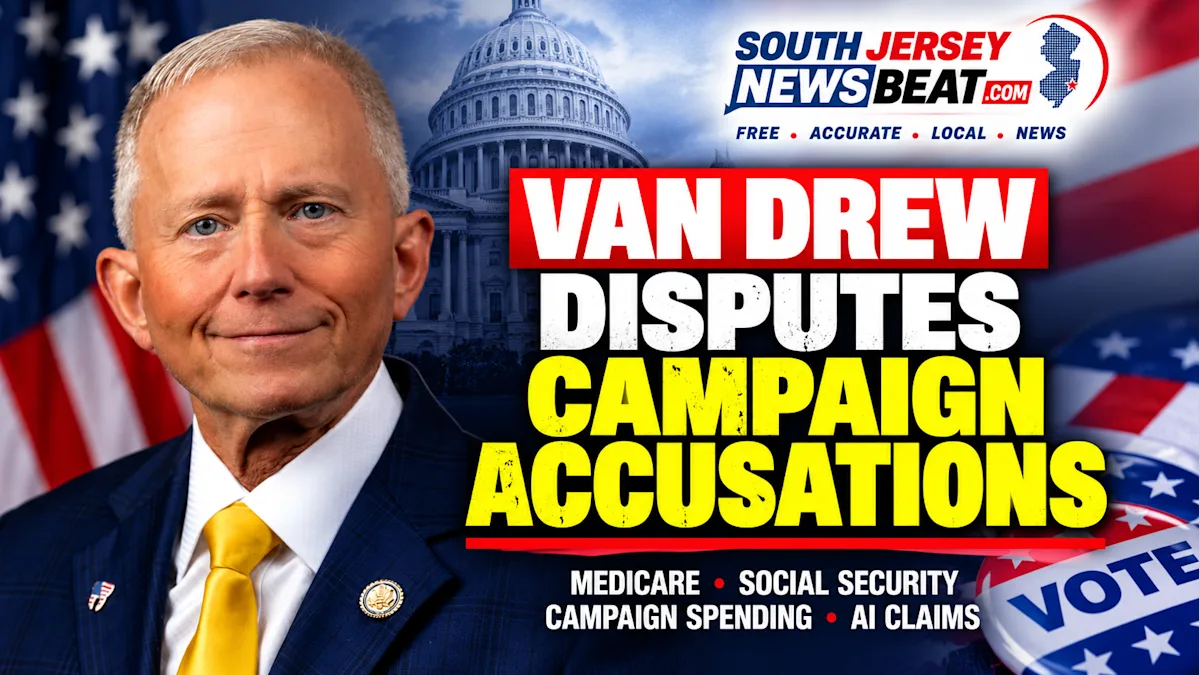
Congressman challenges Democratic opponent's statements during WOND interview, but federal records show important distinctions between Medicare, Medicaid and outside campaign spending.
ATLANTIC CITY, N.J. — With Election Day approaching, Congressman Jeff Van Drew is pushing back against accusations from Democratic challenger Zack Mullock involving Medicare, Social Security, campaign financing and the use of artificial intelligence, as questions about the candidates' competing claims take center stage in New Jersey's 2nd Congressional District race.
During an October 26 appearance on Off The Press with Scott Cronick on News Talk 1400 & 92.3 WOND, Van Drew repeatedly accused Mullock of misrepresenting his record.
But the dispute also highlights how campaign statements can oversimplify complicated federal legislation and election financing rules.
Cronick, who described the candidates' recent Stockton University debate as a strong exchange, pressed Van Drew about the difficulty voters face in determining which candidate is accurately presenting the facts.
"I think both candidates know their topics, they know their subjects," Cronick said.
He then addressed the competing accusations directly.
"You're saying he's not telling the truth. He's saying you're not telling the truth," Cronick told the congressman.
"So I guess my biggest question is how do we know who to trust here?"
Van Drew responded by challenging several of Mullock's statements.
Medicare: A Dispute Over What Congress Actually Changed
Van Drew's first objection concerned accusations that he voted to cut Medicare.
"The facts are there's never been a vote on Medicare ever since I've been in Congress to cut it or do anything to it, and yet he continues to say, I cut Medicare," Van Drew said.
"Not true. It's one Pinocchio right there alone."
The underlying congressional record is more complicated.
Van Drew supported the One Big Beautiful Bill Act, a major tax and spending measure signed into law in 2025.
The legislation included changes to Medicare, although those changes were substantially narrower than the reductions to Medicaid.
Among the Medicare provisions were restrictions affecting eligibility for certain lawfully present immigrants and a delay involving rules intended to help low-income Medicare beneficiaries obtain financial assistance through Medicaid.
The nonpartisan Congressional Budget Office estimated that the eligibility changes would reduce Medicare spending by approximately $5.1 billion over 10 years.
Another provision involving financial assistance for low-income beneficiaries was projected to reduce federal spending by approximately $66 billion over that period.
However, the legislation did not impose the sweeping direct Medicare reductions suggested by some campaign advertisements.
Mullock has cited a potential $491 billion reduction in Medicare spending associated with federal budget enforcement rules.
Those reductions were projected consequences of the legislation's effect on federal deficits, rather than direct Medicare benefit cuts written into the law.
Congress subsequently acted to prevent those automatic reductions.
FactCheck.org reported October 16 that political advertisements describing the 2025 legislation as imposing massive Medicare cuts exaggerated its effects.
The independent fact-checking organization also emphasized that some Medicare provisions could have significant consequences for the smaller groups of beneficiaries they affect.
The distinction is important in South Jersey, where Medicare serves a substantial population of older residents.
According to federal enrollment figures reported by The Philadelphia Inquirer, Atlantic County had 66,832 Medicare enrollees in 2025, while Cape May County had 31,464.
Medicaid: Substantial Federal Spending Reductions Are Documented
The Medicaid dispute involves a different set of facts.
Van Drew voted for the same 2025 legislation, which is projected to reduce federal Medicaid spending by hundreds of billions of dollars over the coming decade.
Medicaid provides health coverage to eligible low-income residents, people with disabilities, children and other qualifying populations.
The legislation includes new work-reporting requirements for certain adult beneficiaries, more frequent eligibility checks and other changes intended by supporters to reduce spending and tighten program administration.
Van Drew has defended the legislation as an effort to eliminate waste, fraud and abuse while protecting vulnerable populations.
During an earlier candidate forum, he said he had worked to ensure the legislation would not harm seniors, children or people with disabilities.
Mullock has argued that the changes will reduce health coverage and place additional burdens on families and healthcare providers.
The Congressional Budget Office has projected substantial reductions in federal Medicaid spending and an increase in the number of uninsured Americans as a result of the law.
Many of the Medicaid changes have not yet taken full effect.
Consequently, the federal spending reductions are documented projections, while the precise effects on individual South Jersey residents will depend on implementation and eligibility circumstances.
Social Security: Van Drew Denies Voting for Cuts
Van Drew also rejected accusations involving Social Security.
"The next one is Social Security," he told Cronick. "Lots of times he'll belt that out, that there was a vote to cut Social Security. Not true."
The 2025 spending law did not directly reduce Social Security retirement benefits.
Social Security and Medicare are separate federal programs, and legislation affecting one does not necessarily affect the other.
The available records reviewed for this report do not establish that Van Drew voted for a direct reduction in Social Security retirement benefits.
However, a broader evaluation of the congressman's Social Security record would require examining specific legislation and votes cited by Mullock's campaign.
The exact Social Security vote Mullock was referring to was not identified during the WOND interview.
Campaign Financing: Outside Spending Complicates the Picture
The congressman also accused Mullock of benefiting from political money whose original sources are not always apparent to voters.
"Says he doesn't take dark money," Van Drew said.
"He has more money coming in than I do, which is okay."
Van Drew said he discloses his own campaign contributions, citing support from professional associations and other contributors.
"He's taking dark money," the congressman alleged.
Federal campaign finance records confirm that outside organizations have spent money attempting to influence the race.
An October 26 investigation by NJ Spotlight News identified spending by organizations supporting Mullock and other Democratic congressional candidates.
The reporting traced contributions involving Garden State Forward, a political organization supported by the New Jersey Education Association, and the Turnout Project, a super PAC involved in Democratic election efforts.
The investigation also identified additional outside spending opposing Van Drew, including a reported $1 million radio advertising effort by Project 218.
Van Drew has also benefited from outside spending, including approximately $64,000 in planned communications from a group associated with the national dental industry, according to the same reporting.
Federal law distinguishes contributions made directly to candidates from independent expenditures made by outside organizations.
Super PACs can accept unlimited contributions but generally cannot coordinate their independent spending with a candidate's campaign.
Some outside political spending is funded through organizations that do not publicly disclose all original donors.
However, the existence of outside spending supporting Mullock does not, by itself, establish that his campaign accepted undisclosed contributions or coordinated illegally with outside groups.
The same distinction applies to organizations supporting Van Drew.
Federal filings also show that both campaigns have received direct contributions and reported their finances under applicable disclosure requirements.
Van Drew Denies Using Artificial Intelligence in Campaign
Another accusation raised during the interview involved artificial intelligence.
Van Drew said Mullock had accused his campaign of using AI-generated material.
"Says I use AI in my campaign," Van Drew told Cronick.
"Talk to my campaign manager. He'll tell you we've never, ever used AI in my campaign."
The interview did not identify a particular advertisement, image, video or communication that Mullock alleged was created using artificial intelligence.
Without a specific example and supporting evidence, the allegation cannot be independently evaluated.
Van Drew's denial establishes his campaign's stated position, but it does not independently verify how every piece of campaign material was produced.
Debate Dispute Adds to Campaign Tensions
Van Drew also disputed suggestions that he had been unwilling to debate Mullock.
He told Cronick that the debate had already been agreed upon when Mullock publicly criticized him.
The candidates ultimately appeared together October 22 at Stockton University for a debate organized with The Press of Atlantic City and the university's William J. Hughes Center for Public Policy.
The debate covered healthcare, immigration, energy, the war in Iran and other issues.
It was held without a public audience, a decision that also generated disagreement between the campaigns.
Van Drew cited security concerns, while Mullock criticized the restrictions on public attendance.
The debate was livestreamed.
Both candidates used the event to challenge each other's records and positions.
A Race With Significant South Jersey Implications
Van Drew, a Republican who was first elected to Congress as a Democrat in 2018 before switching parties, is seeking another term representing the 2nd Congressional District.
Mullock, the Democratic mayor of Cape May, is challenging him in the November 3 election.
The district includes Atlantic, Cape May, Cumberland and Salem counties, along with portions of Gloucester and Ocean counties.
Healthcare costs, electric bills, economic development and federal spending have become central issues in the campaign.
During Monday's interview, Van Drew argued that his record should be judged by his work for constituents.
"I love America. I love South Jersey. I love my people," he said.
"I work hard for all of them, and I've always been an independent thinker."
Mullock has argued that Van Drew's support for major federal legislation has consequences for South Jersey families, particularly those who depend on healthcare assistance.
The competing statements illustrate why the specific language of legislation, congressional voting records and campaign finance disclosures matter.
Federal records establish that Van Drew supported legislation reducing projected Medicaid spending and making narrower changes to Medicare.
They also establish that outside organizations are spending money to influence the congressional race.
Other accusations, including the alleged use of artificial intelligence and claims involving particular Social Security votes, require more specific evidence before they can be independently resolved.
For voters preparing to cast ballots November 3, those distinctions are important in evaluating the candidates' competing descriptions of their records.
Congressman Jeff Van Drew discussed the congressional race and his opponent's accusations during an October 26 interview on Off The Press with Scott Cronick, heard weekdays from 4–6 p.m. on News Talk 1400 & 92.3 WOND.

About the Author
Peter Killeen
A 25-year radio news veteran, Peter covers South Jersey for NewsTalk 1400 & 92.3 WOND radio. Known for his concise and impactful delivery, he ensures listeners and readers stay informed without unnecessary filler.