
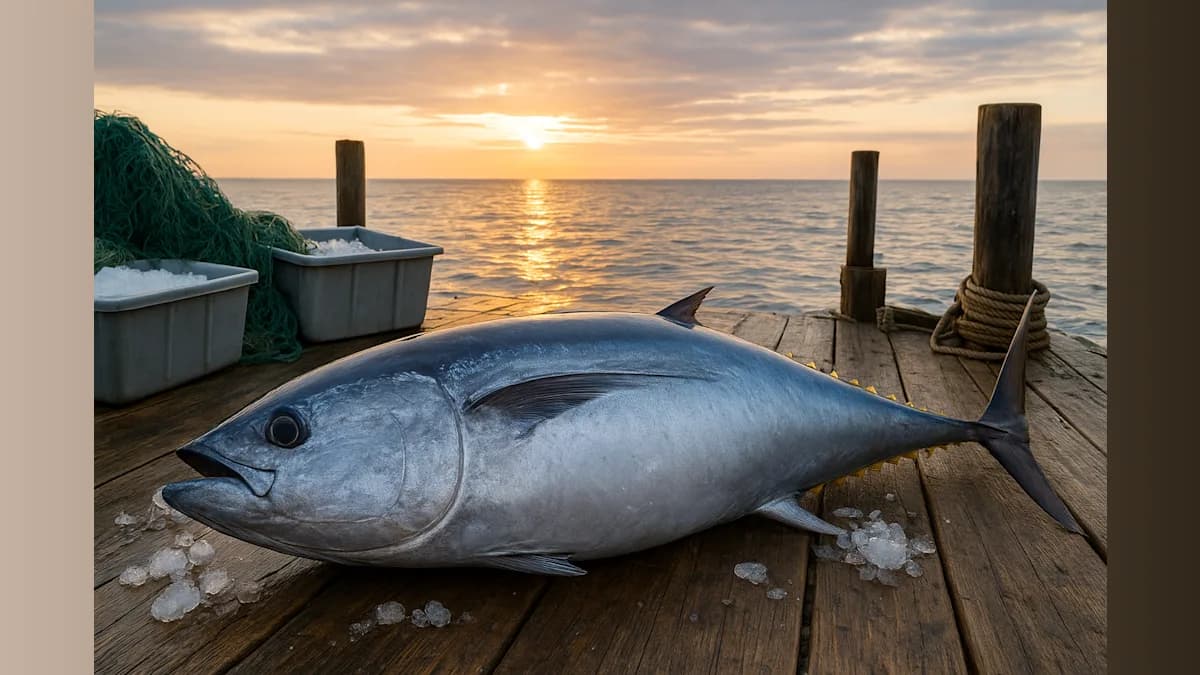
When Jack Gardner spotted the massive fish on his line, he recognized the potential for an extraordinary catch. The captain and his crew aboard the Dominator spent hours battling what would become a historic moment for North Sea fisheries—a 745-pound Atlantic bluefin tuna, the first of its species caught in these waters in 60 years.
The enormous tuna, caught off the coast of Whitby on Britain's northeast coastline near the Scottish border, fell just 112 pounds short of a fishery record. But the significance extends far beyond the impressive weight. Marine scientists view the catch as confirmation that decades of conservation efforts have successfully restored a once-collapsed ecosystem.
Dr. Lucy Hawkes, a researcher at the University of Exeter, explained that the tuna's remarkable size reflects the health of the entire marine food web. "Bluefin tuna are also top predators who can only be in these waters if the ecosystems underneath them are healthy," she told the BBC. The recovery stems from careful fisheries management that maintains catch limits at minimal levels relative to overall fish populations.
British tuna fishing once represented a world-renowned industry in the decades surrounding the Second World War. Restaurants and canneries prized the fish for its meat, creating substantial economic value. However, excessive harvesting of both bluefin tuna and their herring prey ultimately caused the fishery to collapse—a pattern repeated throughout industrialized fishing worldwide.
The United Kingdom implemented measures over subsequent years to rebuild these critical fish stocks. The dramatic moment when Gardner's catch broke the surface demonstrated the success of those efforts. "It jumped out of the water, we all just looked at each other in awe," Gardner told the BBC.
Dr. Hawkes and her research team regularly tag bluefin tuna for monitoring purposes off the coast of Exeter on Britain's southwest shoreline. The geographic distance between Exeter and Whitby—opposite points of the British coastline—suggests multiple tuna populations may be returning to different regions. A University of Exeter spokesperson indicated that the Whitby tuna could have entirely different origins from the fish researchers tag and track in the southwest.
The presence of bluefin tuna at two distant British locations points to a broader marine recovery. As apex predators requiring abundant prey and stable conditions, their return signals that the North Sea ecosystem has regained the productivity necessary to support large, long-lived species at the top of the food chain.