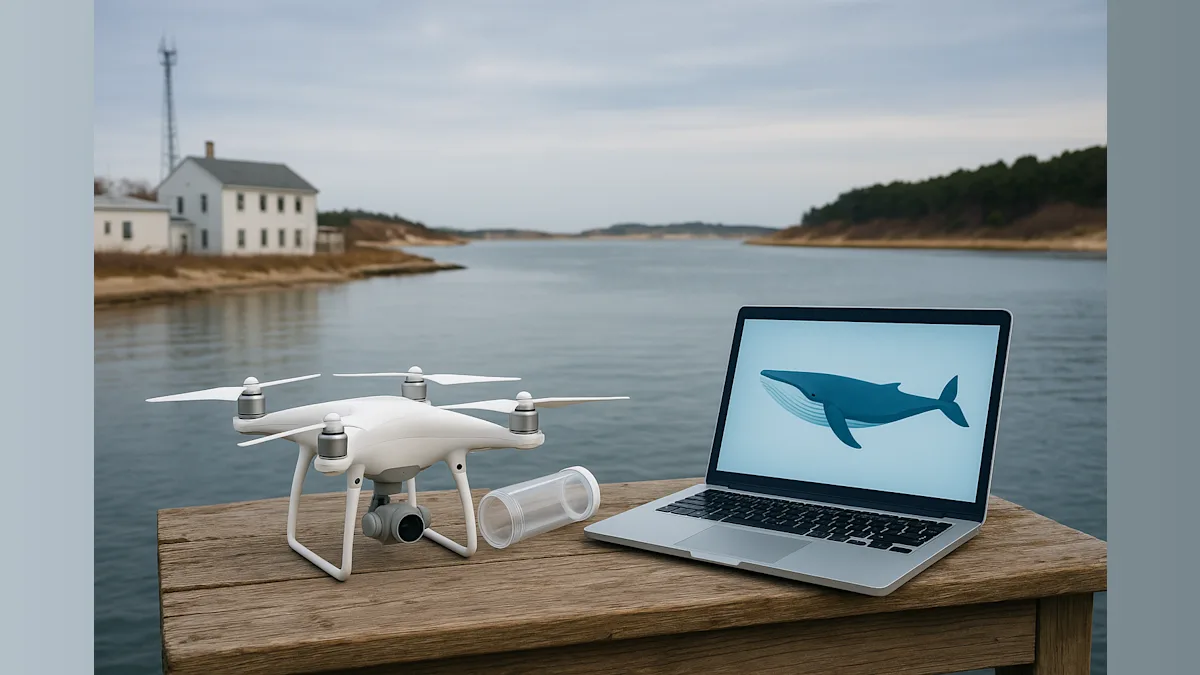
An international research collaboration that included scientists from the University of St. Andrews in Scotland has completed whole genome sequencing of a whale using nothing more invasive than the animal's exhaled breath, gathered by a small aerial drone. The work marks the first time a full genome has been assembled from whale blow rather than from darts, boat-based biopsies, stranded animals, or historical specimens.
Conventional sampling methods disturb the animals, and in some locations and for some species they are simply not feasible. Genomic information is considered essential for conservation because it allows researchers to gauge the health of a population, track genetic diversity and inbreeding, identify individual animals for mark-recapture work, determine sex, and estimate how many animals live in a given area.
To sidestep the collection problem, the team mounted sterile petri dishes on a small drone and flew it through the exhalations of one humpback whale at a time. A humpback typically takes between one and six breaths each time it surfaces. In total, the researchers gathered 58 blow samples from 26 individual humpback whales in the Kitimat Fjord System in northern British Columbia, Canada.
Roughly 84 percent of the DNA recovered in the blow belonged to the whale. When the same whales were sampled again during separate encounters over a span of two years, the resulting genomes matched. To prevent DNA from different animals from mixing, the team targeted the whale positioned furthest upwind within a group. More than one-third of the samples were obtained without a boat at all, with the drone launched and flown directly from shore.
Prior to this study, only one North Pacific humpback's whole genome had ever been made publicly available. The newly collected DNA yielded low-coverage nuclear genomes, which are inherited from both parents, along with high-coverage mitochondrial genomes, which pass down only through the mother.
The team also found that genetic diversity calculated from blow closely matched estimates derived from traditional biopsies. This particular population showed no evidence of inbreeding beyond what would be expected from shared ancestry or past population bottlenecks.
Lead researcher Dr. Éadin O'Mahony told Good News Network that the blow-derived genomes will be used to examine kinship and family relationships among humpback whales foraging in northern British Columbia. "The aim is to understand how their social bonds form: are the whales that forage together family, or long-term friends?" Dr. O'Mahony told Good News Network.
According to Dr. O'Mahony, the genetic analyses from drone-captured samples correctly identified the sex of every whale and uncovered three previously undescribed mitochondrial DNA variants. "Blow from whales swimming in groups showed no sign of contamination from neighboring whales," Dr. O'Mahony told Good News Network, adding that the results confirm blow-derived data behave just like conventional genomic data.
The research carries implications beyond the whales themselves. Because a portion of the DNA in each sample comes from microbes in the animal's airways, a single breath may offer a window into the whale's respiratory microbiome and, potentially, its overall health.