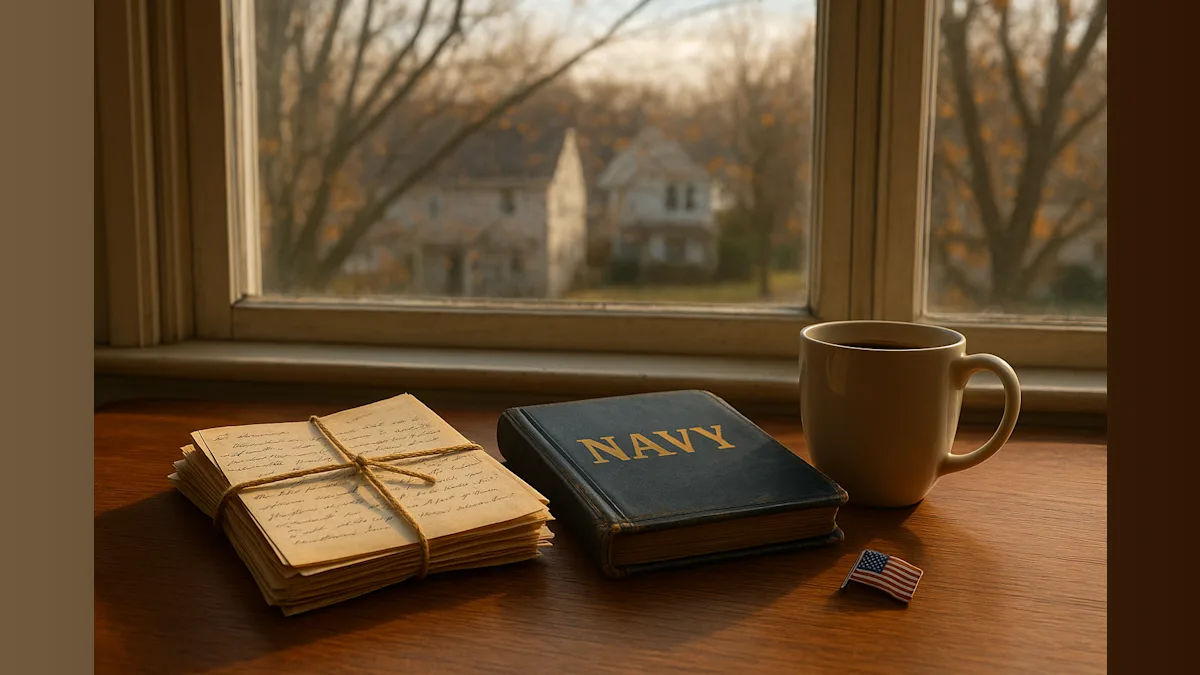
GLOUCESTER, Mass. — In 1967, a class of 33 schoolchildren in Massachusetts received an assignment unlike any other: write a letter to a Navy corpsman wounded in Vietnam, a man none of them had ever met. What those children could not have known was that their words would help pull a dying man back from the brink — and that nearly 50 years later, his son would set out to find each of them and say thank you.
That son is Dave Jacobson. His father was HM3 Russell Jacobson, who sustained 12 gunshot wounds and shrapnel injuries from a grenade blast. He returned home to an understaffed Chelsea Naval Hospital, where he was placed in a full-body cast. Outside the hospital, protesters opposed to the Vietnam War directed abuse at returning servicemen. For Russell, who Dave described as having entered the war as a "pacifist" intent on "healing people," the combination of his injuries and the public hostility produced a profound sense of shame.
Dave, who would not be born for another 10 years, recounted the severity of his father's condition. "He was non-verbal for many weeks and he was refusing food and water, and was down to about 80 pounds. He had lost a dozen of his friends in a couple of hours," Dave told Good News Network. His mother was a nurse, and one of her co-workers, Kitty, kept searching for a way to reach the veteran. Kitty's sister was a nun at a Catholic school in Gloucester, and she arranged for all the children there to write letters of support. The students attended St. Ann School in Gloucester, Massachusetts.
Russell had already been receiving mail from friends and colleagues, but Dave characterized those letters as containing "kind of what they think they should say." The envelope from St. Ann School was different. As Kitty later described it, leafing through those 33 letters is what set Russell on the path to recovery. He and his wife read them slowly, one by one. Each letter carried a small yearbook-style photograph of its young author. One boy, named Peter, wrote about his pet lizard; two classmates wrote about how remarkable it was that Peter had brought the lizard to school at all. Another correspondent asked, as though placing a phone call, whether Russell had been following the Montreal Expos' season.
Dave described the letters as "the most genuine thing ever," according to Good News Network. "You could just tell a lot of these kids knew they weren't going to get a call back but, they're writing these sweet things from the bottom of their heart, like 'Hey I'm gonna be praying for you every night.' 'Remember that I need you to get home safely and need you to come visit me when you're better,'" he told Good News Network.
That conviction — that small acts of kindness deserve to be acknowledged — drove Dave to begin tracking down the authors. "I just needed to get back to them and be like, 'Hey, I know it seems really silly, you're talking about your pet lizard and you're saying God bless you, but it made a difference,'" he told Good News Network. He acknowledged that the effort is no small feat in an era when people must guard against scams at every turn.
The first person Dave located was Sister Flatly, the nun who organized the project. Now 90 years old, she has since told him that the St. Ann School letters were one of "millions" of similar gestures she would routinely make. According to Dave, she was astonished to learn that her effort had made an impact.
For many of the former students Dave has reached, the memory of the assignment had long since faded. Maryann Kilman, the first of the 33 children he contacted, told him she remembered the teacher and the school but did not recall the letter itself — though Dave said she seemed to be "still the same person." Another woman, Lisa Lovell, did remember writing and confessed to feeling guilty that she had not made her letter longer. Dave told Good News Network that this continuity of character is among the most amusing aspects of the search: a trace of the same child persists in the adult, preserved in a tiny writing assignment.
The letters healed more than one person. Dave grew up in a household where honest conversation about what Russell had experienced in Vietnam was absent, replaced by an ominous silence. "We couldn't talk about it," Dave told Good News Network. "One day, these letters come out kind of casually. And I think it was the first time I realized there are kids my age that think my dad's a hero! I can't even talk about him at school, and it was kind of like a sea change for me—of how I identified with what happened to him in the service."
Dave's search is not finished. Some of the letter writers remain unaccounted for, and he told Good News Network that he would welcome contact from anyone who might have information about the whereabouts or identities of the remaining classmates. Photographs and images of each letter and its author are available on his project website, The Letters from Gloucester.