
A father-daughter business in Assam, India, has built a paper-making operation around an unlikely raw material: rhino dung. Elrhino Stationery, co-founded by Mahesh Chandra Bora and his daughter Nisha, produces notebooks, journals, paper bags, lampshades, playing cards, and other stationery and decorative goods from dung harvested by residents living near the region's wildlife reserves.
The venture began with a simple observation. Mahesh Chandra Bora, a retired mining engineer, encountered reports of paper being produced from rhino dung in Rajasthan, the arid western state where the animals are scarce. He reasoned that if the technique could work there, it could work in Assam, which is home to approximately 2,900 greater one-horned rhinos.
His early experiments took place in the family kitchen, where he used his wife's blender to test production methods. The process relies on undigested plant fibers packed into the animal's dung balls. Nisha later left a 17-year corporate career to join the effort, and Elrhino was established in 2014.
The supply chain starts with communities near reserves such as Kaziranga and Pobitora national parks, where rhino and elephant dung is collected and trucked to the production site. Assam's parks hold some of the densest rhino populations per kilometer found anywhere, with between 2 and 6 Indian rhinos per kilometer in these areas, alongside elephants. The animals frequently wander into farmland, damaging crops and destroying fences.
Purchasing the dung changes the calculus for affected villagers. Rather than viewing the animals solely as a threat, residents gain a recurring income stream from material that would otherwise be waste, giving them an incentive to tolerate crop damage rather than retaliate.
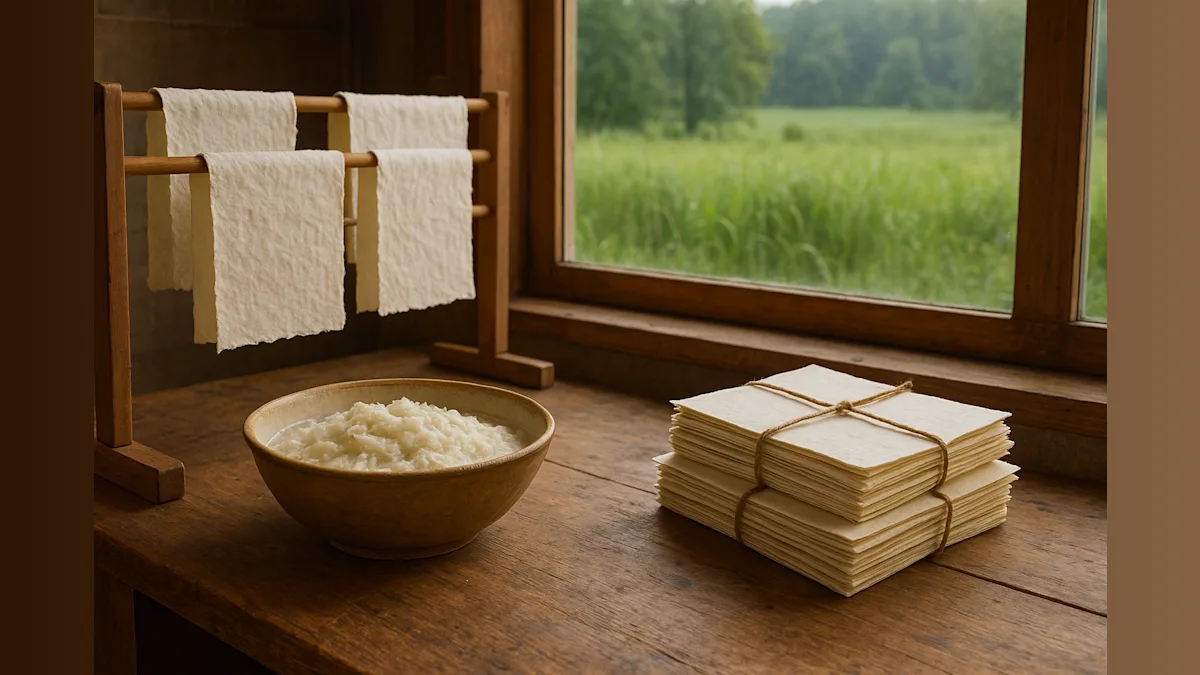
Once collected, the dung is washed and boiled so that the plant fibers can be extracted and pulped. Recycled paper or cotton waste is blended in, and the mixture is pressed and dried into sheets. The finished products are sold as stationery and home decor.
The model illustrates a broader principle in wildlife conservation: giving local communities a direct economic interest in the survival of nearby species can be more effective than enforcement alone. By turning a nuisance into a resource, Elrhino has created a business that aligns livelihoods with protection of the greater one-horned rhino.