ATLANTIC CITY — Atlantic City's casino industry is generating record amounts of gaming revenue for New Jersey, but a new economic analysis warns that the number of jobs supported by the city's brick-and-mortar casino economy could continue moving in the opposite direction.
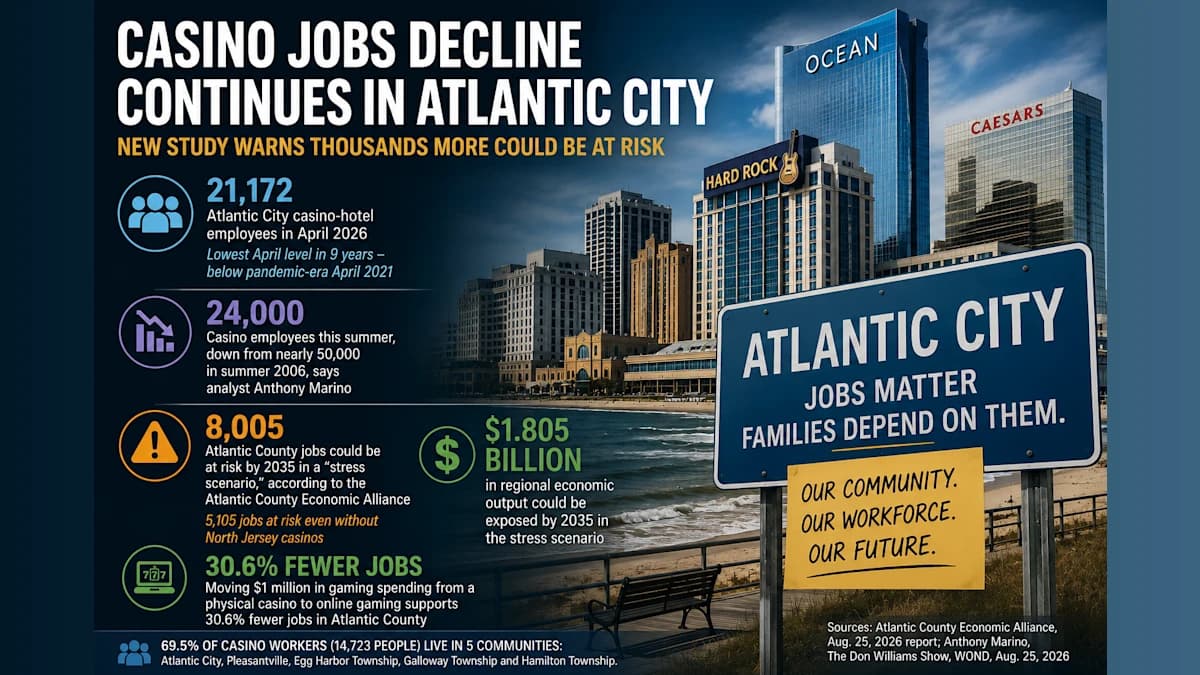
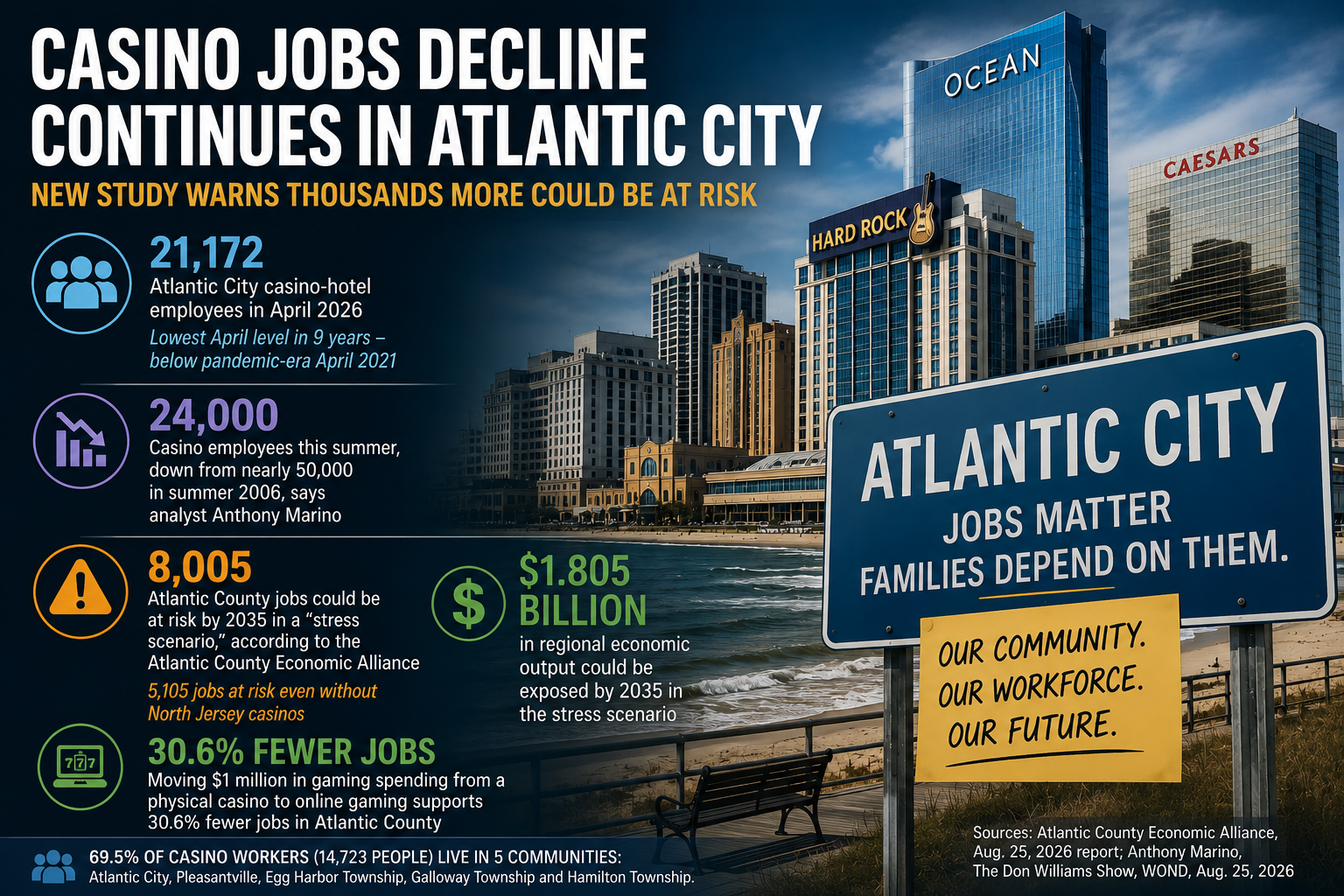
The Atlantic County Economic Alliance released a study Tuesday estimating that as many as 8,005 Atlantic County jobs and $1.8 billion in regional economic output could be placed at risk by 2035 if several competitive pressures converge, including continued growth of online gambling, new full-scale casinos in New York City and potential casino expansion into North Jersey.
Even without North Jersey casinos, the study's baseline scenario estimates 5,105 Atlantic County jobs could be exposed by 2035.
The report comes as casino employment has already fallen to its lowest level in years.
Direct Atlantic City casino-hotel employment stood at 21,172 in April 2026, according to the ACEA report — the lowest April figure in its nine-year employment comparison and even below the 21,484 jobs recorded in April 2021 during the COVID-19 pandemic recovery.
"The money is still flowing to Trenton. The same level of work is not flowing to Atlantic City households," the ACEA report states.
Casino analyst Anthony Marino said Tuesday on The Don Williams Show on WOND that the longer-term decline is even more dramatic.

Marino said Atlantic City's casino workforce peaked at just under 50,000 employees in the summer of 2006.
"This summer, we're down to about 24,000 employees," Marino said, using a more recent summer employment estimate that includes the seasonal increase in casino staffing.
"Do the arithmetic, and it's easy," Marino said. "We've lost 26,000 jobs. Now, that's the reality."
Marino said Atlantic City's casino workforce was also roughly 5,000 to 6,000 employees larger shortly after Hard Rock and Ocean opened in 2018 than it is today.
He cautioned, however, against interpreting the seasonal employment decline expected after Labor Day as a new wave of casino layoffs.
"I wouldn't really call them layoffs," Marino said. "A lot of folks are brought on in the summer, many of them college students, doing various activities in the casinos."
He said the casinos typically increase staffing during July and August before reducing seasonal positions as summer ends.
"It'll start going down again in September," Marino said. "And, in fact, it's probably happening now in the last week or two of August, too, as kids go back to school."
Online gambling brings revenue — but fewer local jobs
One of the central findings of the new ACEA study is that not all gambling revenue has the same impact on Atlantic County employment.
Online casino gaming generated $2.91 billion in New Jersey in 2025, surpassing Atlantic City's $2.89 billion in brick-and-mortar casino revenue for the first time.
But placing a bet on a phone does not require the same workforce as bringing a customer into an Atlantic City casino hotel.
According to ACEA's modeling, shifting $1 million in gaming spending from an Atlantic City casino hotel to online gaming supports 30.6% fewer direct and supplier jobs in Atlantic County.
The report estimates $1 million spent through the online channel supports 3.66 full-time-equivalent jobs, compared with 5.28 jobs associated with brick-and-mortar casino activity.
A physical resort requires dealers, housekeepers, restaurant workers, bartenders, security personnel, hotel employees and other workers. It also generates business for local suppliers ranging from food companies to laundry and linen services.
That distinction has become increasingly important as New Jersey's gaming revenue and gaming tax collections reach record levels while Atlantic City's casino employment contracts.
New Jersey's Casino Revenue Fund collected a record $801.5 million in inflation-adjusted 2025 dollars last year, according to ACEA, while total statewide gaming revenue reached $6.98 billion.
Five communities have the most at stake
Any additional casino job losses would also be heavily concentrated geographically.
ACEA found that 69.5% of Atlantic City casino-hotel workers — 14,723 employees — live in five Atlantic County communities: Atlantic City, Pleasantville, Egg Harbor Township, Galloway Township and Hamilton Township.
That means a major contraction in casino employment would extend well beyond the Boardwalk and Marina District.
"This report confirms what we see on our casino floors and in our hotel operations every day: Atlantic City's casino-hotels aren't just gaming revenue for the state; they're thousands of family-sustaining jobs," said George Goldhoff, president of the Casino Association of New Jersey and president of Hard Rock Hotel & Casino Atlantic City.
ACEA President Lauren Moore said the organization commissioned the study so policymakers could evaluate the potential impact using economic modeling rather than speculation.
"We invested extensive time and resources to produce this report because decisions of this magnitude affecting thousands of hardworking New Jerseyans and two important revenue sources for New Jersey, casino gaming and the conventions and meetings market, must be grounded in real data and facts, not speculation," Moore said.
The study's author, ACEA Director of Business Development Max Slusher, emphasized that the estimates should not be interpreted as a prediction that 8,005 jobs will disappear.
"This is a planning document, not a doomsday prophecy," Slusher said.
Instead, ACEA created four scenarios ranging from a low-exposure case to a stress scenario.
The baseline case assumes continued online gaming substitution and New York competition but no new North Jersey casinos. It places 5,105 jobs and about $1.15 billion in regional economic output in exposure by 2035.
The stress case adds proposed casinos at the Meadowlands and Monmouth Park and increases the estimated exposure to 8,005 jobs, $1.28 billion in brick-and-mortar casino revenue and $1.805 billion in regional economic output.
New York competition is coming
Marino also identified New York as the next major competitive challenge facing Atlantic City.
"New York is going to exert more and more pressure on our local casino industry," Marino said.
And the potential revival of casino proposals in northern New Jersey could intensify that pressure.
"If we ever have casinos in North Jersey," Marino said, Atlantic City's casino industry could face significant additional consequences.
The ACEA study reaches a similar conclusion but argues that policymakers still have time to prepare.
Its recommendations include additional investment in Atlantic City's convention and meetings business, continued incentives for casino-hotel reinvestment, worker retraining and broader economic diversification.
The organization also recommends that New Jersey not approve additional brick-and-mortar casino competition within the state until protections are developed for Atlantic City's economy and the Casino Revenue Fund.
Atlantic City's convention business could provide one avenue for workers affected by casino employment losses, according to the report. Visit Atlantic City booked 205 events in 2025 that generated more than 533,000 attendees, 328,000 room nights and $362.3 million in direct economic impact.
But ACEA cautions that conventions could absorb only a portion of displaced casino workers.
For Marino, the numbers show that Atlantic City's casino industry remains a major economic force but one that has already undergone an enormous employment transformation.
Competition from casinos in neighboring states helped cut the city's workforce dramatically over the past two decades. Now online gaming and another generation of regional casinos are creating a different kind of challenge.
"Competition started up heavily by the first decade of this century," Marino said, "and it's only gotten worse."

About the Author
Scott Stephens
Scott has been an on-air personality, producer and newscaster for 30+ years. He has been a mainstay in the South Jersey Community and on the air across many different area stations. Scott can currently be heard on Kool 98.3 and News Talk 1400 & 92.3 WOND.