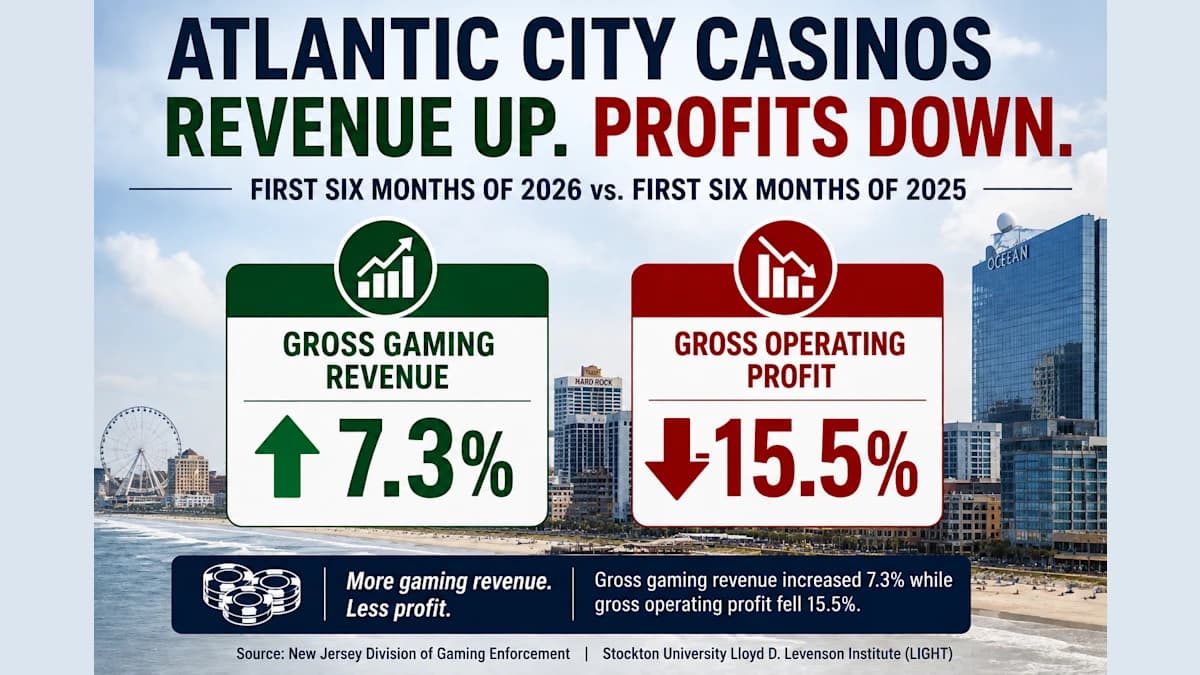
ATLANTIC CITY — Atlantic City's casino industry continues to generate more gaming revenue, but new financial results show that more money coming in does not necessarily mean more money reaching the bottom line.
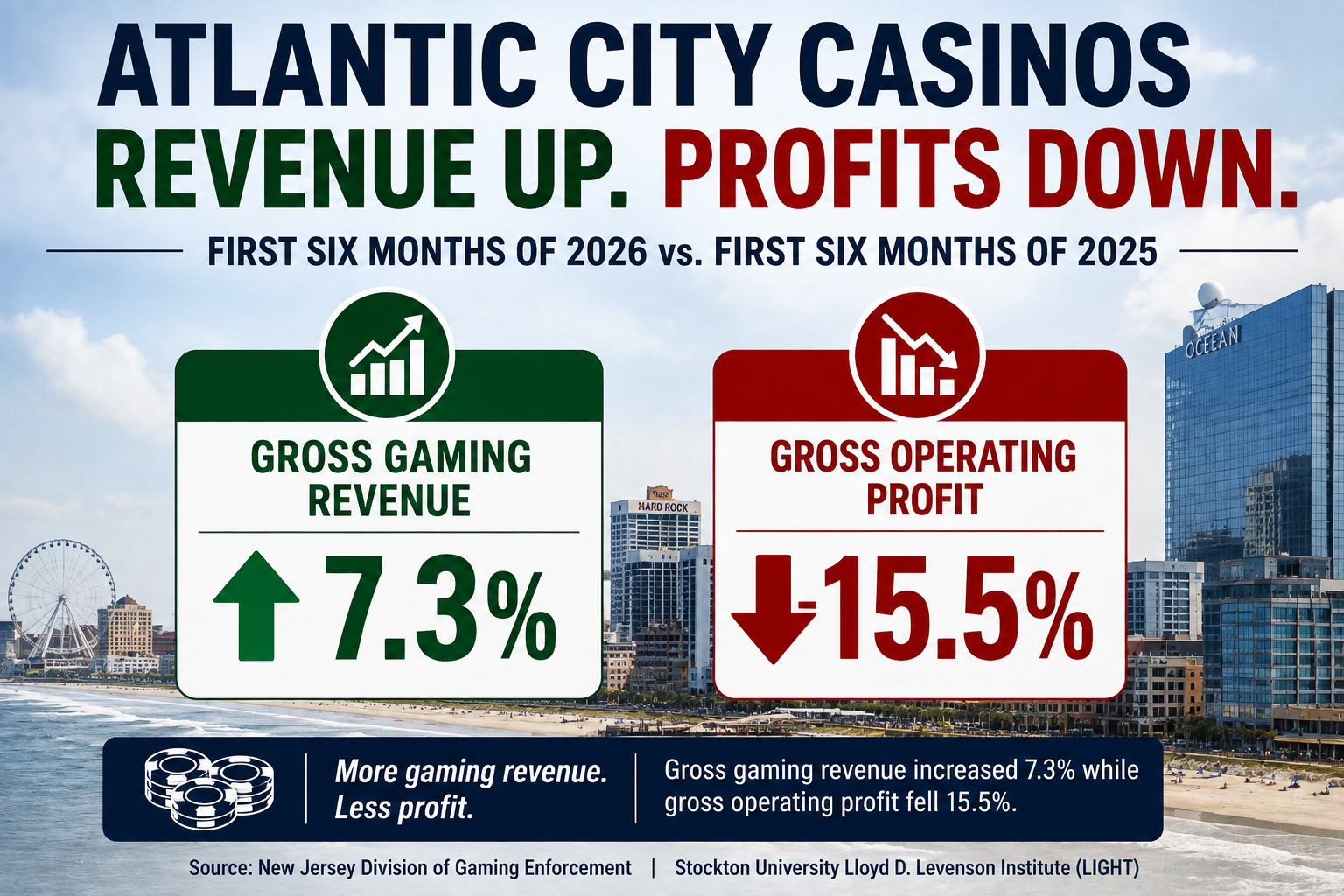
Gross operating profits for Atlantic City's casino industry fell 15.5% during the first six months of 2026 compared with the same period last year, even as total gross gaming revenue increased 7.3%, according to second-quarter figures released Monday by the New Jersey Division of Gaming Enforcement.
Net revenue, meanwhile, increased just 0.2% during the six-month period.
For Brian Tyrrell, faculty director of Stockton University's Lloyd D. Levenson Institute of Gaming, Hospitality and Tourism, the numbers illustrate an increasingly important distinction when evaluating the health of Atlantic City's casino industry.

“The second quarter of 2026 release from the New Jersey Division of Gaming Enforcement illustrates once again that revenue at Atlantic City casinos does not always translate to profitability,” Tyrrell said.
The latest numbers extend a trend already visible earlier this year. During the first quarter, casino licensees reported $725.6 million in net revenue, down 0.6% from a year earlier, while gross operating profit plunged 22.9% to $104.7 million, according to the DGE.
Tyrrell said the longer-term pattern is becoming increasingly difficult to overlook.
“Even allowing for seasonal variation, there appears to be a clear trend in declining GOP even as the relatively mature integrated casino resort market in Atlantic City has produced steady net earnings year over year,” Tyrrell said.
“This relationship between earnings and profits suggests that something more complex is happening.”
Higher Costs Squeeze the Bottom Line
Part of the explanation, according to Tyrrell, is familiar to virtually every business: rising expenses.
“Inflationary pressures — labor, energy, cost of goods, etc. — continue to impact the profitability of the industry,” Tyrrell said.
But he said operating expenses aren't the only factor.
New Jersey increased taxes on both internet casino gambling and online sports betting this year. The internet gaming tax rose from 15% to 19.75%, while the online sports wagering tax increased from 13% to 19.75%.
Tyrrell said those increases have contributed to at least $120 million in additional expenses for operators.
“The casinos have also faced a significant increase in tax burden,” Tyrrell said.
That matters as internet gambling becomes an increasingly large component of the overall revenue reported by Atlantic City's casino operators and their online partners.
It Also Costs Money to Get Customers to Atlantic City
Another piece of the profitability puzzle may be particularly relevant following a strong summer for Atlantic City's physical casinos.
Getting people through the doors isn't free.
Tyrrell pointed to the increasing cost of attracting customers through complimentary hotel rooms, meals, entertainment and promotional gaming credits.
“The cost of attracting patrons to the resort is increasingly putting pressure on casino resort overall revenue,” Tyrrell said.
The accounting can also make the industry's financial performance more difficult to interpret.
A complimentary hotel room or meal can appear as nongaming revenue on one side of a casino resort's operation while simultaneously being recorded as an expense associated with attracting a gaming customer.
“Even if comped rooms, food, entertainment etc. are recorded as net nongaming revenue, they are likewise recorded as an expense for gaming operations,” Tyrrell said.
“Comps and promotional gaming credits make it difficult to compare the performance of gaming and nongaming operations within the resorts and complicate comparisons of casino hotel operations to their noncasino peers.”
Strong Summer Doesn't Eliminate the Concern
The profitability figures arrive against what otherwise appears to be encouraging momentum for Atlantic City's casino floors.
The nine casinos generated $304.2 million from in-person gambling in July, a 7.1% increase from a year earlier. Eight of the nine properties posted year-over-year increases.

Those results prompted New York City Councilman and radio host Frank Morano to argue during a recent appearance on The AC Mike Lopez Show on WOND that brick-and-mortar gambling remains particularly important to Atlantic City's economy because visitors spend money outside the casino floor.
“The in-person gambling is much more significant in my view,” Morano said.
“That's not only keeping a craps dealer employed or a blackjack dealer employed, but these are folks that are then going to the restaurants,” he said, also pointing to visitors spending money at Boardwalk attractions.
That echoes Visit Atlantic City President and CEO Gary Musich's recent argument that the resort needs to give visitors more reasons to extend their stays.

“You've got to give different reasons for people to come and extend their stay,” Musich said during an appearance on Off the Press with Scott Cronick on WOND.
Musich cited restaurants, events, golf, wineries and ecotourism among the attractions that can persuade visitors to spend additional time — and money — in the region.
At one point, Musich said, roughly 70% of Atlantic City visitors stayed only one night.
“Imagine what happens if they stay a day and a half,” Musich said. “That's hundreds of millions of dollars in economic impact.”
Revenue and Profit Tell Different Stories
The latest financial report therefore adds another layer to the debate over the health of Atlantic City's casino industry.
Monthly gaming reports can show how much casinos win from gamblers, while the quarterly reports provide a broader look at the businesses themselves.
The DGE defines gross operating profit as earnings before interest, taxes, depreciation, amortization, charges from affiliates and certain other items, and describes it as a widely accepted measure of profitability in the Atlantic City casino industry. Earlier this year, the first-quarter numbers already showed that relatively stable net revenue could coexist with a steep decline in operating profit.
Now, with six months of 2026 on the books, Tyrrell says that divergence is becoming a trend worth watching.
Atlantic City's casinos may be generating more gaming revenue and drawing substantial summer crowds, but higher taxes, inflation, labor and operating expenses and the cost of competing for those customers are taking a larger bite out of what remains.
As Tyrrell put it, revenue does not always translate to profitability.
I think this is stronger with the Morano and Musich material included, because it connects today's financial report to the larger story we've been developing: Atlantic City needs physical visitors and longer stays, but attracting and servicing those visitors also costs the casino resorts money. It makes the 15.5% profit decline much more meaningful than simply presenting another set of DGE numbers.

About the Author
Peter Killeen
A 25-year radio news veteran, Peter covers South Jersey for NewsTalk 1400 & 92.3 WOND radio. Known for his concise and impactful delivery, he ensures listeners and readers stay informed without unnecessary filler.