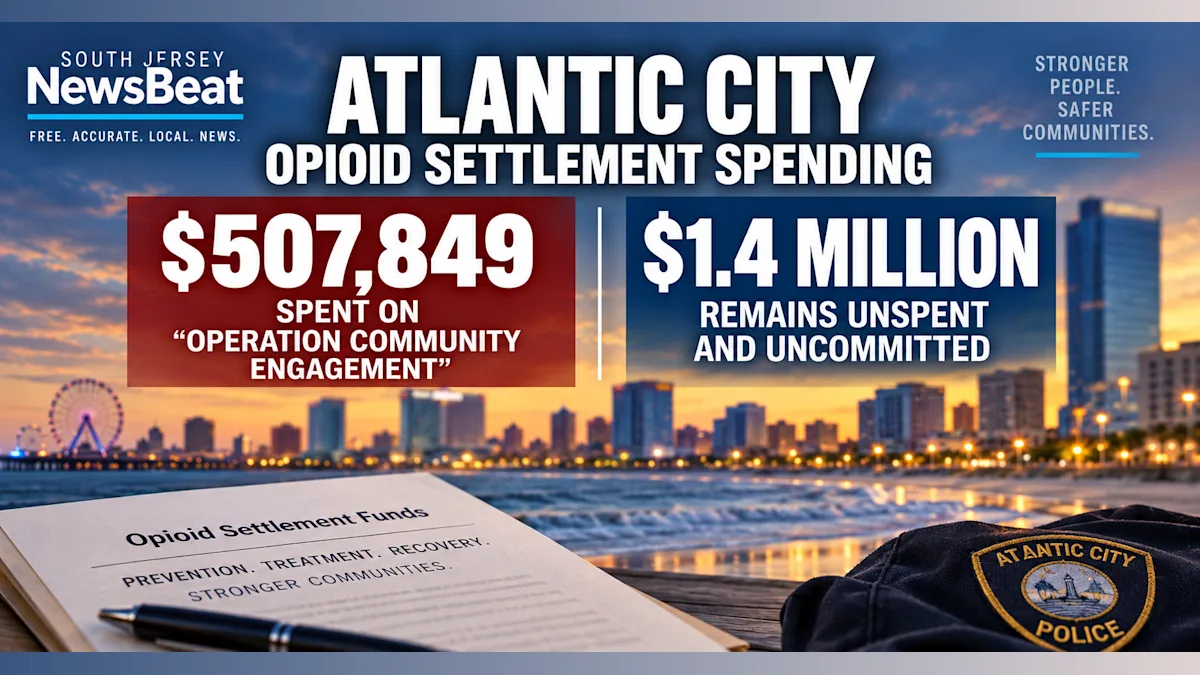
ATLANTIC CITY — Newly released state records show Atlantic City spent more than $500,000 in opioid settlement money during its latest reporting year on a program the city calls “Operation Community Engagement,” while more than $1.4 million remained unspent and uncommitted.
The disclosure provides a new look at the city's use of opioid settlement funds following recent scrutiny over how Atlantic City and other New Jersey municipalities have used money intended to address the opioid crisis.
According to Atlantic City's filing included in New Jersey's 2025 opioid abatement reporting, the city reported receiving a total of $2,308,413.32 in opioid settlement funds since distributions began in 2022.
During the reporting period covering July 1, 2024, through June 30, 2025, Atlantic City reported receiving $719,307.53 in settlement money, along with $13,318.19 in interest.
The city reported spending $507,849.94 during that period and having another $52,075 appropriated or encumbered.
That left $1,407,202.61 unspent and uncommitted, according to the city's filing with the state.
More than $500,000 listed under one program
The city's reported $507,849.94 in expenditures was attributed to a program identified as “Operation Community Engagement.”
According to the filing, the program was designed to address opioid-related issues through outreach and engagement with people considered at risk.
Atlantic City reported that the program served approximately 200 participants, distributed 600 Narcan kits and 18 overdose kits, generated approximately 800 encounters, made 40 referrals for treatment and assisted 10 people in entering sober-living facilities.
The city also reported conducting one training or educational session.
What is not apparent from the state's summary filing is a detailed, line-by-line breakdown showing exactly how the entire $507,849.94 was spent.
That could become significant following recent scrutiny of municipal opioid spending across New Jersey — including Atlantic City's reported purchase of a $73,000 electric Ford Mustang Mach-E for the Atlantic City Police Department using opioid settlement money.
The vehicle was among expenditures highlighted in recent reporting examining whether municipalities are using settlement funds in ways sufficiently connected to addressing the opioid epidemic.
City says community presence was a priority
Atlantic City's latest filing also provides insight into how city officials say they determined their spending priorities.
The city reported consulting with key stakeholders before determining there continued to be a need for a greater presence in the community and engagement with at-risk youth and adults in an effort to prevent repeated opioid-related behavior.
The filing says Atlantic City has developed a strategic plan for use of the settlement money.
However, the city also reported that it has not completed a demographic or geographic risk-assessment profile, although officials indicated one is planned.
That distinction could become increasingly important as questions grow statewide over whether opioid settlement money is being directed toward evidence-based treatment, prevention and recovery efforts or toward broader municipal programs that officials argue have a connection to the opioid crisis.
Mustang spending remains under scrutiny
Atlantic City's Mustang purchase became one of the most prominent examples cited in recent reporting about New Jersey municipalities' use of opioid settlement money.
Advocates have questioned whether purchases such as police vehicles fulfill the purpose of money obtained through settlements with opioid manufacturers, distributors, pharmacies and other companies accused of contributing to the addiction crisis.
At an International Overdose Awareness Day event in Atlantic City last month, participants specifically raised questions about the Mustang and called for people directly affected by addiction and overdose to have a greater voice in determining how the money is spent.
A community meeting focused in part on opioid settlement spending is scheduled for Sept. 19 from 1 to 3 p.m. at Stanley Holmes Village, 1539 Adriatic Ave.
The meeting is expected to include discussion of overdose prevention, harm reduction and how settlement funds should be used in Atlantic City.
No state ruling yet on Atlantic City's Mustang
The new filing should not be interpreted as a determination by New Jersey that all of Atlantic City's expenditures comply with settlement requirements.
The New Jersey Department of Human Services is the lead state agency overseeing distribution and allocation of the state's opioid settlement money. State law also calls for DHS, in consultation with the New Jersey Office of the State Comptroller and Attorney General's Office, to ensure local governments use settlement money for approved purposes.
The Comptroller has already demonstrated that municipal opioid spending can face retrospective scrutiny.
In another case, the office concluded that Irvington improperly spent more than $600,000 in opioid settlement money on opioid-awareness concerts in 2023 and 2024.
As of Sunday, South Jersey NewsBeat found no comparable public ruling from the Comptroller, DHS, Attorney General's Office or Department of Community Affairs declaring Atlantic City's Mustang purchase improper or ordering the city to repay the money.
The latest Atlantic City filing therefore represents a spending disclosure, not state approval of the expenditures.
Questions remain over the $507,849
The new records leave another potentially significant question unanswered: What individual expenses make up the $507,849.94 Atlantic City reported spending on Operation Community Engagement?
Invoices, purchase orders, vendor payments, salaries and other underlying expenditure records could provide a more complete picture of how the settlement money was actually used.
The issue could take on additional significance as Atlantic City decides how to spend the approximately $1.4 million it reported still having available at the end of the reporting period.
South Jersey NewsBeat will continue reviewing Atlantic City's opioid settlement spending and any state action concerning the city's expenditures.

About the Author
Peter Killeen
A 25-year radio news veteran, Peter covers South Jersey for NewsTalk 1400 & 92.3 WOND radio. Known for his concise and impactful delivery, he ensures listeners and readers stay informed without unnecessary filler.