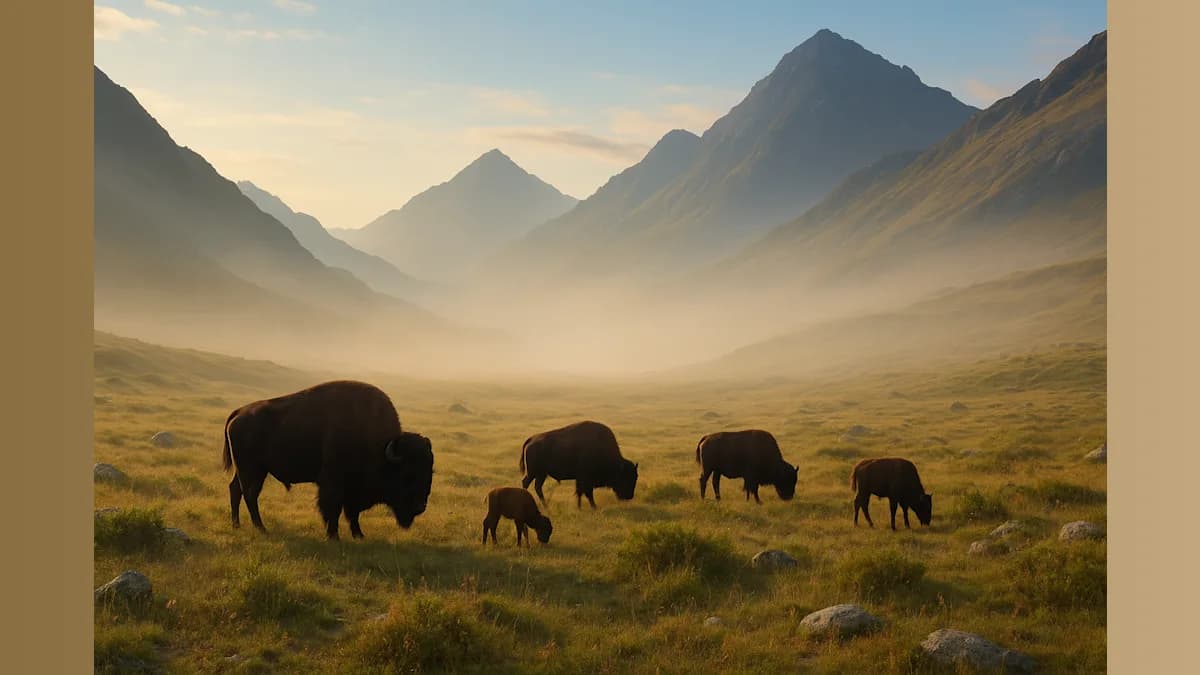
A bold conservation initiative in Azerbaijan has achieved remarkable success seven years after its inception, with 25 European bison calves now born wild in Shahdag National Park. The milestone represents a significant step toward restoring a species that once roamed freely across Eurasia before being hunted to near extinction.
The restoration effort began in 2019 when 12 European bison, raised in German zoos, were released onto the slopes of Shahdagh, known as the King's Mountain, in northern Azerbaijan. The animals emerged from transport crates to encounter an unfamiliar wild landscape that would become their new home.
World Wildlife Fund led the project in partnership with the UN Environment Program Fund and the Azerbaijani Ministry of Ecology and Natural Resources. The initiative forms part of a broader European effort to restore bison populations, with similar projects underway in Portugal, the United Kingdom, and Romania.
The project's origins trace back to 2012, when conservationists began breeding the last surviving male Caucasian bison, housed in a Western European zoo, with several European bison females. This careful genetic work laid the foundation for returning the species to its native range after decades of absence.
"We now have a historic opportunity to restore our species," Elshad Askerov, head of WWF Azerbaijan, told Good News Network. He noted that Shahdagh's environment suffered significant degradation during the Soviet period, with soils and forests severely overused and numerous animals losing their habitats.
The rewilding success in Azerbaijan has drawn attention from neighboring nations. Askerov indicated that a nearby country, potentially Georgia or Armenia, has expressed interest in replicating the model. "The rewilding projects are very successful in Azerbaijan—they are a model for other Caucasian countries," Askerov told Good News Network. "We hope that eventually, these different herds will meet each other and become one big Caucasian population."
Beyond their symbolic value, bison serve as ecosystem engineers that fundamentally reshape their environment. Their shaggy coats function as effective seed dispersers, carrying plant material across vast distances. Through selective foraging, the animals control understory vegetation and reduce wildfire risk in forested areas.
The ecological impact extends further through their dung, which provides essential nutrients for numerous plant and insect species. Their substantial size and weight allow them to trample and break up vegetation in ways that create a diverse mosaic of grassland and woodland habitats. This environmental patchwork supports a wider array of species than uniform landscapes can sustain.
The Azerbaijan project demonstrates how targeted conservation efforts can reverse historical losses and restore ecological balance. As the herd continues to grow naturally in Shahdag National Park, the vision of reconnected bison populations across the Caucasus moves closer to reality. The 25 wild-born calves represent not merely a numerical achievement, but living proof that carefully managed rewilding can succeed even in landscapes scarred by past exploitation.