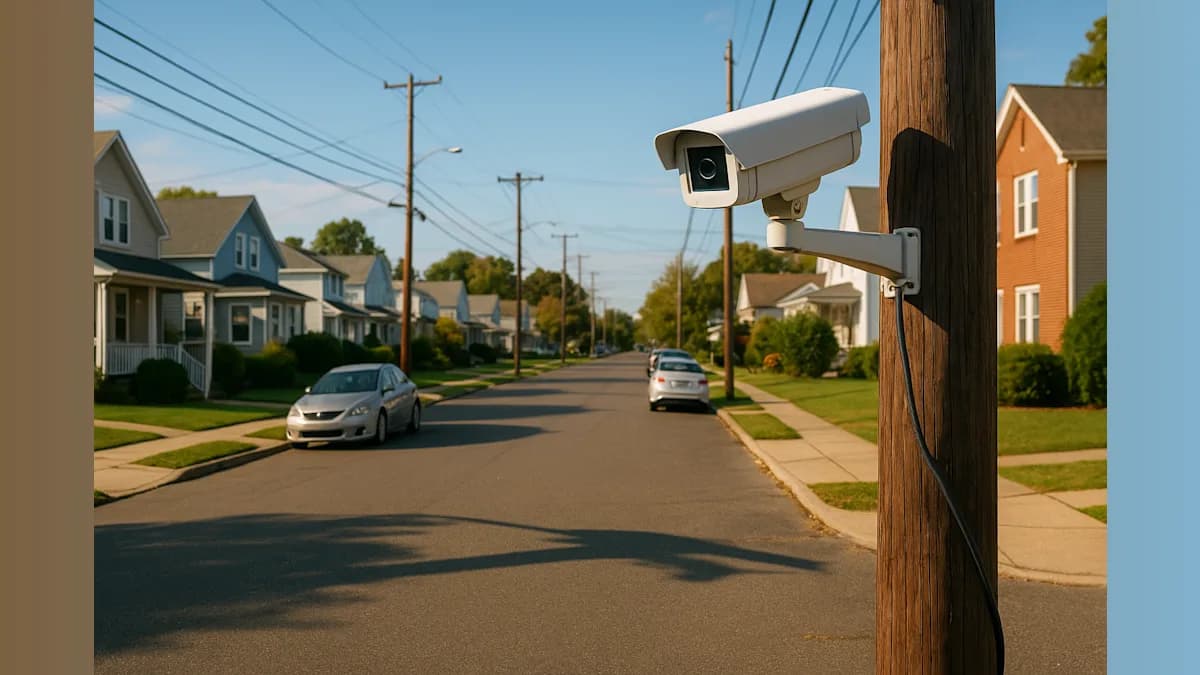
A rare moment of political unity has emerged around opposition to Flock surveillance cameras, with governors and candidates from both major parties calling for restrictions on the AI-powered license plate tracking technology.
Pennsylvania Democratic Governor Josh Shapiro declared his support for a statewide prohibition during a press conference late last month, stating that while law enforcement requires effective public safety tools, these particular cameras do not serve the public interest.
"I would welcome bipartisan legislation to ban these across the state," Shapiro told NPR. "This is not something in the public interest."
Florida Republican Governor Ron DeSantis moved this week to revoke permits allowing license plate readers on state highways, expressing concern about the surveillance implications despite his general support for law enforcement technology.
"I'm all about having law enforcement have tools," DeSantis told NPR. "But I don't want to have this become a surveillance state."
The cameras capture billions of license plates monthly alongside additional vehicle information. Law enforcement agencies defend the technology as essential for locating stolen vehicles and missing persons. However, documented cases of abuse have emerged, including officers exploiting the system to stalk former romantic partners.
Texas Republican Governor Greg Abbott halted state expenditures for the cameras last week, while Senate Republicans have launched an investigation into potential misuse by police departments. Flock has recently modified certain features in response to abuse concerns.
Jay Stanley, who serves as senior policy analyst at the ACLU, observed that Americans harbor deep-seated opposition to government surveillance regardless of political affiliation. The technology forces citizens to conduct their daily lives under constant observation, a prospect many find unacceptable.
"Now you have to live your life with what sociologists call the third eye that is watching you," Stanley told NPR, "and I think a lot of Americans don't want to live that way."
The opposition stems from divergent concerns across the political spectrum. Progressive critics highlight the technology's use in tracking immigrants and individuals seeking abortion services. Conservative voices warn the cameras could facilitate creation of a national gun registry.
Conservative commentator Glenn Beck characterized the surveillance network as government overreach. He compared the system to a panopticon, the circular prison design enabling a single guard to observe all inmates simultaneously, warning that such pervasive monitoring must be prevented.
The unease transcends partisan divisions. Recent polling data indicates that public disapproval of Flock Cameras now exceeds approval, reflecting widespread discomfort with the surveillance technology as the midterm elections approach in states including Florida, Ohio, and Wisconsin.