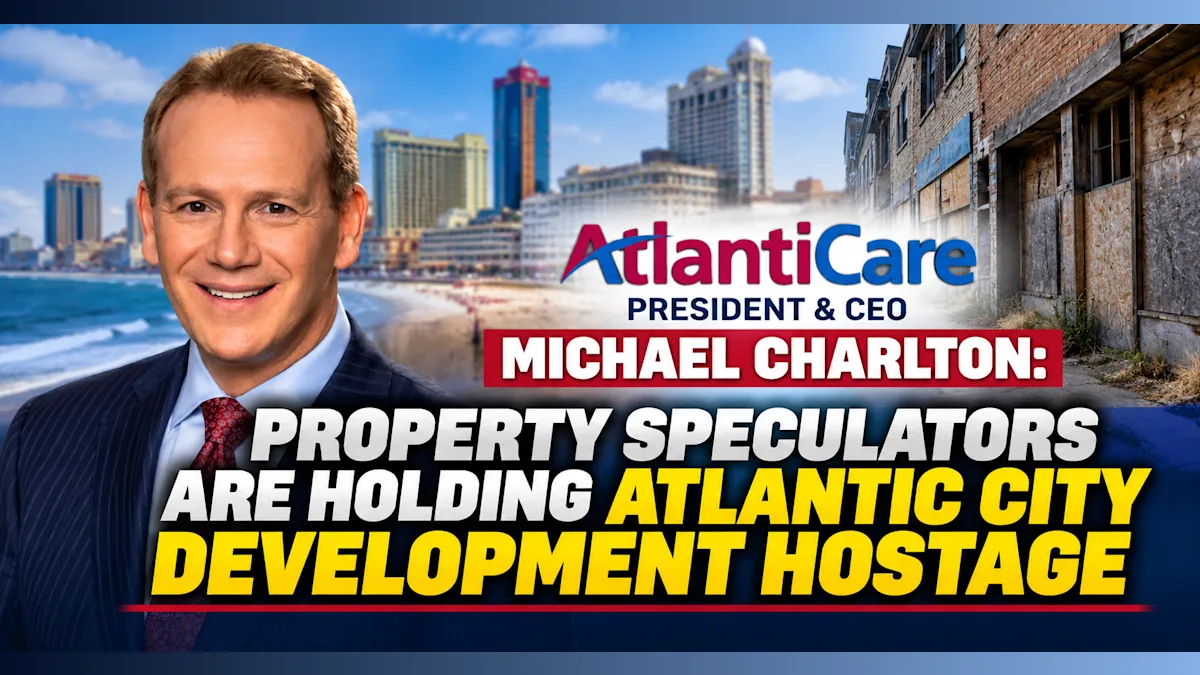
Michael Charlton calls for stronger action against neglected properties and urges state and local leaders to unite behind a comprehensive redevelopment strategy.
ATLANTIC CITY, N.J. — One of South Jersey's most prominent business leaders is taking aim at property speculation in Atlantic City, warning that owners who hold land and buildings while demanding dramatically higher prices are obstructing redevelopment and hurting the city's future.
AtlantiCare President and CEO Michael Charlton delivered the unusually direct criticism during an Oct. 13 interview on Off The Press with Scott Cronick on News Talk 1400 and 92.3 WOND.
"We have too many speculators that are buying real estate and they're basically holding everybody hostage," Charlton said.
He described a scenario in which an investor purchases property at one price and then demands many times that amount before agreeing to sell.
"I bought it for a million. I want to sell it for 10 if you don't give it to me," Charlton said, illustrating the type of negotiating position he believes is preventing properties from being redeveloped.
"And that is slowing development. We see it every day, every single day as we're trying to make change."
Charlton did not identify specific property owners or transactions during the interview, and his allegations about speculative practices have not been independently established.
But his comments raise a larger question about Atlantic City's redevelopment: How can the resort attract new housing, businesses and investment when properties remain vacant, neglected or priced beyond what prospective developers are willing to pay?
Calling for Stronger Enforcement
Charlton said government officials need to put greater pressure on property owners who allow buildings to deteriorate.
"We have to put some political pressure on people or some of the people that are not maintaining some of these housing developments to say, either get compliant or we're going to step in because you need to create community," he said.
Atlantic City already has a Code Enforcement Division responsible for enforcing property maintenance standards, including requirements governing exterior conditions, residential habitability, overcrowding and illegal housing conversions.
The city's official description of the division emphasizes protecting residents and maintaining neighborhood conditions.
Charlton's comments suggest he believes existing enforcement efforts need to be part of a more aggressive, coordinated redevelopment strategy.
Cronick also questioned whether the Casino Reinvestment Development Authority should make greater use of its redevelopment powers.
New Jersey law gives the CRDA eminent domain authority for qualifying public-use projects in Atlantic City, subject to statutory procedures and legal limitations.
In fact, the law specifically identifies inflated land values caused by speculation and unreasonable demands for property prices as concerns that helped justify granting the agency condemnation powers.
That does not mean government can automatically seize any property deemed vacant or overpriced. Eminent domain requires a legally supportable public purpose and compliance with applicable procedures and protections for property owners.
The CRDA also administers land-use regulations within Atlantic City's Tourism District.
Housing Affordability Adds to the Challenge
Charlton connected the city's redevelopment problems to a broader shortage of housing that working residents can afford.
He pointed to two-bedroom apartments renting for approximately $2,400 a month as an example of the difficulties facing families.
"We can't really look at affordability that a two bedroom apartment within Atlantic City is $2,400 when minimum wage, you know, we're still paying people minimum wage. That's not solving the problem," he said.
The $2,400 figure was Charlton's example, not a verified citywide rental average.
U.S. Census Bureau estimates for 2020 through 2024 show Atlantic City's median gross rent was $1,136, although that measure covers different apartment sizes and leases signed across several years.
The Census Bureau also reports that only 30.3% of Atlantic City housing units were owner-occupied during that period.
Median household income was approximately $41,000, and the city's poverty rate was 32.3%.
Those figures help illustrate why housing affordability and homeownership remain major challenges for many Atlantic City residents.
Charlton said expanding homeownership should be a priority because it can help families establish long-term financial security.
"How do we get them into home ownership so they can create generational wealth?" he asked.
He also argued that residents struggling to find stable housing are less likely to prioritize preventive medical care.
"Nobody cares about their primary care, their dental, or these things, if they're housing insecure," he said.
Vacant Buildings and Public Safety
Charlton and Cronick also discussed how abandoned buildings and empty lots can affect the way residents and visitors perceive Atlantic City.
Charlton praised Atlantic City Police Chief James Sarkos and the department's work, while arguing that law enforcement alone cannot solve the problems created by underused neighborhoods.
"You can put 500 police officers on the street. If you do not have activity and people walking around, it's still not going to be safe and secure," Charlton said.
Cronick agreed that the appearance of vacant and deteriorating properties contributes to negative perceptions of the resort.
The discussion reflected a broader urban redevelopment principle: Active storefronts, occupied homes and pedestrian activity can help make neighborhoods feel more welcoming.
Charlton argued that investment in housing and commercial properties must accompany improvements in public safety.
A Call for a Unified Atlantic City Plan
The AtlantiCare CEO said Atlantic City needs a comprehensive strategy that brings together government, casinos, educational institutions and major employers.
He urged Gov. Mikie Sherrill's administration, local officials, county leaders and the business community to work toward shared redevelopment goals.
Charlton pointed to AtlantiCare's Vision 2030 initiative as an example of an organization establishing long-term priorities and aligning investments around them.
The health system's strategy includes medical education, physician recruitment, expanded clinical services and community health initiatives.
Charlton said similar cooperation is needed across Atlantic City.
He noted that the resort has significant advantages, including its beaches, Boardwalk, casinos, entertainment venues and educational institutions.
"We have beaches, we have boardwalks, we have golf, world-class education," he said. "Tell me that the recipe isn't right. We just all need to get on the same page."
He also criticized the tendency to focus on individual projects rather than the city's long-term direction.
A previous Atlantic City revitalization implementation plan identified completing a master plan, addressing vacant and abandoned homes and increasing homeownership among its priorities.
Charlton argued that Atlantic City has already spent years studying its problems and should now concentrate on implementation.
'It's Time to Reinvest in the City'
Charlton also called for greater reinvestment in Atlantic City after decades of casino-generated economic activity.
He questioned proposals for major convention-center spending in North Jersey while Atlantic City's existing convention infrastructure needs improvements.
The city, he said, could benefit from coordinated investments in its convention center, the adjoining Sheraton hotel, Pacific Avenue and surrounding neighborhoods.
His remarks come as local and state officials continue discussing the future of the Sheraton Atlantic City Convention Center Hotel, which has become a major concern for the resort's meetings and convention industry.
Charlton argued that Atlantic City's challenges are serious but solvable if the region's leaders act together.
"People seem to be down. I don't think people should be down in this region," he said.
He then delivered a sharper message to residents frustrated with the pace of progress.
"What they need to get to is the next stage. They need to be mad as hell," Charlton said.
"Because a lot of this has been done on the back of the residents of South Jersey. So get mad as hell, coalesce around it."
For Charlton, the central issue is not whether Atlantic City has the potential to improve, but whether its public and private leaders are prepared to make the decisions necessary to realize that potential.
"Let's just collectively lean in so we can fix it," he said.
Michael Charlton was interviewed Oct. 13 on Off The Press with Scott Cronick, which airs weekdays from 4 to 6 p.m. on News Talk 1400 and 92.3 WOND.

About the Author
Peter Killeen
A 25-year radio news veteran, Peter covers South Jersey for NewsTalk 1400 & 92.3 WOND radio. Known for his concise and impactful delivery, he ensures listeners and readers stay informed without unnecessary filler.