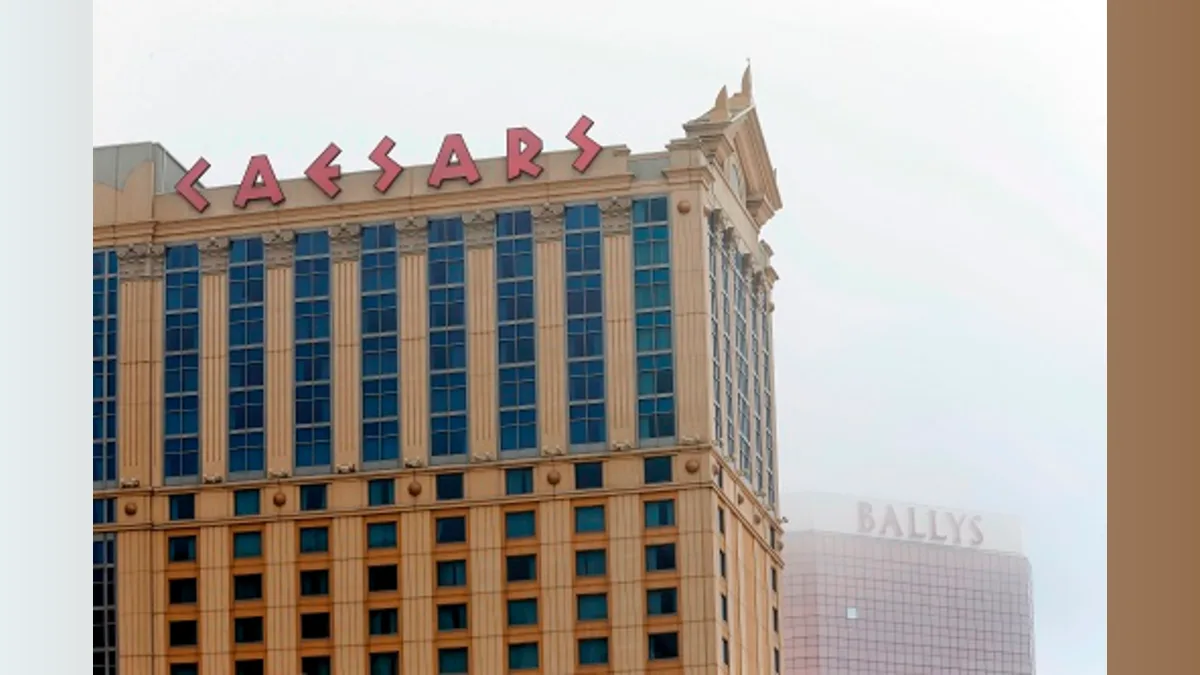
ATLANTIC CITY — New Jersey gaming regulators have hit Caesars Sportsbook with nearly $300,000 in penalties and forfeited funds in a responsible-gaming enforcement action, an unusually large sanction that comes as online gambling continues to expand in the state.
The New Jersey Division of Gaming Enforcement imposed a $251,250 civil penalty and ordered Caesars Sportsbook to disgorge another $45,465.38, bringing the total financial impact to $296,715.38.
Read the New Jersey Division of Gaming Enforcement report HERE.
The state described the enforcement action as involving violations of New Jersey regulations governing responsible gaming.
The publicly available enforcement information does not spell out exactly what Caesars did, how many customers were affected or how the $45,465.38 disgorgement figure was calculated.
Gaming America, which reported on the penalty Monday, said the infractions involved responsible-gaming messaging and self-exclusion policies. The publication also said it believes the $251,250 fine could be the largest ever imposed by the DGE against a New Jersey online gambling operator, although regulators did not confirm that distinction.
Another report on the enforcement action says Caesars agreed to the $251,250 penalty and that regulators initially took action against the company Aug. 5. That report also said the underlying document does not identify affected customers or individual transactions.
New Jersey's Self-Exclusion System Goes Beyond One Sportsbook
The reported self-exclusion component is particularly significant because New Jersey operates a statewide system designed to prevent people who voluntarily exclude themselves from continuing to gamble.
Under current DGE procedures, only one request is required for a person to self-exclude from all New Jersey casinos and sports wagering facilities as well as internet gaming and online sports betting.
Once someone enrolls, the DGE says that person's photograph and identifying information are distributed to New Jersey casino licensees, sportsbooks and internet gaming platform providers.
People enrolling online can choose a one-year or five-year exclusion. A lifetime option is also available through the DGE using a different enrollment process.
The system is intended to give people who believe they need to stop gambling a mechanism to block their access across New Jersey's regulated gambling industry rather than requiring them to contact every sportsbook and casino individually.
Caesars' Own Rules Address Self-Excluded Customers
Caesars' published New Jersey policies also contain extensive provisions addressing responsible gambling and self-exclusion.
The company's current terms identify people appearing on self-exclusion or similar lists as unauthorized to establish or use an account.
Caesars also tells customers that if they use self-exclusion tools through one of the company's platforms, they are not permitted to open or use another account with another company in the Caesars group during the selected exclusion period.
On its New Jersey responsible-gaming page, Caesars says requests for responsible-gaming measures are taken seriously and remain valid for the agreed-upon period. The company provides customers with tools for establishing personal limits and other gambling controls.
Those policies make the nature of the DGE enforcement action especially noteworthy if the reported self-exclusion violations are confirmed in more detailed regulatory records.
What Does ‘Disgorgement’ Mean?
The state separated Caesars' financial obligation into two pieces rather than simply imposing a $296,715 fine.
The $251,250 is the civil penalty.
The additional $45,465.38 is disgorgement, meaning Caesars is being required to surrender money associated with the regulatory violations.
However, regulators have not publicly explained in the information available Monday night exactly what the $45,465.38 represents.
It would therefore be premature to characterize that money specifically as bets from self-excluded gamblers, Caesars' winnings from those customers or another category of revenue.
Size of Fine Stands Out
The Caesars penalty is considerably larger than a number of previously reported DGE enforcement actions involving online gambling companies.
Gaming America cited a $112,188 penalty against Super Group, which operated Betway and Jackpot City in New Jersey, for violations involving self-excluded gamblers. It also pointed to a $100,000 fine against DraftKings in 2024 involving inaccurate reporting of wagering and revenue information.
The $251,250 civil penalty — plus more than $45,000 in disgorgement — represents a substantial enforcement action by a state that has become one of the nation's largest regulated online-gambling markets.
Caesars Publicly Emphasizes Responsible Gambling
The case also puts Caesars' publicly stated responsible-gambling policies under additional scrutiny.
Caesars Sportsbook's New Jersey website prominently carries responsible-gaming messaging and offers customers tools intended to help control gambling behavior.
The company's terms specifically direct customers seeking to close accounts for responsible-gaming reasons to New Jersey's self-exclusion program.
The DGE enforcement action establishes that regulators found noncompliance involving responsible-gaming requirements significant enough to warrant a six-figure civil penalty.
What remains unknown is potentially the most important part of the story: exactly what happened.
The publicly available information does not yet establish the number of violations, how many gamblers were affected, when the violations occurred or the precise conduct that produced the $45,465.38 disgorgement order.
Those details could emerge if the DGE releases additional documentation surrounding the case.
For now, the official numbers are clear: $251,250 in civil penalties, $45,465.38 in disgorgement and a total cost to Caesars Sportsbook of $296,715.38.

About the Author
Peter Killeen
A 25-year radio news veteran, Peter covers South Jersey for NewsTalk 1400 & 92.3 WOND radio. Known for his concise and impactful delivery, he ensures listeners and readers stay informed without unnecessary filler.