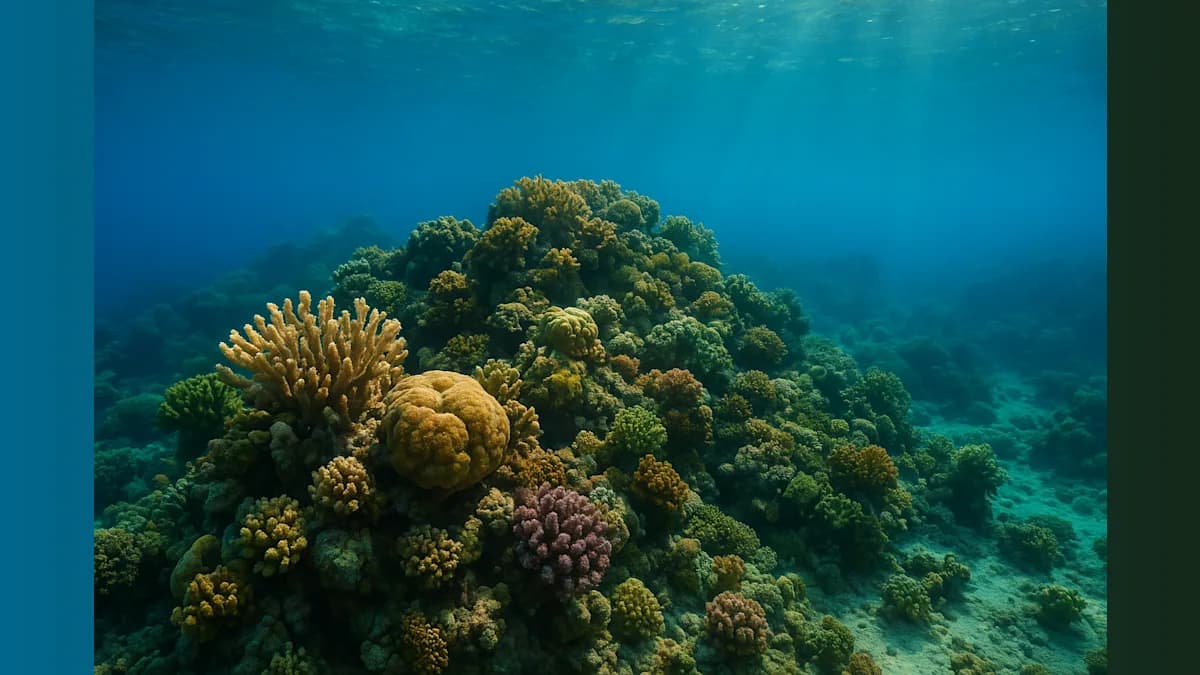
A groundbreaking artificial intelligence study has identified vast stretches of coral reefs around the world that demonstrate remarkable resilience to climate change, potentially surviving and thriving through the middle of the century despite rising ocean temperatures.
The sophisticated AI-powered analysis examined 45,000 observations of coral reefs dating back to 1960, using 46 different criteria to predict which reef systems would maintain their vitality through 2050. The findings, presented at Our Ocean Conference in Mombasa, Kenya, and available on the preprint server EcoEvoRxiv, reveal approximately 64,000 square miles of climate-resistant coral reefs—an area roughly equivalent to the state of Wisconsin.
The research challenges the prevailing narrative of inevitable coral decline. While carbon dioxide emissions and warming seas have caused widespread coral bleaching and mortality, certain reef environments demonstrate unexpected resilience. The AI model identified eight countries as primary locations for these hardy coral systems, with the Philippines, Indonesia, Cuba, the Bahamas, and Australia hosting the majority of resistant reefs. Belize, Nicaragua, and the Turks and Caicos Islands also emerged as havens for climate-resistant coral populations.
The study builds upon the concept of coral refuges—locations where coral species either endure warming waters, recover from damage more rapidly, or avoid damage altogether. The precise mechanisms behind these protective environments remain partially unclear, presenting intriguing questions for marine scientists. Honduras offers a particularly puzzling case: despite substantial ecosystem disturbance from human activity, the country's largest coral reef continues to flourish year-round.
The research team envisions their work serving as a strategic guide for conservation investment, particularly benefiting smaller nations with limited financial resources. By identifying which reef systems possess the greatest likelihood of long-term survival, conservation organizations and governments can allocate funding more effectively to protect these critical marine ecosystems.
The findings arrive amid a wave of encouraging developments in coral conservation worldwide. Papua New Guinea established protections for 77,000 square miles of tropical seas this year, prohibiting fishing in the newly-designated Western Manus Marine Protected Area. Located in the Coral Triangle where the Pacific and Indian Oceans converge, this protected zone forms part of the Melanesian Ocean Corridor of Reserves, a network spanning Fiji, Vanuatu, and Papua New Guinea.
Scientific advances in coral breeding and restoration have accelerated dramatically in recent years. Scientists on Mauritius successfully bred heat-resistant corals this past January, achieving a 98 percent survival rate among specimens that faced a bleaching event the previous summer. The progress represents a remarkable shift from two decades ago, when marine biologists could not breed coral in laboratory settings at all.
Recent innovations include portable breeding stations that enable rapid coral cultivation in remote locations. Scientists in the Maldives bred 10,000 corals in mere weeks using a container-shipped portable station. In 2022, researchers achieved the first out-of-season spawning event for laboratory-bred corals along Australia's northeastern coast, marking what observers described as a cosmic leap forward for coral breeding technology.
Discovery continues to reveal the extraordinary nature of these marine organisms. A National Geographic expedition in 2024 documented the world's largest coral ever recorded—a massive structure stretching longer than a blue whale and spanning more than four tennis courts in length.
The convergence of artificial intelligence analysis, expanded marine protections, and breakthrough breeding techniques suggests a more hopeful trajectory for coral reefs than many scientists anticipated even a few years ago. While climate change continues to threaten marine ecosystems globally, the identification of naturally resilient reef systems provides conservation efforts with clear targets and renewed optimism for preserving these vital underwater habitats through mid-century and beyond.