
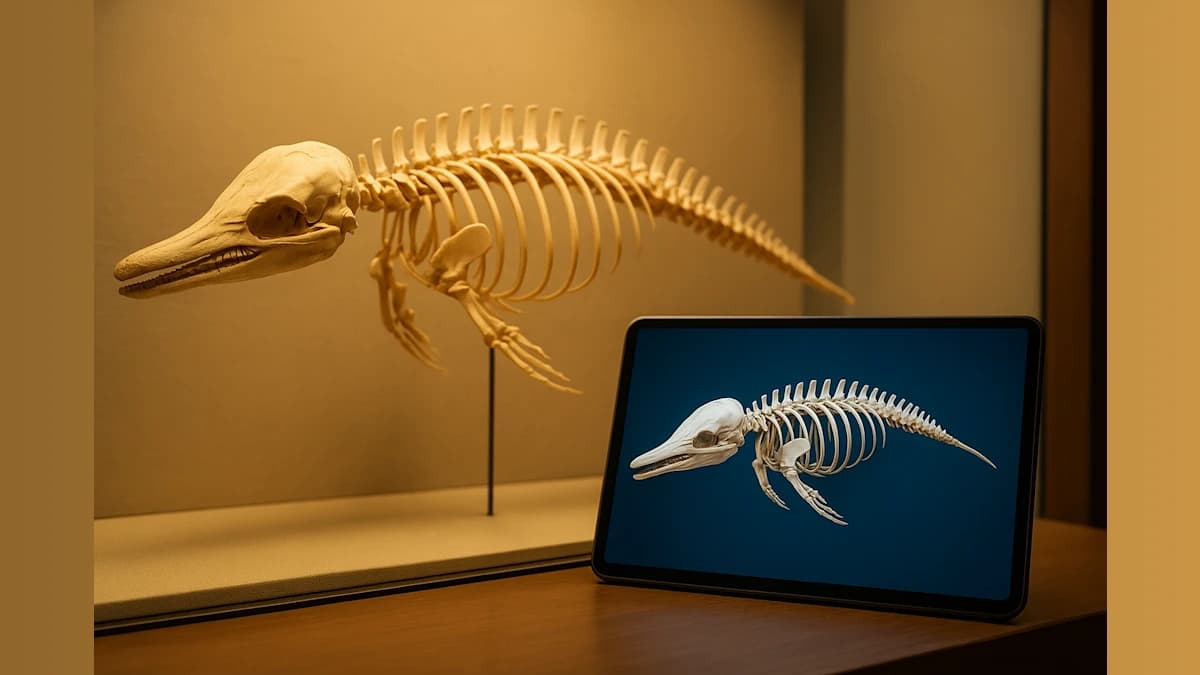
The world's smallest cetacean is on the verge of disappearing forever, but scientists are racing to preserve its legacy through cutting-edge digital technology. The vaquita porpoise, measuring just 5 feet in length, now numbers as few as ten individuals in the wild—making it one of the most endangered marine mammals on Earth.
Researchers from Florida Atlantic University have partnered with the San Diego Natural History Museum, SeaWorld California, and NOAA Fisheries to create an unprecedented digital record of a rare vaquita skeleton. The collaborative effort employs advanced imaging technologies to document the species before it potentially vanishes from the planet.
The vaquita porpoise, scientifically known as Phocoena sinus, inhabits only the shallow northern waters of Mexico's Gulf of California, also called the Sea of Cortez. Distinguished by distinctive dark rings encircling its eyes and mouth, the species remained unknown to science until the latter half of the 20th century.
The research team utilized a combination of medical CT scanning, high-resolution micro-CT imaging, and digital photography to capture a female vaquita skeleton at multiple scales. The specimen, which was donated to the San Diego Natural History Museum in 1966, has been documented from its overall skeletal structure down to microscopic bone detail.
These comprehensive datasets have been reconstructed into precise three-dimensional models, enabling scientists and students to virtually explore, measure, and study the entire skeleton without risking damage to the fragile original specimen. The digital preservation ensures that future generations will have access to detailed anatomical information about the species, regardless of its fate in the wild.
Published in June 2026 in Marine Mammal Science, the project makes all data freely available through MorphoSource, an open-access repository. The archive includes photographs, scan data, and downloadable three-dimensional meshes that researchers and educators worldwide can access.
According to the project's media release, these digital resources serve multiple purposes beyond academic research. The materials can support public outreach initiatives and enable the creation of three-dimensional printed replicas for museums and classrooms, expanding educational opportunities about this critically endangered species.
The vaquita's precipitous decline stems from entanglement in gillnets, fishing equipment used illegally to catch another banned species destined for the international black market. Despite intensive conservation efforts in recent years, the porpoise's future remains precarious.
Conservation experts emphasize that the species' survival depends on urgent, coordinated international action to eliminate gillnet fishing within vaquita habitat. Such efforts are currently underway, with organizations including the National Marine Mammal Foundation working to protect the remaining population.
By transforming a rare physical specimen into a permanent, shareable digital archive, the research team has provided a new tool for conservation and learning. The project ensures that even if the vaquita disappears from the wild, its anatomical legacy will remain accessible to scientists, educators, and the public for generations to come.