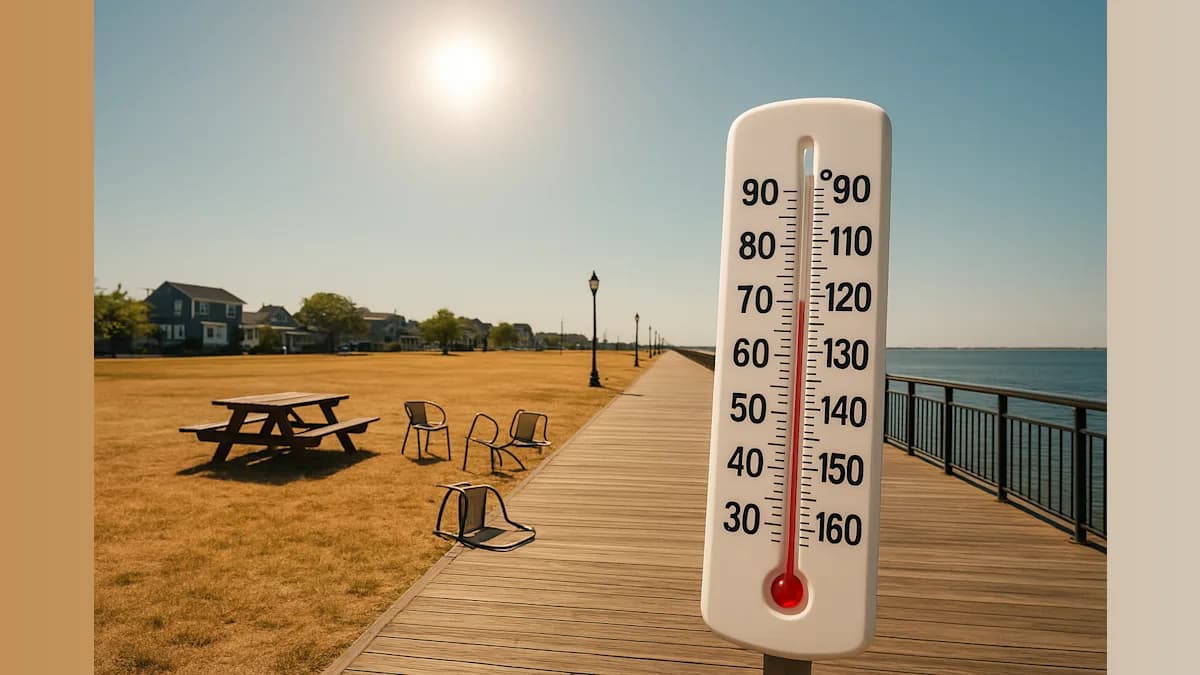
When Thomas Jefferson measured the temperature on July 4, 1776, the high reached 76 degrees Fahrenheit in Philadelphia. Two hundred and fifty years later, millions of Americans across the eastern half of the United States found themselves under extreme heat warnings as they attempted to celebrate that anniversary.
The heat dome that settled over the Midwest and Atlantic coast gave way to multiple rounds of severe storms and flash flooding, according to the National Weather Service. Cities responded by canceling Independence Day parades in Philadelphia and Washington, D.C., while Boston restricted access to its annual fireworks event until 4 p.m.
The human toll proved severe. At least 40 deaths have been reported by local officials in connection with the heat wave: 29 in New Jersey, 3 in New York, 4 in Philadelphia, and 4 in Illinois. Emergency departments across the Eastern United States, from New York to Georgia, experienced extreme rates of visits for heat-related illnesses on July 4, according to the Centers for Disease Control and Prevention's daily heat-related illness tracker.
However, the true death toll likely exceeds reported figures. Heat-related deaths remain undercounted, and extreme temperatures often exacerbate underlying medical conditions, making precise attribution difficult.
"Teasing out which of the deaths are due to extreme heat and which are due to other causes is not an exact science," said Steven Cohen, director of the sustainability management program at Columbia University and a former policy analyst for the U.S. Environmental Protection Agency, speaking to NPR. No universal standard exists for determining cause of death when associated with climate-related disasters.
Emergency response systems faced unprecedented strain. In Washington, D.C., where temperatures hit 102 degrees over the weekend, hundreds of people required treatment at the National Mall celebration. DC Fire and EMS reported 96 patient contacts, George Washington University reported 289 patient contacts, and the U.S. Department of Health and Human Services reported 314 patient contacts.
In Boston, 34 of the 108 people treated by emergency responders at a Fourth of July event were cases associated with the heat, according to Caitlin McLaughlin, director of media and public relations at Boston Emergency Medical Services. From Wednesday through Saturday, 84 of all 911 calls in Boston were associated with heat.
"These numbers are the human cost of what the climate data is telling us," said Michael Rawlins, associate director of the Climate System Research Center at the University of Massachusetts Amherst, speaking to NPR. The figures demonstrate a "public health system under real stress."
Climate scientists emphasize that such extreme weather events represent more than isolated incidents. Climate change, caused primarily by burning fossil fuels, is making heat waves hotter and longer. The average number of heat waves in the United States has doubled since the 1980s.
"It's not an anomaly. It's a preview," Rawlins told NPR.
From June 1 through July 5, temperatures at weather stations across New England recorded their highest temperatures on record or just below their highest, Rawlins noted. The sustained nature of the heat challenges traditional definitions of extreme weather events.
"That's not a heat wave — that's a season," Rawlins told NPR.
While cities have responded by opening cooling centers, extending hours for air-conditioned public buildings, and improving emergency response services, experts warn that adaptation has limits. Cohen characterized extreme weather events as the "new normal" and emphasized that reducing greenhouse gas emissions remains essential to avoiding the worst consequences of climate change.
"It's laudable that the systems are stepping up and parades are being canceled and cooling centers are opening up, but I wouldn't want anyone to get complacent in thinking that we're prepared for what the future may bring," Rawlins told NPR.
Public awareness appears to be growing. A 2025 poll from the University of Chicago found that about nine in ten Americans who experienced extreme weather believe climate change is a contributing factor.
"People are paying attention to it because it's no longer something that happened to somebody else. It's something that happened to my cousin, my brother, my friend or myself," Cohen told NPR.
As the planet continues to warm, Cohen acknowledged the fundamental challenge facing communities nationwide: "We're learning how to adapt to it. But there's a limit to how much we can adapt."