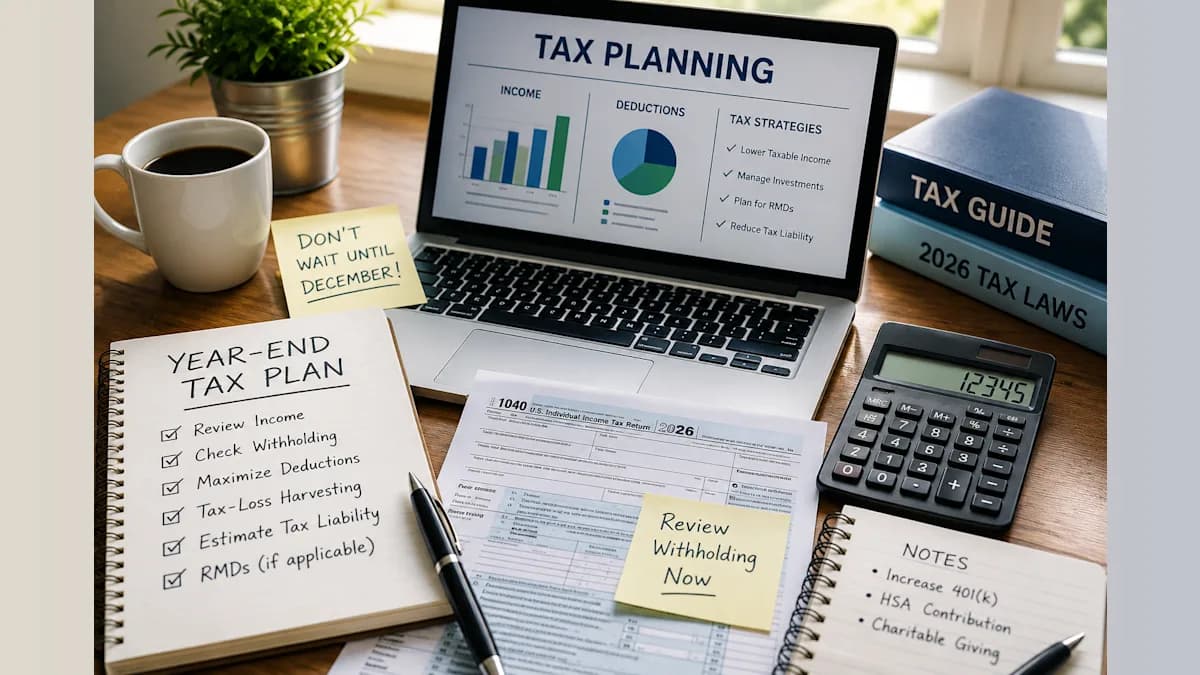
SOUTH JERSEY — December may seem like the logical time to start thinking about year-end financial planning. Retired financial adviser Jeanne Eisele says that's too late.
With the final months of 2026 approaching, Eisele says taxpayers and investors should begin reviewing their withholding, investment gains and losses and overall financial picture now.
“You say it's only August,” Eisele said during an appearance on The Lorry Young Show on WOND. “No. It's the time to start sitting, going over your account.”
One of the simplest places to begin, she said, is a paycheck.
“How much have you paid in taxes so far this year?” Eisele asked. “Does anybody know? Do you have an idea of how much has been sent to the government, paid on your behalf?”
For employees whose pay is deposited electronically, Eisele recommends retrieving their pay statements and looking at year-to-date withholding.
“Take a look at your pay stubs,” she said. “If you get them automatically deposited, you should be able to pull them up online.”
The goal is to determine whether the amount being withheld appears sufficient before discovering a problem when tax returns are prepared next spring.
“It will give you a year-to-date paid in,” Eisele said. “Take a look at the percentage of what's been paid in versus your gross pay.”
“You should be able to figure out, am I on the mark or am I going to get hit with a big tax bill?” she said. “So it's important.”
The IRS offers a free Tax Withholding Estimator that allows workers and retirees to compare their expected federal tax liability with the amount being withheld. The estimator was updated in 2026 to incorporate changes in federal tax law.
The IRS says taxpayers should particularly reconsider their withholding following major changes such as a new job, significant income change, marriage, divorce, birth or adoption of a child or home purchase.
Investors should look at gains — and losses
Eisele said late summer is also a good time for investors to review their portfolios.
“Are there any losses there that we can take to make them work against gains that we have?” Eisele said.
That strategy, commonly called tax-loss harvesting, generally involves selling investments at a loss and using qualifying capital losses to offset capital gains.
The IRS says capital gains and losses are netted against one another for tax purposes. If eligible capital losses ultimately exceed capital gains, taxpayers generally may deduct up to $3,000 of the remaining net capital loss against other income — $1,500 for someone married filing separately — with additional eligible losses potentially carried into future years.
But Eisele cautioned investors about the wash-sale rule.
“If I have something that's at a loss and I can sell it now, realize the loss, I can wait 31 days and buy it back if I really want to own it,” Eisele said.
Under IRS rules, a wash sale generally occurs when someone sells stock or securities at a loss and acquires substantially identical stock or securities within 30 days before or after that sale. The loss generally cannot be deducted at that time.
“Otherwise, I'm facing a wash sale, and the IRS will disallow the loss,” Eisele said.
Because the rule also looks backward 30 days and can involve transactions beyond simply buying the same stock back in the same brokerage account, investors should be cautious about treating “wait 31 days” as the only consideration.
Review now instead of scrambling later
Eisele said year-end planning shouldn't be limited to taxes.
She recommends reviewing investment performance and meeting with a financial adviser well before December to determine whether adjustments make sense.
“It's been a very good year in the markets,” Eisele said. “Not every sector has been participating in the market, but it's been a very good year.”
Her advice is not to wait until the calendar is nearly out of time to make decisions.
“I really want to stress the fact of getting together with your advisor,” Eisele said near the end of the interview.
“You've got to sit down now,” she added. “Just start the process for year-end planning. It's never too soon.”
Tax circumstances vary substantially from person to person, and decisions involving withholding, capital gains and investment losses can have consequences beyond a single tax year. Taxpayers should consult an appropriate tax or financial professional about their individual circumstances.

About the Author
Karen Johnson
With over 30 years of news experience in major markets like Los Angeles, Denver, and Columbus, Karen now covers our area for South Jersey NewsBeat. She also brings her articulate and conversational news delivery to WOND radio listeners every weekday. Her background includes work with the NBC Radio Network, and she thrives in fast-paced news environments.