
A striking photograph of a green turtle reveals more than meets the eye. Under ultraviolet light, a human handprint emerges on the creature's shell, made visible through specialized forensic powder. The image captures a revolutionary shift in wildlife protection: the application of crime scene investigation methods to combat animal trafficking.
The technique originates from the Wildlife Crime and Forensics Unit in the United Kingdom, where specialists have adapted traditional forensic methods to detect human contact with trafficked animals. The powder can reveal fingerprints, blood traces, bodily fluids, and gunpowder residue on wildlife specimens, providing investigators with concrete evidence to identify and prosecute poachers.
"I created this image to expose the traces we leave behind and to demonstrate how science is becoming a vital tool in protecting wildlife from exploitation," photographer Britta Jaschinski told Positive News. Her work earned recognition at the Royal Geographical Society's Earth Photo 2026 competition, with selected images currently displayed in London through July 24.
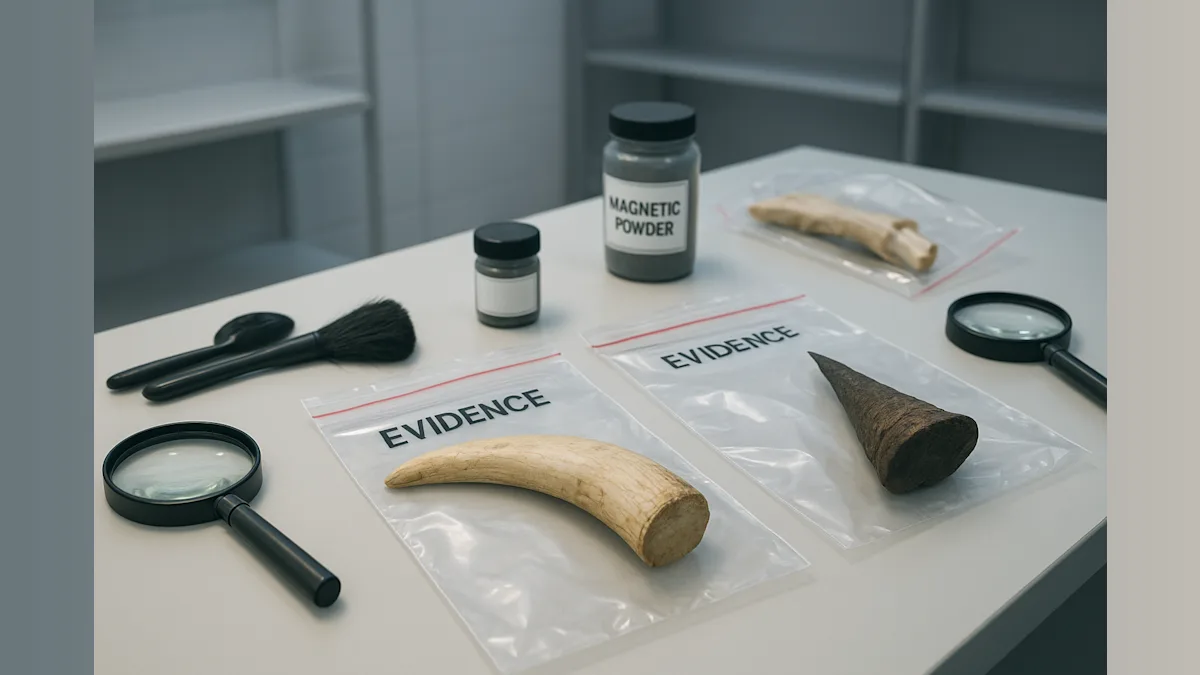
The forensic approach has proven particularly effective in disrupting ivory smuggling operations. Mark Moseley, a forensic investigator with London's Metropolitan Police, developed a magnetic powder specifically designed to lift fingerprints from elephant tusks. When authorities seized ivory at Heathrow Airport, investigators successfully recovered human prints that could be traced back to specific individuals in the trafficking chain.
Border enforcement agencies in 40 nations across Africa and Asia have received more than 200 fingerprinting kits utilizing this technology. The impact has been swift and substantial. Kenyan authorities used evidence gathered with one kit to apprehend 15 individuals, among them five law enforcement officers, while recovering 11 elephant tusks. The breakthrough marked a fundamental change in wildlife crime prosecution: ivory transformed from mere proof that poaching occurred into direct evidence linking specific perpetrators to the offense.
Investigators have expanded the technology's application beyond ivory. A white version of the magnetic powder now enables forensic teams to extract fingerprints from rhino horn and the scales of pangolins, one of the world's most heavily trafficked mammals. The powders offer significant practical advantages: they require minimal investment, can be deployed in remote field locations, and function effectively in environments where DNA analysis would be impractical or impossible.
The forensic innovations represent a critical evolution in wildlife protection strategy. Rather than simply documenting that illegal trade has occurred, investigators can now build prosecutable cases against individual traffickers and map the structure of criminal networks. As these techniques become more widely adopted, they promise to increase the risks and consequences for those who profit from wildlife exploitation.
Following its London exhibition, the Earth Photo 2026 collection will tour additional locations throughout the United Kingdom, bringing awareness of these scientific advances to broader audiences.